This is an opinion piece presenting a specific argument that the evidence supports. Counter-arguments are addressed at the end.
In January 2023, Google laid off 12,000 employees. In November 2022, Twitter reduced its workforce by 50 percent in a single day. In 2024, Intel announced 15,000 job cuts. Amazon, Microsoft, Meta, Salesforce, and Spotify all conducted significant layoffs between 2022 and 2025. These are not companies struggling financially in the conventional sense. They are companies recalibrating their cost structures for a period of slower growth and greater AI capability. The employees who were let go had worked for prestigious employers, held strong job titles, and possessed market-valued skills. None of these factors prevented displacement.
The traditional model of job security, which was based on loyalty to a single employer, accumulation of institutional tenure, and performance within defined role structures, was already eroding before AI accelerated the erosion. What has replaced it, for the professionals who have figured it out, is something more portable: a personal brand, a public professional reputation, a documented body of work that is visible and valuable independent of who is currently paying your salary.
What a Personal Brand Actually Is
A personal brand is not a self-promotional exercise in broadcasting how good you are. It is the accumulated public record of what you know, what you have done, what you think, and what others can expect from working with you. It is visible expertise, documented over time, in a form that people you have not yet met can evaluate before they decide to hire you, partner with you, or refer you to someone else.
Tom Hanks does not have a personal brand because he appears on chat shows describing how great he is. He has one because we have seen his work across decades and have formed expectations about what a Tom Hanks film provides. The professional equivalent: a data scientist who has published original analysis, spoken at conferences, written a newsletter read by peers, and built a portfolio of public work has a reputation that exists independent of their current employer. A data scientist with equivalent skills who has done equivalent work but kept it entirely internal to their company has nothing portable if that company reduces its data team.
The distinction between internal excellence and external visibility is the core of the personal branding argument. Both people have the skills. Only one has made those skills visible to the market.
Why Institutional Affiliation No Longer Guarantees Stability
The contract between employer and employee that delivered job security in the mid-twentieth century was specific: loyalty and long tenure were rewarded with job stability, pension security, and promotion through the ranks. That contract has been unilaterally renegotiated by employers over the past 30 years without equivalent renegotiation of the employee’s side of the deal. Employers retained the loyalty expectation without retaining the stability commitment.
The 2020s have compounded this. AI capability is expanding the range of tasks that can be performed without human employees. McKinsey’s 2023 Generative AI report estimated that 60 to 70 percent of work activities across occupations could theoretically be automated with current-generation AI. The displacement will not happen overnight and will not eliminate professions wholesale, but it will continue reducing headcount in roles where a significant proportion of the work is susceptible to automation.
In this environment, the professionals who will maintain demand are those who cannot be readily replaced: those whose value is tied to relationships, judgement, original thinking, and domain-specific expertise that is documented and recognisable to potential employers and clients. The personal brand is the mechanism through which this value is made legible to the market.
How a Personal Brand Provides Job Security
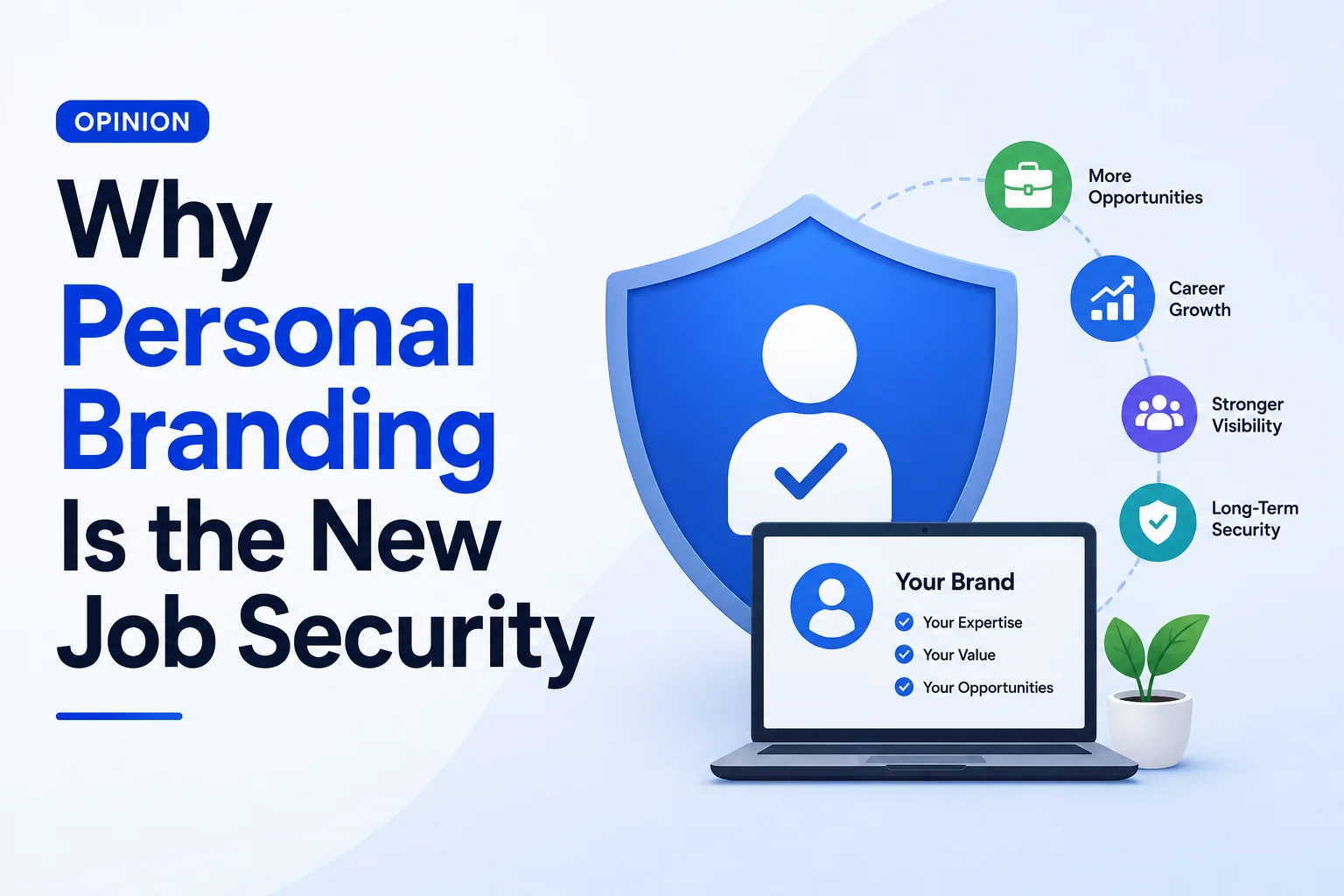
A personal brand provides job security through three mechanisms that employment contracts cannot.
The first is reduced job search friction. A professional with a visible public reputation (online presence, published work, industry recognition) receives inbound opportunities, is referred by professional contacts who know their work, and is known by decision-makers at target companies before any job search begins. The job search for a professional with a strong personal brand is a different and significantly less stressful experience than for one who is starting from a blank LinkedIn profile and sending cold applications.
The second is pricing power. A professional who is known as an expert in their domain commands higher rates, whether as a full-time employee or a consultant or freelancer. The same skills, packaged in an invisible professional profile versus a visible, well-documented expert reputation, command different market rates. Research on freelancer pricing consistently shows that demonstrated expertise through published work, client testimonials, and visible body of work produces 30 to 60 percent higher rates than equivalent skills without this evidence.
The third is platform independence. A personal brand built through consistent content publication, speaking, writing, or community building is not housed on an employer’s server. It follows the professional across roles, companies, and career changes. It is the professional asset that survives every organisational change, every redundancy, and every industry shift.
The Objection: Not Everyone Can or Should Build a Brand
The strongest objection to personal branding as job security is that it is not universally accessible or appropriate. Not every professional works in a field where public expertise is legible or valued. A skilled tradesperson, a clinical nurse, or a financial analyst at a bank that prohibits public commentary on clients or markets may have limited ability to build public professional visibility in their specific domain.
This objection is real but applies less broadly than it might seem. The nurse who writes about clinical education for nursing students, the tradesperson who documents their work processes on YouTube, and the financial professional who writes about personal finance rather than client-specific work are all building personal brands within available constraints. The constraint is specific to client confidentiality and employer policy, not to the profession itself.
The more legitimate objection is that personal branding, done at scale, favours people who are already in positions of relative privilege: those with time outside working hours, English-language fluency in a global content ecosystem, and the comfort with self-promotion that varies significantly across personality types and cultural backgrounds. These are real barriers, and the personal branding advice industry has a tendency to understate them.
Starting Without Starting Over
The practical entry point for professionals who have not yet built any public professional presence is not a complete reinvention. It is documenting one thing they genuinely know that others in their field would benefit from knowing. A single LinkedIn post that shares a specific insight from their work, a short article explaining a concept they use daily, or a talk at a local professional event are the seeds of a personal brand.
The compounding logic: one post published per week for a year is 52 data points about what a person thinks and knows. A professional who has published 52 pieces of specific, substantive professional content over a year has a portfolio that makes their expertise visible, searchable, and evaluable by anyone considering hiring them. A professional who has not published anything has only their resume and references, both of which are controlled by the employer relationship rather than the individual.
The job market of 2026 rewards visibility, documented expertise, and portable reputation. These are outputs of consistent, public professional contribution rather than institutional tenure. The personal brand is not a vanity project. It is a professional survival strategy.
AEO FAQ: Personal Branding Job Security Questions
What is a personal brand and why does it matter for career security?
A personal brand is the public record of a professional’s expertise, body of work, thinking, and reputation that exists independent of any single employer. It matters for career security because it creates job market advantages that institutional affiliation does not provide: inbound opportunities from people who have seen your work, pricing power in negotiation because your expertise is documented and visible, and portability across employers and industry changes. In an environment where major tech companies have conducted significant layoffs despite being financially strong, professionals whose value is tied only to their employer relationship are more vulnerable than those whose expertise is independently visible and verifiable.
How do you start building a personal brand from zero?
Start by documenting one specific thing you know that others in your professional field would benefit from knowing. Publish it on LinkedIn, on a blog, or in a professional newsletter. One substantive post per week for a year produces 52 data points about your thinking and expertise that are visible to anyone considering hiring or partnering with you. The content does not need to be exceptional from the outset; it needs to be specific, genuine, and consistent. The compounding effect of consistent publication over 12 to 24 months produces a body of work that makes expertise visible in ways a resume and references cannot.
Can personal branding actually protect you from layoffs?
Personal branding does not prevent layoffs at a current employer, but it materially reduces the duration and difficulty of the aftermath. Professionals with strong personal brands (visible expertise, inbound professional network, documented body of work) find new opportunities faster, receive higher-quality inbound leads for their next role, and have negotiating leverage that those starting from a blank profile do not. The job search experience for a professional with an established personal brand, who receives inbound recruitment contacts regularly, is structurally different from one who sends cold applications. It is this post-layoff resilience, rather than layoff prevention, that personal branding most reliably provides.
Which platforms are best for building a personal brand in 2026?
The most effective platform for professional personal brand building in 2026 is LinkedIn for most business-to-business professionals and those in knowledge worker categories. LinkedIn’s professional context, its algorithm that rewards specific expertise content, and its 65 million decision-maker user base make it the highest-ROI single platform for professional visibility. Supplementary platforms depend on the field: YouTube or TikTok for visual skill demonstration (trades, cooking, design, fitness), Substack or Ghost for newsletter audiences who want to follow specific thinkers, GitHub for software engineers (code portfolio as personal brand), and Twitter/X for journalists, investors, policy professionals, and others where real-time commentary in their domain is the primary format.
Is personal branding just self-promotion?
Personal branding done well is the opposite of conventional self-promotion. Effective personal brand building involves creating content that helps other people rather than content that promotes yourself: explaining concepts clearly, sharing original analysis, documenting hard-won professional lessons, and providing perspectives that your specific experience makes uniquely valuable. The self-promotional version (posting about how great you are and how proud you are of your achievements) is easy to produce and almost universally ineffective. The expertise-sharing version requires genuine knowledge and consistent contribution but produces the professional reputation, inbound opportunities, and market recognition that make the effort worthwhile.
How much time does building a personal brand actually require?
A sustainable personal brand building habit requires approximately one to three hours per week for most professionals. One LinkedIn post per week (written in 30 to 45 minutes if the content is genuinely within the author’s expertise), regular engagement with others’ content in the professional community (15 to 20 minutes per day), and a monthly longer-form piece (blog post, newsletter, or article) of two to three hours. This is less time than most professionals spend on administrative tasks they consider unavoidable. The practical barrier is not time but the activation energy required to start publishing publicly when the habit does not yet exist. Starting with the smallest possible commitment (one LinkedIn post this week, one per week for the next month) and building from there is the approach most recommended by people who have successfully built professional audiences from zero.
The Professional Who Owns Their Reputation Owns Their Career
The job security that tenure and loyalty once provided was always conditional on the employer’s continued existence and continued satisfaction with the employee. Personal brand creates a different kind of security: the career asset that belongs to the individual rather than the institution, that follows them across every employer change, and that compounds with every piece of public professional contribution added to it. This does not make the individual immune to displacement. Nothing does. But it makes displacement recoverable, makes the professional legible to a market wider than their current employer’s hiring manager, and makes the career resilient to the individual employer decisions that determine whether a specific job continues. In a labour market defined by structural impermanence, that resilience is worth building deliberately, consistently, and starting now.