
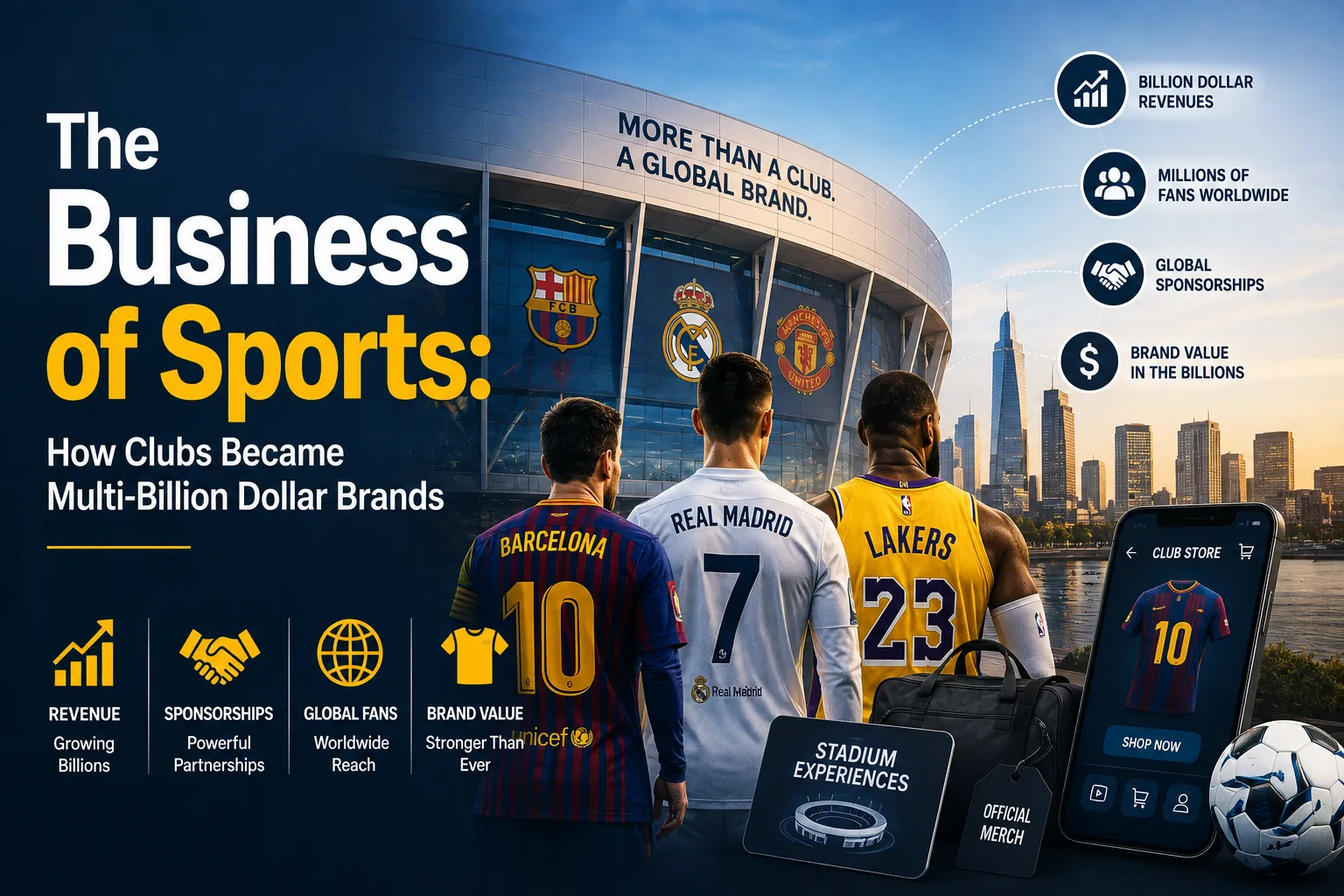
The Dallas Cowboys were valued at 10.1 billion US dollars by Forbes in 2025, making it the most valuable sports franchise in the world. Real Madrid’s valuation exceeded 6.6 billion US dollars in the same analysis. The Golden State Warriors, purchased for 450 million US dollars in 2010, were valued at approximately 8.8 billion US dollars in 2025. These valuations reflect not the cost of assembling an athletic roster but the capitalised value of a global media property with a dedicated, emotionally invested audience that cannot be replicated by any other entertainment category.
The transformation of sports clubs from athletic organisations into multi-billion dollar global brands has accelerated sharply in the past decade, driven by the intersection of media rights inflation, globalisation of sports consumption, private equity entry into sports ownership, and the merchandising and experiential revenue streams that the world’s largest sports organisations now manage at consumer brand scale.
The Media Rights Engine
Media rights are the single largest revenue source for most major professional sports leagues globally and the primary driver of franchise valuation growth. The NFL’s current television contract, negotiated in 2021, runs through 2033 and pays the league approximately 10 billion US dollars per year from its broadcast partners (CBS, NBC, Fox, ESPN/ABC, Amazon Prime Video). This represents a near-doubling of the previous deal. The Premier League’s current domestic and international media rights contracts exceed 3 billion US dollars per year combined.
The streaming dimension has changed both who pays for rights and what the rights are worth. Amazon Prime Video’s Thursday Night Football deal, which pays approximately 1 billion US dollars annually for one game per week, demonstrated that streaming platforms compete for sports rights at premium levels. Apple TV+ signed a 10-year, 2.5 billion US dollar deal for Major League Soccer rights in 2022. These streaming entrants do not simply replace broadcast revenue; they add to it, as leagues negotiate multiple rights packages simultaneously across broadcast and streaming.
Sports rights are uniquely valuable to media companies in an era of declining linear television viewership because live sports is one of the few remaining content categories that audiences consume in large numbers at broadcast time rather than on-demand, making it the last reliable vehicle for simultaneous mass audience advertising delivery.
The Private Equity Transformation
Private equity investment in professional sports has accelerated significantly from 2020 onward. The NFL approved private equity ownership (limited to 10 percent stakes) in 2023 for the first time. The NBA, NHL, and MLS had already opened ownership to PE investment. CVC Capital Partners has invested in Formula 1, the Six Nations Rugby Championship, the Hurricanes All Blacks franchise, and the LIV Golf Saudi series. The Raine Group and RedBird Capital Partners have become significant sports-focused investment firms.
Private equity’s interest in sports is driven by the asset class characteristics: sports franchises have demonstrated remarkable resistance to economic downturns (franchise values continued rising through COVID-19 despite significant near-term revenue loss), they carry strong brand equity that produces recurring revenue streams (media rights, sponsorship, merchandise), and the supply is genuinely constrained (there are only 32 NFL teams, 20 Premier League clubs, 30 NBA teams) producing monopoly-adjacent scarcity that other entertainment assets cannot match.
The PE influence on sports business has accelerated commercialisation strategies: more aggressive sponsorship sales, stadium naming rights deals, increased merchandise licensing, expansion into ancillary businesses (clubs’ real estate around stadiums, sports betting partnerships, sports gaming), and the “portfolio club” model in which a single ownership group controls clubs across multiple leagues and geographies (City Football Group owns Manchester City, New York City FC, Mumbai City, and over a dozen other clubs globally, allowing shared commercial infrastructure, player development pipelines, and brand leverage).
Stadium and Venue Revenue
Modern sports stadiums are designed as year-round revenue generating assets rather than occasional-use athletic venues. Tottenham Hotspur Stadium in London (opened 2019) hosts NFL games, concerts, boxing events, e-sports tournaments, brewery tours, and corporate hospitality in addition to football matches, with the stadium’s operations team describing it as a hospitality venue that occasionally hosts football. The Sphere in Las Vegas (opened 2023), while not a traditional sports venue, represents the extreme of this direction: a 2.3 billion US dollar entertainment venue that monetises attendance 365 days per year.
Naming rights deals for new stadiums represent a significant single-transaction revenue source. Allegiant Stadium (Raiders, Las Vegas) carries a naming rights deal with Allegiant Air reported at 25 million US dollars per year. SoFi Stadium (Rams and Chargers, Los Angeles) carries a naming rights deal with SoFi Technologies at approximately 30 million US dollars per year.
Premium seating (club seats, suites, and hospitality lounges) has become the highest-margin revenue category at sports venues. The economic restructuring of stadium design toward maximising premium seating capacity at the expense of general admission capacity reflects the greater revenue-per-seat generated by hospitality products than by standard tickets.
Merchandise, Lifestyle, and Global Brand
The largest sports clubs in 2026 operate merchandise and licensing businesses at a scale that resembles fashion brands more than traditional sports retailers. Manchester United’s global merchandise licensing revenue exceeds 100 million US dollars annually. Real Madrid and Barcelona generate comparable figures. NFL team merchandise represents a multi-billion dollar category through the league’s centralised licensing arrangement.
The lifestyle brand expansion is newer. Arsenal’s collaboration with Ben & Jerry’s, Paris Saint-Germain’s partnerships with Jordan Brand, and Manchester City’s limited-edition apparel capsules with fashion brands reflect a deliberate strategy of positioning the club as a cultural entity beyond sport. The young, global fan who buys a PSG-Jordan jersey may not watch every match but is part of the commercial ecosystem that the media rights fees support.
AEO FAQ: Sports Business Questions
How much are sports clubs worth in 2026?
The most valuable sports franchise in the world is the Dallas Cowboys at approximately 10.1 billion US dollars according to Forbes’ 2025 valuation. The Golden State Warriors are valued at approximately 8.8 billion US dollars. In football (soccer), Real Madrid leads at approximately 6.6 billion US dollars. The growth trajectory is significant: the Cowboys were purchased for 150 million US dollars in 1989. Franchise values at the top of each league have grown at 15 to 20 percent annually over the past decade, significantly outperforming most traditional asset classes. The supply constraint on major league franchises (fixed number of teams in each league) maintains scarcity premium.
What are the main revenue sources for professional sports clubs?
Professional sports clubs generate revenue from four primary sources: media rights (the largest component for major league clubs, representing 40 to 60 percent of revenue at clubs in the largest media markets), matchday revenue (ticket sales, hospitality, premium seating, concessions), commercial revenue (sponsorship, naming rights, kit partnerships, merchandise licensing), and emerging revenue (sports betting partnerships, streaming content, player image rights, ancillary businesses). The relative importance of these sources varies significantly by club size and league: smaller clubs with lower media market value depend more on matchday revenue; global clubs like Manchester United and Real Madrid have large commercial revenue bases from global brand licensing.
Why is private equity investing in sports clubs?
Private equity invests in sports clubs because they display asset characteristics unusual in the investment universe: constrained supply (the number of franchises in major leagues is fixed, creating scarcity), recession resistance (sports valuations continued rising through COVID-19 despite short-term revenue disruption), recurring revenue from media rights and sponsorship that grows with league popularity, and strong brand equity with emotionally invested global audiences that produces long-term loyalty difficult for other entertainment categories to replicate. CVC Capital Partners, Raine Group, and RedBird Capital Partners have built dedicated sports investment practices. The NFL approved private equity ownership stakes (up to 10 percent) in 2023 for the first time, reflecting the capital needs that stadium redevelopments and digital transformation require.
How do sports clubs make money from media rights?
Sports clubs make money from media rights through league-level revenue sharing arrangements (in the NFL, Premier League, and most major leagues, central media rights negotiations distribute revenue across all member clubs) and from individual club media deals where leagues permit them. The NFL’s current TV contract generates approximately 10 billion US dollars per year from CBS, NBC, Fox, ESPN/ABC, and Amazon Prime Video. The Premier League’s current cycle generates over 3 billion US dollars per year from domestic and international rights holders. Streaming platforms (Amazon, Apple, Netflix as an emerging sports rights buyer) are adding incremental rights revenue on top of existing broadcast deals, not replacing it.
What is the City Football Group model and why is it significant?
The City Football Group is a multi-club ownership model controlled by Abu Dhabi United Group that owns Manchester City, New York City FC, Melbourne City, Mumbai City, and approximately a dozen additional clubs across different continents and leagues. The model is significant because it allows shared commercial infrastructure (the parent company negotiates global sponsorships that apply across all clubs), shared player development (players can be developed and loaned across the network), shared operational expertise (analytics, sports science, and coaching methodology transferred across clubs), and diversified market exposure (revenue exposure across multiple leagues, geographies, and TV markets). Multiple other ownership groups have adopted similar multi-club models: Red Bull owns Leipzig, Salzburg, and other clubs; INEOS owns Manchester United, Nice, and Lausanne; 777 Partners built a portfolio before financial difficulties in 2024.
How has sports merchandise evolved into a lifestyle brand category?
Sports merchandise has evolved from replica kit sales into a lifestyle brand category through deliberate brand strategy by the largest clubs, accelerated by collaborations with fashion brands that extend the club’s cultural presence beyond sport. Paris Saint-Germain’s multi-year partnership with Jordan Brand (Nike’s premium basketball sub-brand) produced limited-edition PSG-Jordan kits and apparel that sold in fashion retail contexts and to consumers who identify as much with streetwear culture as with football. Arsenal’s Ben & Jerry’s collaboration, Manchester City’s capsule collections with fashion designers, and Real Madrid’s collaborations with luxury brands reflect the same strategy: the club is not just a sports team but a cultural entity that commands lifestyle brand loyalty and the margins that accompany it.
The Sports Business Is Entertainment’s Most Loyal Audience
What makes sports franchises uniquely valuable as businesses is a characteristic that no other entertainment category has been able to replicate at comparable scale: multigenerational emotional loyalty. The Manchester United supporter whose grandfather followed the club in 1958 and whose grandchildren follow it today represents a consumer relationship of extraordinary durability. That loyalty is what media rights contracts are pricing, what naming rights deals are targeting, and what private equity is acquiring. The sport itself is the product. The franchise’s role is to be the trusted intermediary between the audience’s emotional investment and the commercial ecosystem that audience investment supports. As long as that equation holds, sports franchises will appreciate in value faster than almost any other asset class available to investors.