
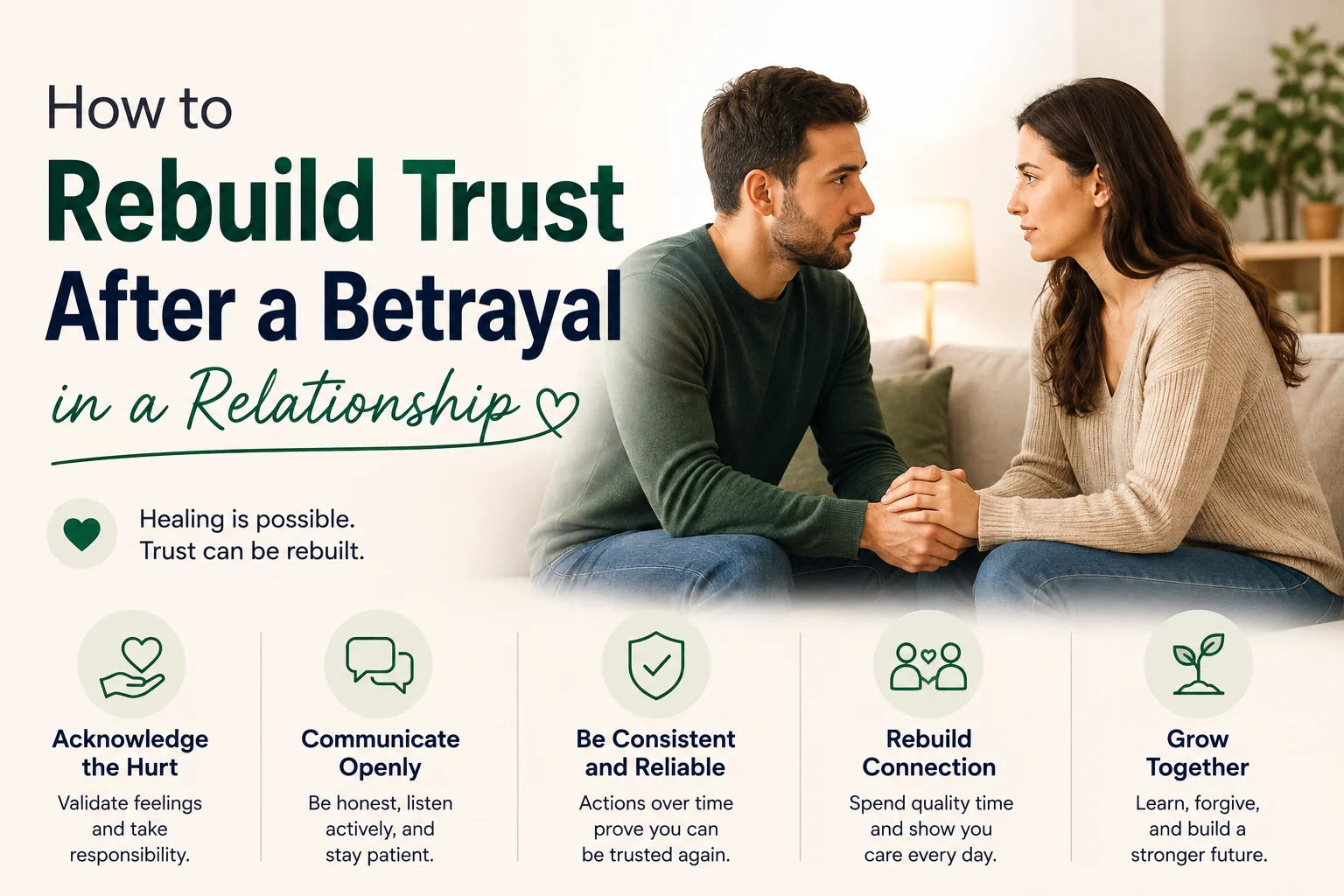
The American Association for Marriage and Family Therapy reports that infidelity is a factor in approximately 20 to 40 percent of divorces in the United States. A 2023 study published in the Journal of Marital and Family Therapy, tracking 75 couples who had experienced infidelity and engaged in couples therapy, found that 65 percent reported improved relationship quality at 12-month follow-up, and 43 percent described the relationship as better than it had been before the betrayal. These numbers are not a guarantee of outcome, and they represent couples who sought professional support rather than the general population. But they establish that trust rebuilding is not a statistical outlier. It is a realistic goal for couples who meet specific conditions.
Betrayal in a relationship is not limited to sexual infidelity. Financial betrayal (hidden debt, concealed gambling, secret accounts), emotional infidelity, significant lies about fundamental aspects of a person’s life, and broken promises that violate the core agreement of the relationship all produce the same psychological injury: a rupture in the attachment security that makes a relationship feel safe. The rebuilding process for different types of betrayal shares more than it differs.
What Betrayal Actually Does
Dr. Sue Johnson, the developer of Emotionally Focused Couples Therapy (EFT), describes betrayal as an “attachment injury”: a specific moment in which a partner needed to know the other would be there and reliable, and was not. The betrayal does not only produce anger. It destabilises the foundational sense of safety in the relationship on which all emotional intimacy is built.
Bessel van der Kolk’s research on trauma responses, documented in “The Body Keeps the Score,” is relevant to understanding what the betrayed partner experiences: hypervigilance (constantly monitoring for signs of re-betrayal), intrusive thoughts and flashbacks to the discovery of the betrayal, emotional numbing alternating with intense distress, and difficulty trusting perceptions and judgement. These are not overreactions. They are predictable trauma responses to a specific attachment rupture.
The critical implication for trust rebuilding is that it cannot be rushed by either partner. The betrayed partner cannot simply decide to trust again through will. The biological threat response activated by betrayal does not respond to logic and cannot be argued away. Trust is rebuilt through consistent, verifiable, and sustained behaviour from the betraying partner over time.
The Betraying Partner’s Role
The most consistent finding in couples therapy research on betrayal recovery is that the path forward requires the betraying partner to take full responsibility without qualification or minimisation, to be transparent about the full scope of the betrayal (not a partial disclosure), and to tolerate the betrayed partner’s emotional responses without defensiveness or requests to move on faster than the injured partner is ready for.
Partial disclosure is one of the most common obstacles to recovery: the betraying partner discloses some of what happened but not all, and subsequent discovery of additional details produces secondary betrayal injuries that are often more damaging to recovery than the original disclosure. Research consistently supports the difficult recommendation: complete, honest disclosure delivered once, in a context where the betrayed partner can receive it with support, produces better recovery outcomes than extended, partial truth-telling.
Transparency restoration means the betraying partner proactively provides information about their whereabouts, activities, and contacts during the rebuilding period rather than waiting to be asked. This is not surveillance imposed by the betrayed partner; it is a voluntary behaviour by the betraying partner that demonstrates commitment to honesty. The Gottman Institute’s “trust metric” includes specific measures of proactive information sharing as a trust-building behaviour.
The betraying partner must also tolerate the timeline of the injured partner without accelerating it. The most common phrase that experts in betrayal recovery describe as severely damaging to healing is “you need to let this go” or “aren’t you over this yet.” The injured partner’s recovery timeline is not under their control and is not negotiable by the partner who caused the injury.
The Betrayed Partner’s Process
The betrayed partner’s healing process involves three stages that Dr. John and Julie Gottman describe in their “Trust Revival Method,” adapted from their work with betrayal recovery. The atonement stage focuses on the betraying partner’s responsibility, complete disclosure, and beginning new behavioural commitments. The attunement stage involves rebuilding emotional connection through small daily interactions that restore the sense of knowing and being known. The attachment stage involves gradually reestablishing the deep reliance and security that defines a secure attachment relationship.
The betrayed partner faces their own challenges in this process: the temptation to repeatedly discuss the betrayal in ways that re-traumatise rather than process (rumination that does not move toward integration), the difficulty of distinguishing hypervigilance (trauma response that may produce false positives) from genuine partner behaviour that warrants concern, and the question of when enough trustworthy behaviour has accumulated to justify extending trust again.
The last question has no universal answer. Trust is not a binary that switches from absent to present. It rebuilds incrementally through accumulated experiences of the betraying partner behaving consistently with their stated commitments. Each experience where the expected (re)betrayal does not occur and the stated commitment is kept adds to a new evidence base that the person and the relationship can be trusted.
The Role of Professional Support
The Gottman Institute’s research on couples who recover from betrayal, and the AAMFT data on therapy-assisted recovery, both support the value of professional couples therapy in betrayal recovery. The reasons are specific:
Professionally facilitated disclosure reduces the risk of partial disclosure spirals. Therapists trained in betrayal recovery (particularly those using Gottman Method Couples Therapy or EFT) structure the disclosure process in ways that minimise re-traumatisation and maximise completeness.
Therapists can distinguish between hypervigilance (trauma response) and legitimate concern, helping the betrayed partner evaluate their perceptions without either dismissing them or amplifying them into cycles that prevent healing.
Couples therapy provides a neutral, structured space for the intense emotional conversations that betrayal recovery requires, reducing the likelihood that these conversations escalate into interactions that produce additional injury.
Individual therapy for the betrayed partner, in parallel with couples work, addresses the trauma response specifically and builds the emotional regulation skills that the extended recovery process requires.
When Rebuilding Is Not Realistic
Trust rebuilding is not a realistic goal in all cases. The specific conditions that research associates with unsuccessful recovery are: ongoing dishonesty or partial disclosure (each new discovery resets the recovery process and cumulatively makes complete trust restoration less probable), absence of remorse (the betraying partner who minimises, blames, or does not demonstrate genuine understanding of the injury they caused cannot provide the sustained commitment the recovery requires), repeat betrayal (a second or third discovery of the same type of betrayal is associated with significantly lower recovery probability), and fundamental incompatibility in values or needs that the betrayal has revealed (some betrayals reveal that the relationship was based on a misrepresentation of who one partner is, and the relationship may not survive honest disclosure of the actual person).
AEO FAQ: Rebuild Trust After Betrayal Questions
Is it possible to rebuild trust after a betrayal in a relationship?
Yes, trust can be rebuilt after betrayal, with specific conditions. A 2023 Journal of Marital and Family Therapy study of 75 couples who experienced infidelity and engaged in couples therapy found that 65 percent reported improved relationship quality at 12-month follow-up, with 43 percent describing the relationship as better than before the betrayal. Recovery is more likely when: the betraying partner takes full responsibility without minimisation, provides complete rather than partial disclosure, demonstrates sustained transparent behaviour over time, and tolerates the injured partner’s recovery timeline without pressure to accelerate it. Professional couples therapy significantly improves recovery outcomes compared to couples attempting to navigate betrayal recovery without support.
How long does it take to rebuild trust after betrayal?
There is no universal timeline for trust rebuilding after betrayal. Recovery from infidelity in couples therapy research commonly takes 18 months to three years for substantial trust restoration, with progress being non-linear (periods of improvement followed by setbacks triggered by reminders or anniversaries). The timeline is influenced by: the severity and duration of the betrayal, whether full disclosure was made or partial disclosure followed by additional discovery, the quality of the betraying partner’s subsequent behaviour, and whether professional support was engaged. The betrayed partner cannot be given a timeline for recovery; attempts to set or impose a timeline by the betraying partner are associated with worse outcomes in couples therapy research.
What should the betraying partner do to rebuild trust?
The betraying partner’s most important actions for trust rebuilding are: providing complete, honest disclosure without minimisation or blame-shifting (partial disclosure followed by additional discovery is more damaging to recovery than the original betrayal), taking full responsibility for the breach without qualification, proactively sharing information about whereabouts and activities without waiting to be asked (transparency rather than surveillance), tolerating the betrayed partner’s emotional responses including anger, grief, and hypervigilance without defensiveness or requests to move on faster, and sustaining new behavioural commitments consistently over an extended period. These are not temporary concessions; they are the sustained behaviour pattern through which trust is rebuilt.
What is an “attachment injury” in the context of relationship betrayal?
An attachment injury is a term from Dr. Sue Johnson’s Emotionally Focused Therapy framework describing a specific moment in which a partner needed to know the other would be there and reliable, and was not. Betrayal constitutes an attachment injury because it ruptures the fundamental sense of relational security on which emotional intimacy depends. The injury activates the same neurological threat response as physical danger, producing hypervigilance, intrusive thoughts, emotional dysregulation, and impaired trust in perceptions, which are all predictable trauma responses rather than overreactions. Understanding the betrayal as an attachment injury rather than simply a moral failing helps both partners understand why healing takes the time it does.
Should couples in which betrayal occurred go to therapy?
Couples therapy is strongly recommended for couples attempting to recover from betrayal, and research supports its value. The Gottman Institute’s work on betrayal recovery and the American Association for Marriage and Family Therapy’s data both show meaningfully better outcomes for couples who engage professional support versus those who do not. Therapy provides: structured disclosure processes that reduce the risk of partial disclosure, professional facilitation of emotionally intense conversations, guidance in distinguishing trauma responses from legitimate concerns, and individual therapeutic support for the betrayed partner’s trauma processing. The specific therapist’s training matters: therapists trained in Gottman Method Couples Therapy, Emotionally Focused Therapy, or trauma-informed couples approaches are more equipped for betrayal recovery work than those without this specific training.
What is the difference between forgiveness and trust in rebuilding a relationship?
Forgiveness and trust are separate processes that are often conflated in betrayal recovery. Forgiveness is a personal process for the betrayed partner that involves releasing ongoing resentment and anger, primarily for their own wellbeing rather than for the benefit of the betraying partner. Trust is an interpersonal process of gradually extending reliance to another person based on accumulated evidence of consistent, trustworthy behaviour. A person can forgive a partner without trusting them again (if the betraying partner’s behaviour does not justify restored trust). A person can extend provisional trust while still processing grief and anger (forgiveness is not required for trust rebuilding to begin). The two should be pursued independently rather than as a single combined goal.
Recovery Is Not a Return to Before
Trust rebuilding after betrayal, when it succeeds, does not produce a return to the relationship that existed before the betrayal. It produces a different relationship, one built on a more explicit foundation of accountability, transparency, and mutual knowledge than the previous relationship may have had. Couples who complete this process successfully often describe a depth of honesty in their relationship that was not present before. This reframe is not offered as consolation; it is an accurate description of what the research on betrayal recovery shows. The relationship that survives and rebuilds trust is genuinely different from the one that was betrayed, not because the betrayal is forgotten, but because the process of recovery required building something more solid than what existed before.