
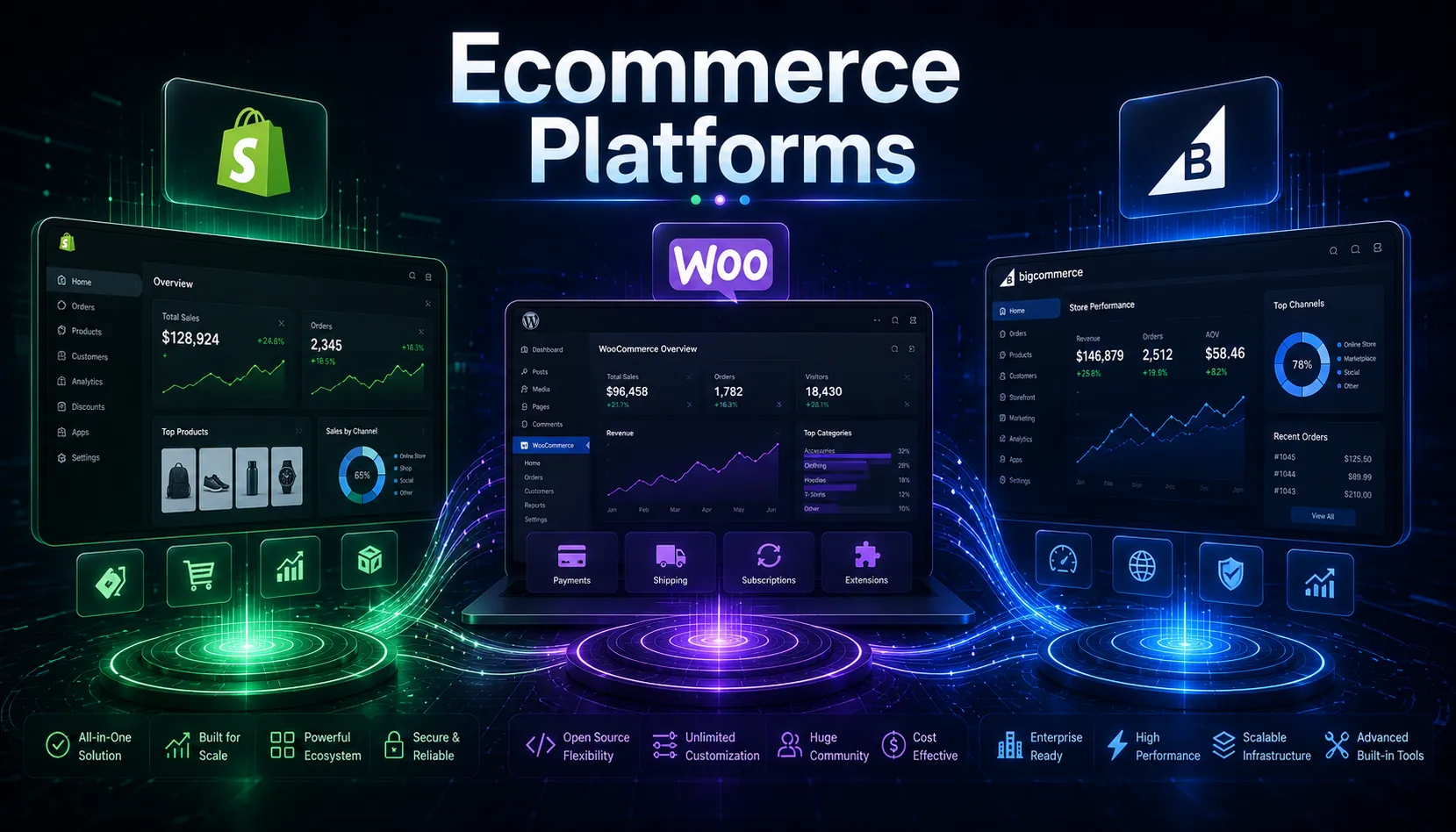
Shopify holds 29% of the US ecommerce software market. WooCommerce powers 33% of all ecommerce sites globally. BigCommerce captures 3% with disproportionate representation among mid-market and enterprise merchants.
All three are capable of powering successful stores. The right choice depends on your technical ability, growth ambitions, and how much control versus convenience you actually want. Getting it wrong is expensive: switching platforms later means migrating products, customers, orders, and reviews, plus rebuilding all integrations.
Here is the honest breakdown.
Shopify: The Default for Most Stores
Shopify is the fastest way to launch an online store. A complete novice can deploy a fully functioning storefront with products, payments, and shipping in an afternoon. No server management, no security patches, no infrastructure decisions.
In 2026, Shopify plans run from $39 to $399 per month. The major catch is transaction fees: 0.5% to 2% on every sale unless you use Shopify Payments. For high-volume stores, this matters significantly. A store doing $500,000 annually on the Basic plan using a third-party gateway pays $10,000 per year just in transaction fees.
For stores under $50,000 per month in revenue, Shopify is almost always the right starting point. The time saved on technical management outweighs the cost premium.
WooCommerce: Maximum Control, Real Complexity
WooCommerce is free. This fact attracts a lot of people who discover the true cost of ownership later.
You need hosting ($5 to $50 per month), a domain, SSL certificate, a theme ($0 to $200), and plugins for most advanced features. A well-built WooCommerce store realistically costs $75 to $920 per year for small operations and $1,420 to $6,550 per year for mid-size stores with premium plugins. And that excludes developer time.
WooCommerce’s actual advantage is its integration with WordPress. For content-driven stores where a blog, editorial content, or community is core to the brand, WooCommerce paired with WordPress is genuinely unbeatable. For pure ecommerce without content strategy, the complexity often is not worth it.
BigCommerce: The Scaling Option People Overlook
BigCommerce occupies the middle ground: cloud-hosted like Shopify (no server management) but with more built-in features and zero transaction fees. Plans run $39 to $399 per month, but you keep 100% of every sale regardless of payment gateway.
The platform shines for B2B merchants. Native wholesale pricing tiers, customer-specific catalogs, and bulk ordering are built into the core without needing plugins. The API-first architecture allows headless deployments for brands that want custom frontend experiences.
The trade-off is a less polished user interface than Shopify and a smaller app ecosystem. BigCommerce is worth the consideration when you are doing above $50,000 per month and feeling the squeeze of Shopify’s transaction fees or app dependency costs.
Direct Comparison
| Factor | Shopify | WooCommerce | BigCommerce |
| Setup Speed | 2-3 hours | 1-2 days minimum | Half a day |
| Monthly Cost | $39-$399 | $75-$6,550+ (true TCO) | $39-$399 |
| Transaction Fees | 0.5-2% (waived with Shopify Pay) | None (payment gateway fees only) | None |
| Technical Skill Needed | Minimal | Medium to high | Low to medium |
| SEO Control | Good | Excellent (WordPress) | Good |
| Best For | Most beginners and growing stores | Content-driven brands with dev resources | Scaling B2B and high-volume merchants |
The Revenue-Based Decision
| Situation | Recommended Path |
| Under $50K/month revenue | Shopify Basic. Simplicity and support outweigh cost. |
| $50K-$200K/month, tech team available | Evaluate WooCommerce or BigCommerce based on whether content or B2B features matter more. |
| $200K+/month, high transaction volume | BigCommerce or Shopify Plus. Compare the total fee structure for your specific mix of payment methods. |
| Content-first brand at any revenue level | WooCommerce on WordPress if you have developer access. Superior for SEO and content architecture. |
The One Thing Most Comparisons Miss
Switching platforms after you have built a business is painful and risky. Products, customers, orders, reviews, SEO redirects, and integrations all need migrating. Factor that switching cost into your initial decision. Choosing Shopify now with a plan to migrate at $200K per month is a reasonable strategy. Choosing WooCommerce with no developer resources because it is free is not.
FAQ
Is WooCommerce really cheaper than Shopify?
The plugin is free, but the true cost of ownership including hosting, themes, plugins, and developer time usually equals or exceeds Shopify for a comparable store. WooCommerce wins on cost only if you have strong internal development resources.
When should I use BigCommerce instead of Shopify?
When transaction fees are a meaningful cost at your revenue level, when you need serious B2B features natively, or when you want API-first flexibility for custom storefronts without managing servers.
Can I migrate from Shopify to another platform later?
Yes. Migration tools and services exist for moving to and from any of these platforms. It takes several weeks and carries SEO and integration risks. Getting the initial choice right is significantly less expensive than migrating later.
Choosing the right platform is only the first step. WritoryBuzz helps ecommerce brands create SEO-driven content that attracts customers, improves search visibility, and supports long-term revenue growth.