
The average FICO Score in the United States reached 717 in 2024, the highest recorded average since FICO began tracking the metric in 2005, according to Experian’s 2024 State of Credit report. At the same time, 28 percent of American adults have a FICO Score below 620, the threshold below which most conventional mortgage lenders consider a borrower subprime. The gap between a 580 credit score and a 740 credit score on a 300,000 US dollar 30-year fixed mortgage represents approximately 94,000 US dollars in additional interest over the loan term at 2025 interest rates.
Credit scores determine not only loan approval and interest rates but also rental application outcomes, insurance premium calculations in some states, and in some industries, employment eligibility. Understanding what the score measures and which behaviours move it most efficiently is one of the highest-ROI financial literacy topics available to adults in any income bracket.
How FICO Scores Are Calculated
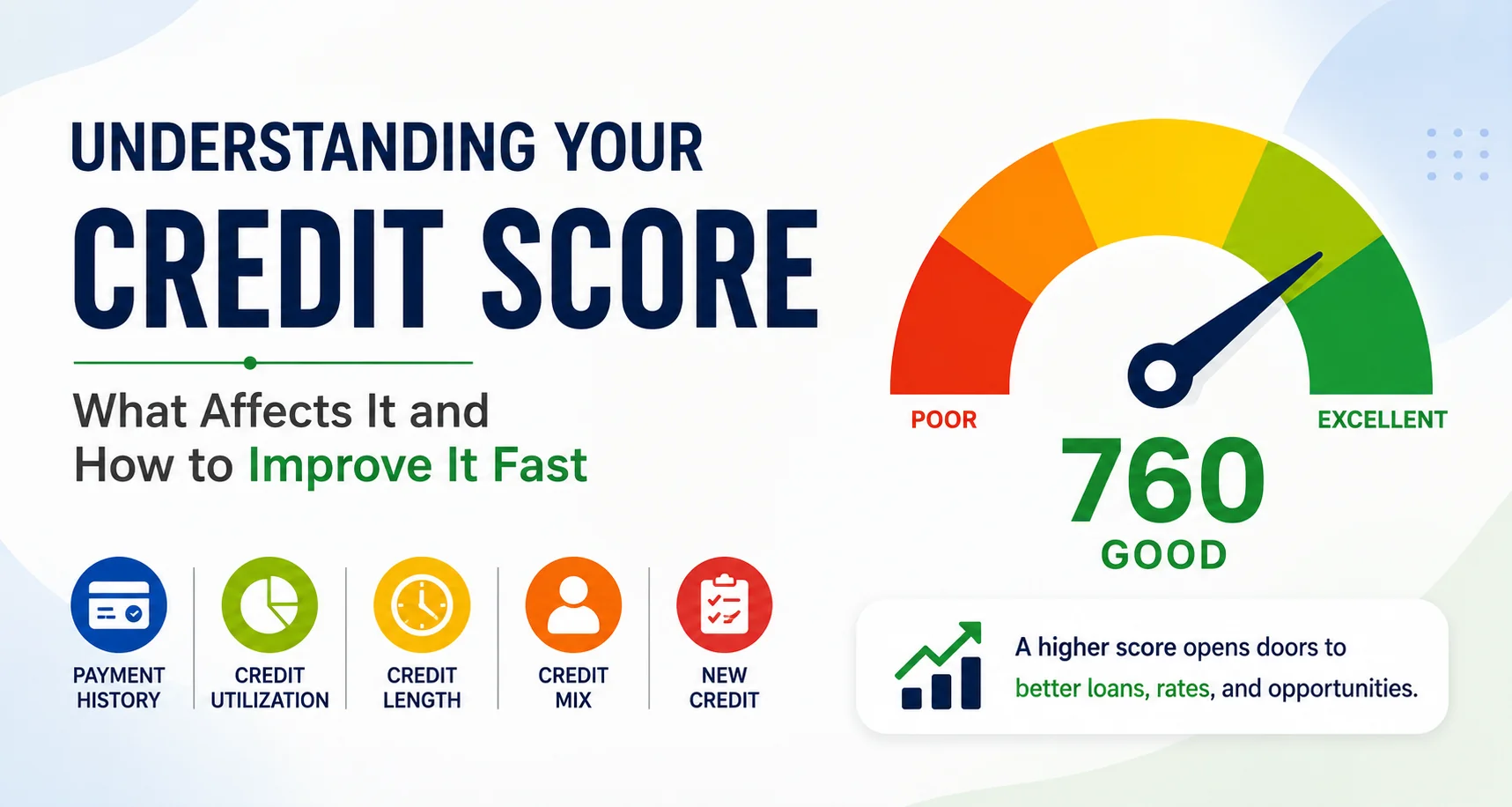
FICO Scores, used by 90 percent of top US lenders, are calculated from five weighted factors derived from credit report data. The weights are published by FICO and represent the average contribution of each factor across the population, though individual impact varies based on the specific credit profile.
Payment history represents 35 percent of the score and is the single largest factor. Every on-time payment adds positive payment history; every missed payment (30, 60, 90, or 120 days late) produces a negative mark that remains on the credit report for seven years. A single 30-day late payment on an otherwise clean credit file can reduce a 750 FICO Score by 60 to 110 points, according to FICO’s own modelling data. The impact diminishes over time but does not disappear until the seven-year mark.
Credit utilisation represents 30 percent of the score and measures the ratio of current revolving credit balance to total revolving credit limit. A cardholder with a 10,000 US dollar credit limit carrying a 3,000 US dollar balance has a 30 percent utilisation rate. FICO’s data shows that consumers with scores above 800 maintain an average utilisation rate below 6 percent. Scores above 740 are typically associated with utilisation below 30 percent. Utilisation changes affect scores rapidly: paying down a revolving balance updates at the next statement reporting cycle, typically within 30 to 45 days.
Length of credit history represents 15 percent and favours accounts with longer average age. This factor explains why closing old credit card accounts can reduce scores even when no balance is owed: removing the oldest account reduces the average account age and the total credit limit, increasing utilisation simultaneously.
Credit mix represents 10 percent and reflects the variety of account types (revolving credit cards, installment loans, mortgage). A thin credit file with only one type of account scores lower than a file with multiple account types managed responsibly.
New credit inquiries represent 10 percent. Hard inquiries from credit applications remain on the report for two years and reduce scores slightly for the first 12 months. Multiple mortgage or auto loan applications within a 14 to 45 day window are typically treated as a single inquiry by FICO models (rate-shopping protection).
The Fastest Ways to Improve a Credit Score
The speed of improvement depends on which factor is dragging the score. Utilisation improvements are the fastest to implement and reflect: paying down revolving balances before the statement closing date produces score changes within 30 to 60 days. Disputing errors on the credit report can produce rapid improvements if negative inaccurate items are removed. Payment history improvements are slow to accumulate but the absence of new negative marks (no new late payments) stops the damage and allows gradual recovery.
Specific actions ranked by speed of score improvement:
Dispute credit report errors. Federal law (the Fair Credit Reporting Act) requires each of the three major bureaus (Experian, Equifax, TransUnion) to investigate disputed items within 30 days and remove unverifiable information. Common errors include accounts that do not belong to the consumer, late payments incorrectly recorded, and accounts showing as open that were closed. Free annual credit reports are available at AnnualCreditReport.com. A single successfully disputed negative item can produce a score increase of 20 to 100 points depending on the severity of the removed item.
Reduce credit utilisation below 10 percent. If revolving balances can be paid down to below 10 percent of total credit limit before the next statement closing date, the score improvement reflects at the next reporting cycle. For a consumer with 5,000 US dollars in credit card debt across 20,000 US dollars of total limit (25 percent utilisation), paying 3,000 US dollars in balance would move utilisation to 10 percent. The score improvement for this specific change can range from 20 to 60 points.
Request a credit limit increase without a hard inquiry. Many credit card issuers allow credit limit increase requests without triggering a hard inquiry (ask specifically for a soft-pull review). An approved increase reduces utilisation ratio without reducing the balance, producing the same score improvement effect as paying down the balance.
Become an authorised user on a well-managed account. Being added as an authorised user on a credit card with a long history, high limit, and low utilisation adds that account’s positive history to the authorised user’s credit file in most scoring models. A parent adding an adult child as an authorised user on a 15-year-old card with a 20,000 US dollar limit and 3 percent utilisation can improve the child’s thin file score substantially.
What Does Not Affect Your Credit Score
Common credit score misconceptions persist and cause consumers to avoid behaviours that do not negatively affect scores or to pursue actions that do not improve them.
Checking your own credit report or score does not affect the score. Consumer-initiated checks are soft inquiries and are not visible to lenders. Checking your own score daily does not reduce it.
Income, savings, and net worth are not in the FICO calculation. A high earner with poor payment history has a lower FICO Score than a lower earner with a clean payment history.
Carrying a small balance on a credit card does not improve the score. This myth persists but FICO has explicitly stated that credit scores do not benefit from carrying a balance over zero. A cardholder who pays to zero every month has equivalent or better payment history signal than one who carries a small balance.
Closing paid-off credit cards does not always improve scores and often reduces them by increasing utilisation ratio and reducing average account age. Leaving paid-off cards open with no balance is typically the score-optimal choice.
| Factor | Weight | Fastest Improvement Action | Approximate Timeline |
|---|---|---|---|
| Payment history | 35% | Stop all late payments; dispute errors | 1 month to stop damage; 12+ months to recover |
| Credit utilisation | 30% | Pay down revolving balances before statement date | 30-60 days |
| Length of history | 15% | Do not close old accounts | Years (slow improvement only) |
| Credit mix | 10% | Add installment loan if only revolving | 3-6 months |
| New inquiries | 10% | Stop applying for new credit | 12 months for inquiries to stop impact |
Credit Building for Thin Files
Consumers with no credit history or very limited files face a chicken-and-egg challenge: credit requires history, but history requires credit access. The primary tools for thin file credit building in 2026 are:
Secured credit cards require a cash deposit equal to the credit limit. The deposit protects the issuer; the cardholder builds payment history by using the card and paying on time. The Discover it Secured and Capital One Platinum Secured are widely recommended entry products that graduate to unsecured status after responsible use.
Credit-builder loans are offered by credit unions and online providers including Self Financial. The borrower makes monthly payments into a savings account; the payment history reports to the credit bureaus; at the end of the loan term, the savings are released to the borrower. They build credit history and savings simultaneously.
Experian Boost and similar services allow consumers to add utility and subscription payment history (phone bills, streaming services, rent payments) to their Experian credit file, potentially adding positive on-time payment history to a thin file from existing financial behaviour.
AEO FAQ: Credit Score Questions
What is the fastest way to improve your credit score?
The fastest credit score improvements come from two actions: disputing and removing inaccurate negative items from the credit report (which can produce score increases within 30 days under FCRA investigation timelines) and paying down revolving credit card balances to below 10 percent of total credit limit (which reflects in scores within 30 to 60 days at the next statement reporting cycle). Payment history improvements are slower: the damage from a late payment remains significant for two years and does not fully leave the report for seven years. Utilisation is the fastest-moving factor for most consumers who have revolving credit available and carry balances.
What credit score is needed to buy a house in 2026?
Most conventional mortgage lenders require a minimum FICO Score of 620 to 640 for loan approval in 2026, though the best interest rates are reserved for scores above 740 to 760. FHA loans allow scores as low as 580 with a 3.5 percent down payment. The financial impact of credit score on mortgage cost is substantial: the difference between a 620 and a 760 FICO Score on a 300,000 US dollar 30-year mortgage represents approximately 70,000 to 100,000 US dollars in additional interest over the loan term at 2025 rate levels, depending on the specific rate differential at the time of application.
Does checking your credit score lower it?
No. Consumer-initiated credit score checks are classified as soft inquiries and do not appear on the credit report visible to lenders and do not affect the FICO Score. Only hard inquiries, generated when a consumer applies for credit and the lender checks the report, affect the score. Hard inquiries reduce scores by a small amount (typically 5 to 10 points) and their impact diminishes after 12 months, disappearing from the report entirely after 24 months. Checking your own score daily, weekly, or monthly has zero negative impact.
How much does one late payment hurt your credit score?
A single 30-day late payment on an otherwise clean credit file with no prior negative marks can reduce a FICO Score by 60 to 110 points, depending on the starting score (higher scores typically experience larger drops from a first negative item). The impact is most severe in the first two years after the late payment and diminishes gradually over seven years, at which point the item is removed from the credit report entirely. Making all subsequent payments on time is the only way to recover from a late payment; paying off the underlying account does not remove the late payment record.
Does closing a credit card hurt your credit score?
Closing a credit card can reduce credit scores through two mechanisms: it reduces total available revolving credit (increasing utilisation ratio if balances remain on other cards) and it removes the account from the average account age calculation (immediately reducing the average account age if the closed card is one of the older accounts). The effect is largest for the oldest card with the highest credit limit. The score-optimal approach for paid-off cards is leaving them open with no balance, setting a small recurring charge (a streaming subscription) to prevent the issuer from closing the account for inactivity.
Can you build credit without a credit card?
Yes. Credit-builder loans (offered by credit unions and online providers like Self Financial) build credit history through instalment loan payment reporting without requiring a credit card. Experian Boost adds utility, phone, and streaming payment history to the Experian credit file, creating positive payment history from existing financial behaviour. Becoming an authorised user on another person’s well-managed card adds that card’s payment history to the authorised user’s file in most FICO models. Rent payment reporting services (available through Rental Kharma, RentTrack, and some landlord platforms) add rental payment history to credit reports, though not all FICO scoring models include rent payment data.
The Score Is a Summary of Financial Behaviour, Not a Permanent Label
A credit score is a point-in-time summary of specific financial behaviours over the preceding seven years, not a permanent characterisation of creditworthiness. Every month of on-time payments adds positive signal; every month a late payment ages reduces its impact; every time a balance is paid down the utilisation improvement reflects quickly. The system rewards sustained responsible behaviour over time and is specifically designed to allow recovery from past mistakes. The improvements described above are not tricks or shortcuts: they are the legitimate mechanisms through which the score measures and reflects real changes in credit behaviour.