
The views expressed in this piece are the author’s own and represent one perspective on a genuinely contested set of questions. Disagreement is welcome.
Let me describe the current state of content marketing in one sentence: we have collectively flooded the internet with AI-assisted articles that answer the same questions the same way, and we have called this a strategy.
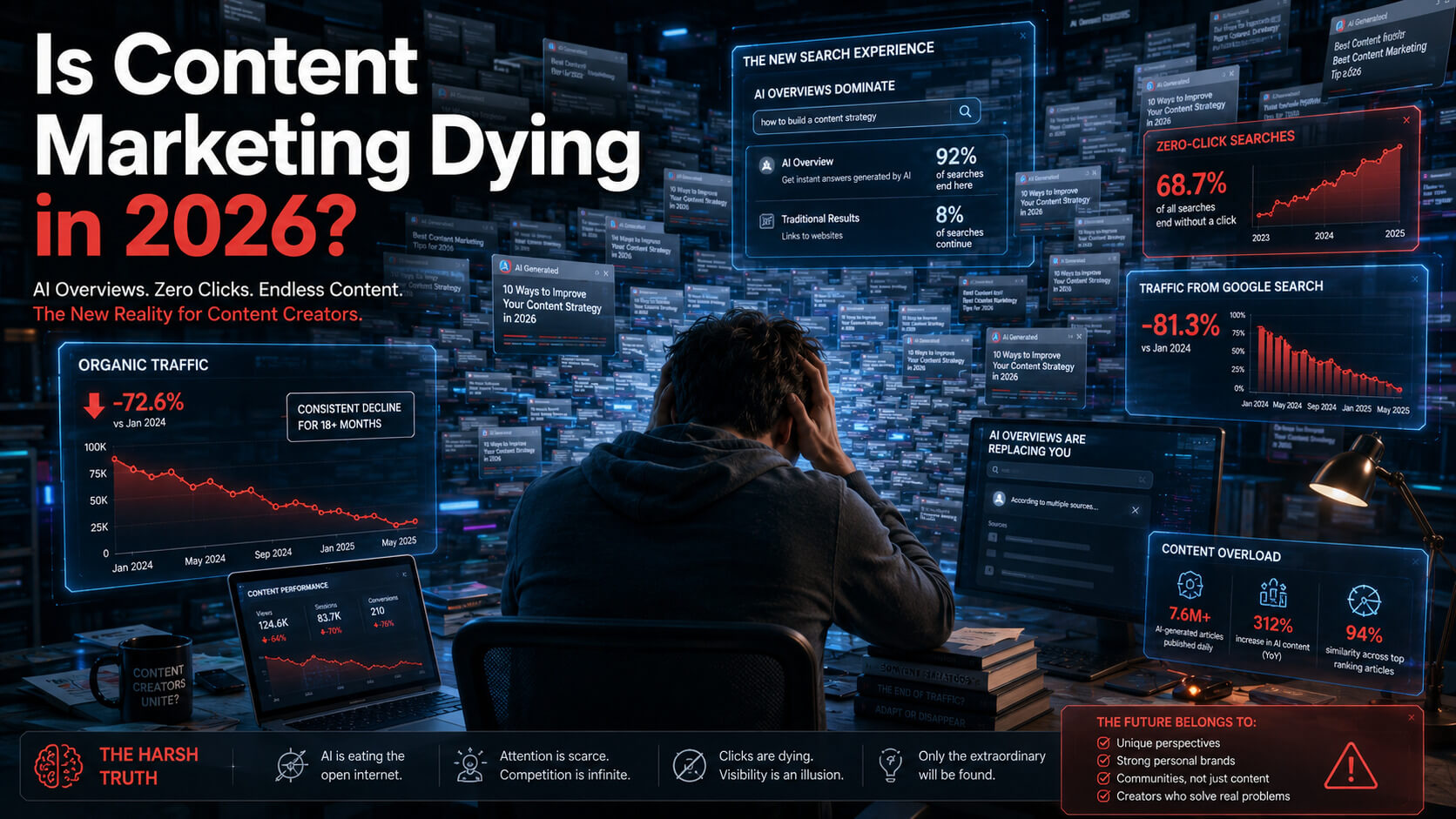
The results are becoming visible. Organic search traffic is declining for a significant share of content-dependent businesses. AI Overviews answer informational queries without a click. Email inboxes are full of AI-generated newsletters that sound identical. Social feeds surface algorithmically-boosted content rather than content from sources people chose to follow.
This is not primarily an AI problem. It is the natural endpoint of a decade-long strategy built on a single premise: produce more content and traffic will follow. That premise was only ever partly true, and we have now reached the point where its limits are impossible to ignore.
The Scale of the Problem
Here is the data worth sitting with. Seventy-five percent of content professionals say AI has increased the volume of content they produce. Only four percent are not using AI for content at all. The volume of content published online is growing faster than the population of people who could conceivably read it.
At the same time, human-generated content receives 5.44 times more organic traffic than AI-generated content, according to research from NP Digital covering a sample of content published in 2025 and 2026.
So we have a situation where the entire industry has adopted a tool that makes content production cheaper and faster, while that cheaper and faster content performs dramatically worse than the human-authored content it is replacing. The economics of this do not work.
What Happens When Everyone Publishes Everything
The original insight behind content marketing was sound. If you produce genuinely useful content on topics relevant to your business, you can attract people searching for those topics, establish credibility, and convert some percentage of them into customers. The logic was correct.
The problem is that the logical extension of this insight, applied by every business in every industry simultaneously with AI tools that reduce the marginal cost of content to nearly zero, produces the opposite of what the logic predicted. When every business publishes a thousand-word article on the same fifteen questions their customers ask, none of those articles are unusual, authoritative, or worth choosing over a direct AI-generated answer.
The content marketing opportunity existed because most businesses weren’t doing it well. Now most businesses are doing it — just not in a way that works.
The Contradiction at the Heart of Current Content Strategy
Most content marketing advice in 2026 contains this contradiction without acknowledging it. The advice says: use AI to produce more content faster, but make sure your content stands out and provides real value. These two instructions cannot both be followed at scale.
Content that stands out requires doing something competitors have not done: original research, a distinct perspective, firsthand experience, a counter-intuitive argument, or an unusually thorough treatment of a difficult subject. None of these things scale cheaply with AI assistance. They require time, expertise, or money. Usually all three.
The brands that are using AI to generate high volumes of generic content are not standing out. They are contributing to the problem they are trying to solve by publishing into a market that already has too much undifferentiated content in it.
The Three Things That Are Actually Dying
I want to be precise here, because the broader statement ‘content marketing is dying’ is too simple.
1. Generic Informational Content
The blog post that answers a common question is the clearest casualty. ‘What is X,’ ‘How to do Y,’ ‘The top 5 Z’ — these served a function when they were the fastest way for a search engine user to get a reasonable answer. Google’s AI Overviews now synthesise a reasonable answer directly in the search result. The click never happens.
This is not a temporary disruption. The informational query — the dominant category of search content marketing was built around — is being systematically captured by AI-generated answers sourced from existing content. The content that fed the system is no longer necessary for the consumer to reach the answer.
2. SEO-First Writing
The practice of writing content structured primarily around search engine optimisation signals, with user experience as a secondary consideration, is collapsing under its own contradictions.
Google’s helpful content guidance, now embedded in its core ranking systems, explicitly targets content created primarily for search engines rather than people. The pages that tick SEO boxes while offering thin or derivative value are losing rankings in every helpful content update cycle. The more aggressively this has been targeted, the more clearly it becomes that SEO-first writing was always a lease, not an asset.
3. Volume-Based Strategies
The strategy of publishing as many pieces as possible to capture as many long-tail queries as possible made sense when the marginal cost of producing the content was the primary constraint. AI has reduced that cost close to zero. The constraint has shifted entirely to attention, differentiation, and trust — none of which are solved by volume.
Businesses that built their organic strategy on publishing four blog posts a week will not fix a declining traffic trend by publishing eight. The problem is not quantity.
The Counter-Evidence: What’s Still Working
I am not arguing that content marketing is over. I am arguing that a specific version of it is over and that this is not always the same thing.
The content that is demonstrably still performing falls into a recognisable pattern. It is authored by people with firsthand expertise. It contains original data, real case studies, or perspectives that cannot be reconstructed from existing sources. It demonstrates the author’s genuine thinking about a subject, including uncertainty and nuance, rather than summarising consensus.
| The NP Digital Research Finding (2025–2026)
Human-generated content received 5.44x more organic traffic than AI-generated content in the same niches. The researchers attributed this to depth, original perspective, and citation-earning quality. The implication is not that AI should not be used in content production — it is that AI should not replace the human thinking, expertise, and original perspective that gives content its competitive differentiation. |
Email newsletters built around a distinctive editorial voice and a specific point of view are seeing engagement rates that general brand emails cannot approach. Communities and membership models are growing precisely because they offer something algorithmically distributed content cannot: a consistent relationship with a specific voice that readers trust.
Original research — surveys, data analysis, proprietary insights — is generating backlinks and citations at the same rate it always did, because AI cannot fabricate primary data and search engines and journalists still need primary sources.
What Comes After the Bubble
The Trust Economy
The scarcest resource in the current information environment is not content. It is credibility. Audiences have developed accurate instincts for detecting AI-generated or formulaic content, and their response is disengagement. The brands and publishers building audiences in 2026 and beyond are the ones that feel genuinely trustworthy — that give readers a reason to believe that a human with real knowledge thought carefully about what they wrote.
This is not a niche position. It is a competitive advantage. Trustworthy content is difficult to produce at scale. That difficulty is the advantage.
Owned Audiences Over Rented Traffic
The strategic lesson of AI Overviews, zero-click search, and algorithmic social distribution is the same lesson email marketers have been trying to communicate for fifteen years: traffic you do not own is traffic you are borrowing, and the landlord will eventually change the terms.
An email list of 20,000 subscribers who open your emails is a more durable asset than 200,000 monthly organic visits from a search strategy that one algorithm update could end. The businesses that are building both — and treating the search traffic as a list-building mechanism rather than an end in itself — are better positioned than those treating SEO traffic as the goal.
Original Perspective Over Synthesis
The AI-optimised market creates a strange opportunity. Because so much content is derivative — summarising, synthesising, and re-packaging existing information — content that contains genuine original thinking, counter-intuitive positions, or honest uncertainty is rare enough to stand out.
Opinion pieces. Original research. Case studies from real implementations. Practitioner-level deep dives into specific problems. First-person accounts of what actually happened when someone tried something. These cannot be commoditised because they are inherently non-reproducible.
A Practical Reframe for Content Marketers
If I were advising a content marketing team right now, I would tell them three things.
Stop measuring success by volume produced. Measure it by the quality of engagement with the content that matters. One piece that earns 50 backlinks and 500 email sign-ups is worth more than 50 pieces that each earn nothing.
Use AI for execution, not ideation. AI is genuinely useful for drafting, formatting, headline testing, and distribution logistics. It is not useful for identifying the original insight, the counter-intuitive angle, or the firsthand observation that makes a piece worth reading. Keep the thinking human. Accelerate the execution.
Build the audience, not just the traffic. Every piece of content should have a mechanism for converting a reader into a subscriber, follower, or community member. The goal is to own the relationship, not just to capture the click.
Where I Think This Goes
The bubble will burst unevenly. Businesses in highly competitive informational niches — the finance explainers, the health tip articles, the marketing how-tos — will feel it first and most acutely. They are already seeing it.
Businesses in niche B2B markets, in areas requiring genuine technical expertise, and in industries where trust matters more than discovery will be more insulated. Their content was never primarily a volume play.
The practitioners who will be valued in 2026 and beyond are not the ones who can produce more content faster. They are the ones who can think originally, write with genuine expertise, and build the kind of reader relationship that persists through whatever the algorithm does next.
That is what content marketing always should have been. We just needed the bubble to burst to remember it.
Want to build real authority instead of publishing disposable AI content? Publish high-authority guest posts through WritoryBuzz and improve your SEO, digital visibility, and long-term brand credibility with placements on trusted business and technology websites.
Frequently Asked Questions
Is content marketing still worth investing in for 2026?
Yes, but the form of content that is worth investing in has changed. Generic informational content at high volume is delivering declining returns. Original, expertise-driven, trust-building content from distinctive voices is still performing — and the competitive landscape for it is better now than it has been in years, precisely because most competitors are focused on volume.
How should a content team respond to AI saturation?
Shift focus from volume to differentiation. Use AI to speed up execution while protecting the quality of original thinking. Build owned audience channels (email, community) that do not depend on algorithmic distribution. Invest in original research and firsthand expertise that AI cannot replicate.
Does this mean SEO is dead?
Not dead, but fundamentally changed. SEO as a primary channel for informational query traffic is under structural pressure from AI Overviews. SEO for commercial and navigational queries, for local search, and for content that earns AI Overview citations through genuine topical authority is still viable. The days of building a business primarily on informational blog traffic are numbered.