
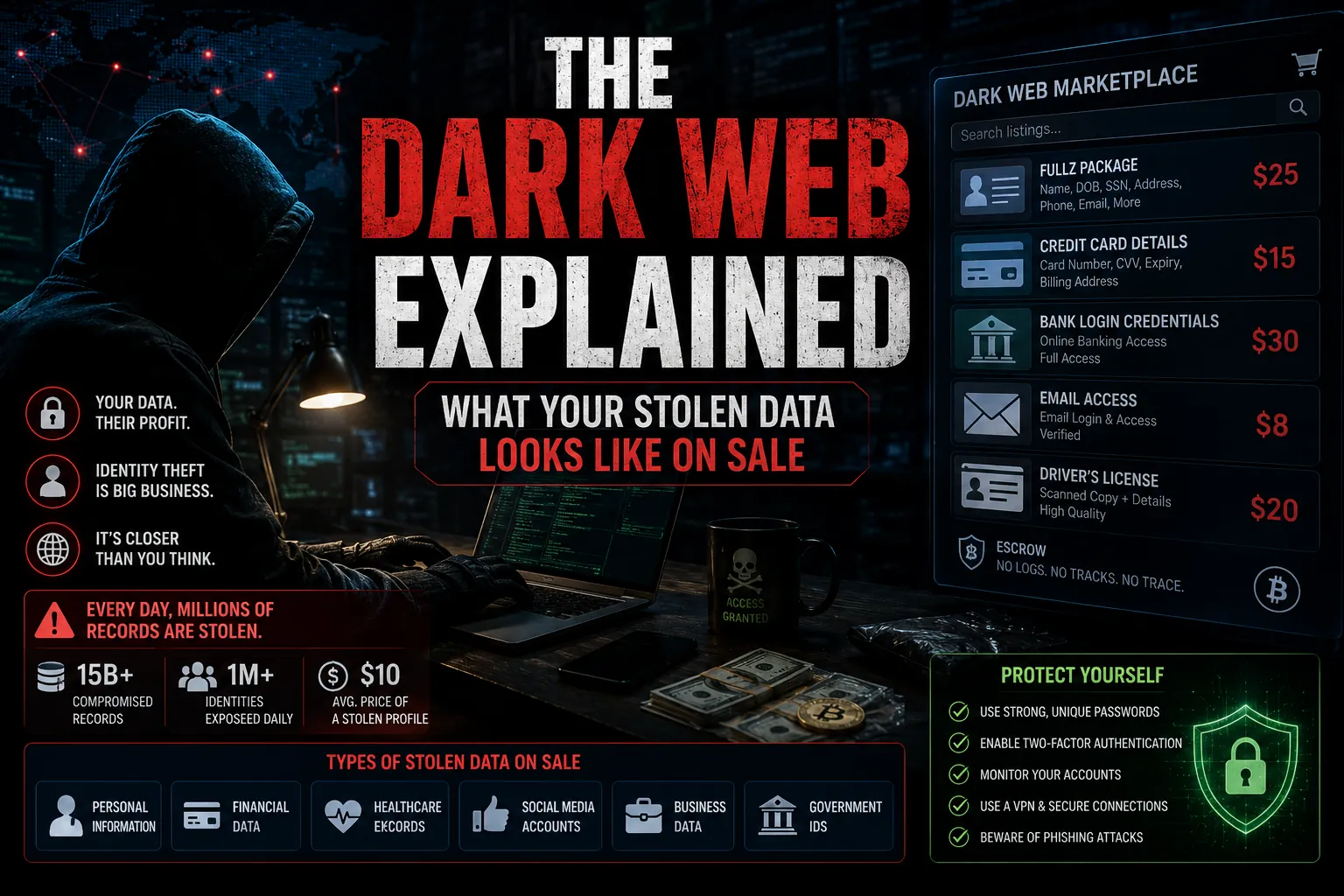
After a data breach, your information does not simply disappear. It enters a structured, surprisingly organised illegal marketplace with consistent pricing, seller ratings, and even customer service. A US credit card sells for $5 to $40. A healthcare record sells for $260 to $310. Your full identity can be purchased for under $100.
Understanding the dark web economy is not about sensationalism. It is about understanding the actual incentives that drive cybercrime and what protection measures are proportionate to the real threat. The price your data commands determines how urgently criminals pursue it and what they do with it after a breach.
What the Dark Web Actually Is
The internet operates in layers. The surface web is everything accessible through standard browsers and indexed by search engines: websites, social media, news, shopping. The deep web is content not indexed by search engines but accessible through browsers with the right URL or credentials: email inboxes, bank account dashboards, private databases. This represents the vast majority of internet content by volume.
The dark web is a small portion of the deep web that requires specific software, most commonly the Tor browser, to access. Tor encrypts traffic and routes it through multiple relay nodes, making it difficult to trace who is accessing what or from where. This anonymity infrastructure is why the dark web hosts both legitimate privacy applications (journalists in repressive regimes, whistleblowers) and illegal marketplaces.
How the Data Marketplace Works
Dark web marketplaces for stolen data function with surprising professionalism. Sellers have ratings and reviews. Listings include detailed descriptions of data quality and verification status. Buyers can request specific data types, geographic regions, or card limit ranges. Some sellers offer replacement guarantees if purchased credentials are already inactive.
Data is typically acquired through three channels: direct breaches of company databases, credential harvesting through phishing and malware (stealer malware subscriptions start at $15 per month), and aggregation of data from multiple smaller breaches into comprehensive identity packages.
The Dark Web Price Index 2026
The following prices are derived from multiple cybersecurity research sources monitoring dark web marketplaces in 2025 and 2026. They represent current market rates, which fluctuate with supply and demand.
| Data Type | Price Range | Notes |
| US credit card (with CVV) | $5 to $40 | Price rises with credit limit and associated info |
| US credit card (high limit $5K+) | $110 to $120 | ‘Fullz’ packages with complete cardholder info |
| EU/UK credit card | $15 to $50 | Higher due to lower supply and different fraud controls |
| Bank account login ($100 balance) | $35 | Lowest-balance accounts |
| Bank account login ($2,000 balance) | $65 | Mid-range accounts |
| Bank account (high balance) | $200 to $2,000 | Scales with available funds |
| Social Security Number (SSN) | $1 to $6 | High supply has driven prices down |
| Healthcare record (full) | $260 to $310 | 10x credit card: records are permanent and immutable |
| Driver’s licence scan | $5 to $50 | Used for identity verification bypass |
| Passport scan | $35 | Physical forged passport: $5,000+ |
| Netflix login | $4.55 | Often sold with replacement guarantee |
| PayPal / Revolut account | $100 average | Direct access to payment balance |
| Verified Coinbase account | $100 to $610 | Prices fell with supply increase |
| Corporate email access | $500 to $5,000+ | Access value depends on company size |
| Zero-day software exploit | Up to $150,000 | Nation-state level, not common retail |
Why Healthcare Records Command 10x the Price of Credit Cards
The pricing disparity between healthcare records ($260 to $310 each) and credit cards ($5 to $40 each) reflects a fundamental difference in remediation: you can cancel a compromised credit card in five minutes. You cannot change your medical history, genetic data, or insurance information.
Healthcare records enable insurance fraud, fraudulent medical claims, and pharmaceutical fraud for years after the initial theft. They also contain the comprehensive personal information required for full identity theft, including diagnoses that may affect future insurance applications or employment. The permanence is what drives the premium.
What Happens to Your Data After a Breach
The typical lifecycle of breached data moves through several stages. Within hours of a major breach, data is packaged and listed on dark web marketplaces. High-quality data with complete records sells first at premium prices. Volume data sells to fraud automation operations that run credentials at scale across multiple services.
Credential stuffing attacks, where stolen username and password combinations are tried automatically against hundreds of websites, are run against 15,000 to 40,000 sites simultaneously using automated tools. A 1 to 2 percent success rate against a database of 10 million credentials produces 100,000 to 200,000 compromised accounts. This is the downstream effect of every major data breach.
The 236 percent increase in DDoS attacks since 2023 reflects in part the commoditisation of cybercrime: DDoS attacks are available from $20, making threats viable for low-skill actors who could not previously access this capability.
How to Check If Your Data Is Already on the Dark Web
Have I Been Pwned (haveibeenpwned.com): Troy Hunt’s free service contains over 12 billion breached records. Enter your email address to check whether it appears in any known breach. This is the most straightforward first check available and is updated regularly as new breaches become public.
Your bank and credit card providers: Most major banks provide dark web monitoring as part of premium account or credit monitoring services. These check whether your financial credentials appear in known dark web marketplaces.
Identity theft protection services: LifeLock, Experian IdentityWorks, and similar services monitor dark web sources for your specific data and alert you when it appears. Value depends on how quickly the service detects appearances and what resolution support they provide.
What To Do If Your Data Is Compromised
- Change the compromised password immediately and any other accounts using the same password.
- Enable multi-factor authentication on any account where it is not already active.
- Contact your bank if financial credentials were involved. Freeze credit if the breach included SSN or comprehensive personal data.
- Monitor your bank and credit card statements for unfamiliar transactions for the following three to six months.
- File an identity theft report with the FTC (identitytheft.gov) in the US if personal data was used fraudulently.
What is the dark web and how is it different from the regular internet?
The dark web is a portion of the internet accessible only through anonymising software like the Tor browser. Unlike the surface web (standard websites) and deep web (private authenticated content), the dark web routes traffic through multiple encrypted relays to obscure user identity and location. This anonymity enables both legitimate privacy applications and illegal marketplaces.
How much does stolen personal data sell for on the dark web?
Prices vary significantly by data type. US credit cards sell for $5 to $40. Healthcare records command $260 to $310 because they are permanent and enable fraud for years. SSNs have fallen to $1 to $6 due to supply abundance. Full identity packages with multiple data types sell for $30 to $150. High-balance bank accounts sell for hundreds to thousands.
Why are healthcare records the most valuable data on the dark web?
Healthcare records are permanent: you cannot change your medical history, genetic data, or diagnoses. They enable insurance fraud, pharmaceutical fraud, and comprehensive identity theft for years after theft. This permanence and multi-use value drives prices 10 times higher than credit cards that can be cancelled in minutes.
How do criminals use stolen credit card data?
Criminals use stolen card data for card-not-present fraud (online purchases), to create physical cloned cards where possible, or sell the data to other criminals who run automated fraud operations. Large batches are run through credential stuffing tools that attempt purchases across hundreds of retail sites simultaneously.
How do you check if your data is on the dark web?
Check haveibeenpwned.com with your email address. This free service contains over 12 billion breached records and is updated as new breaches become public. Your bank may also provide dark web monitoring as part of premium services. Identity protection services like LifeLock provide ongoing monitoring.
Does changing your password protect you after a data breach?
Changing your password on the breached service and any other service using the same password reduces the immediate risk. Enabling multi-factor authentication prevents use of stolen credentials even when the password is known. If the breach included payment card data, SSN, or comprehensive personal information, password changes alone are insufficient: contact your bank and consider a credit freeze.
Your Data Has a Market Value and a Shelf Life
The dark web economy treats personal data as a commodity with predictable market dynamics. Supply abundance drives prices down. Data uniqueness and permanence drives prices up. Understanding this economy clarifies why certain data types (healthcare, high-balance financial access) warrant stronger protection than others.
The most effective personal protection is limiting the data you expose, using unique strong passwords per service, and enabling MFA on everything. These do not guarantee safety, but they move you from an easy target to one that requires disproportionate effort.