
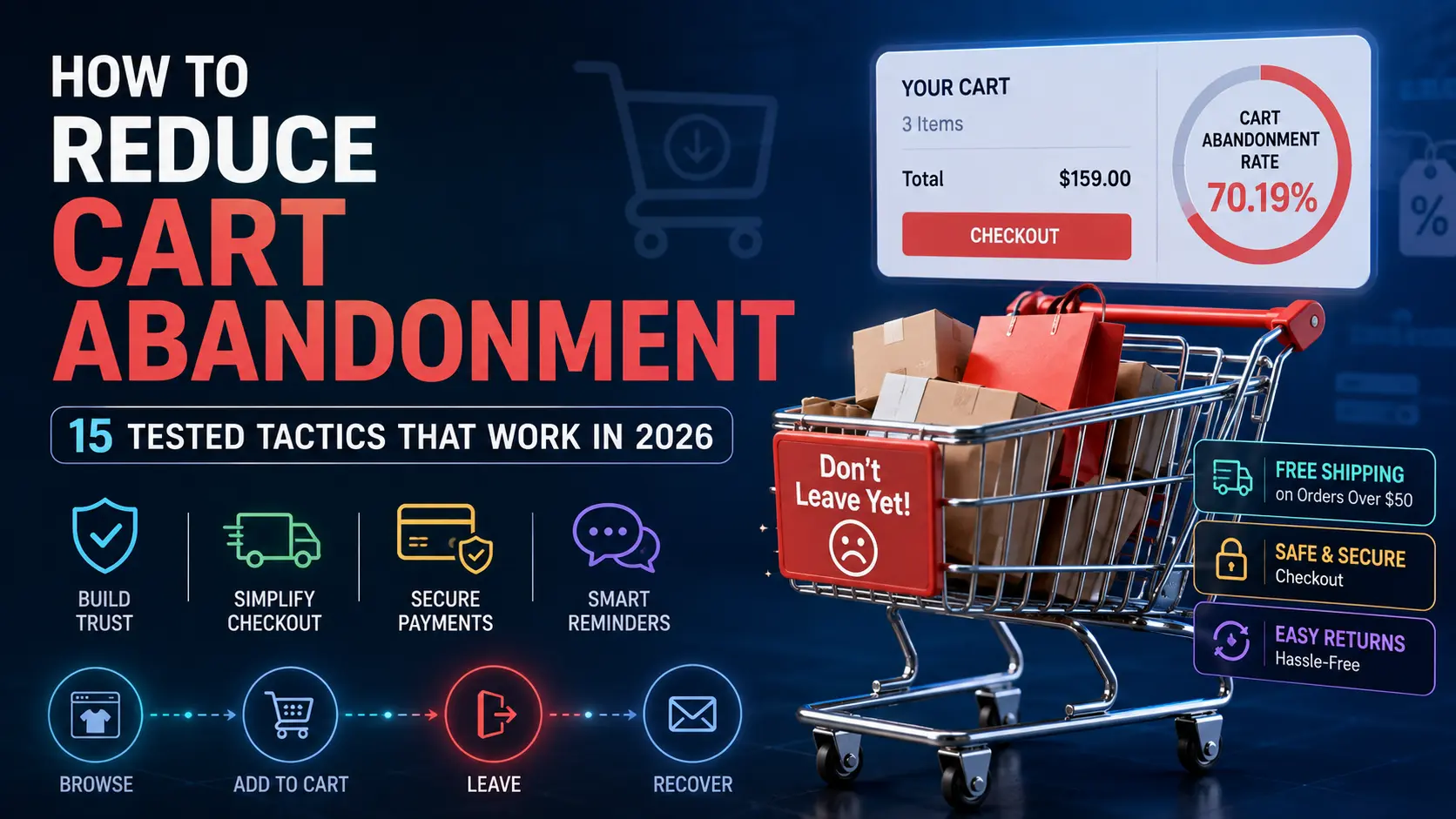
The Baymard Institute’s aggregate research across 48 cart abandonment studies produces a benchmark average cart abandonment rate of 70.19 percent. That means for every 100 people who add something to an e-commerce cart, approximately 70 leave without completing the purchase. Baymard’s 2025 large-scale checkout usability study, testing 60 major e-commerce sites across 4,000 US adults, found that the average checkout flow has 23.5 form fields by default, even though only eight are genuinely required to process a purchase. The same study found that usability-related checkout issues cause an estimated 260 billion US dollars of potentially recoverable revenue to be lost annually across US and EU e-commerce.
Cart abandonment is not one problem. It is a cluster of distinct problems at different points in the purchase journey, each requiring different interventions. Treating it as a single issue to be solved with a single abandoned cart email misses the majority of the recoverable opportunity. The 15 tactics below are grouped by the specific abandonment cause they address.
Checkout Friction: Remove It Before the Cart
Tactic 1: Enable Guest Checkout
Requiring account creation before purchase is the most consistently cited cause of checkout abandonment in usability research. Baymard’s 2025 study found that 24 percent of US adults have abandoned a checkout within the past quarter specifically because they were required to create an account. Guest checkout should be the default path, with account creation offered as an optional benefit (saved addresses, order history) after purchase completion.
Tactic 2: Reduce Form Fields to the Necessary Minimum
The average e-commerce checkout with 23.5 form fields can typically be reduced to eight without losing any required information. Separate first name and last name fields can be combined. Company name, address line two, and county fields can be made optional or conditional. Phone number should only be required if it is genuinely used for delivery communication. Each form field removed reduces the cognitive effort of checkout completion and the probability of mid-checkout abandonment.
Tactic 3: Show the Full Order Total Before Checkout Initiation
Baymard’s research identifies unexpected costs at checkout (shipping, taxes, fees) as the top reason for cart abandonment, cited by 48 percent of abandoning users. Displaying the full expected order total including shipping estimate and taxes before the user begins the checkout flow eliminates the surprise that most commonly causes final-stage abandonment. Shipping calculators on the cart page allow users to see total costs before committing to checkout.
Tactic 4: Implement Progress Indicators
Multi-step checkout processes without progress indicators leave users uncertain how many more steps remain. A clear step indicator (Step 2 of 3: Shipping Details) reduces abandonment at the multi-step checkout stage by communicating that the end is in sight. Baymard’s testing found that checkouts with clear progress indication had measurably lower mid-checkout abandonment than those without.
Tactic 5: Offer Multiple Payment Methods
Offering only card payment excludes shoppers whose preferred payment method is PayPal, Apple Pay, Google Pay, or Buy Now Pay Later (BNPL) options like Klarna or Afterpay. A 2025 PYMNTS Global Digital Shopping Index found that 31 percent of online shoppers have abandoned a purchase because their preferred payment method was not available. At minimum, Apple Pay and Google Pay (which enable one-click checkout for mobile users) should be offered alongside standard card processing.
Trust and Security Signals
Tactic 6: Add Trust Seals at the Point of Payment Entry
Trust seal placement matters as much as presence. Displaying security badges (SSL certificate indicator, Norton Secured, McAfee Secure, or the payment processor’s security badge) immediately adjacent to the payment form fields, not only in the footer, produces measurable conversion improvement. Baymard’s testing found that users consciously or unconsciously look for security signals at the moment of card entry, and that seals positioned away from the payment form were less effective than those placed within the form area.
Tactic 7: Display Return Policy Clearly at Checkout
Uncertainty about return or refund policy causes checkout hesitation that is rarely expressed by users but consistently shows in behavioural data. A clearly stated return window (30-day free returns) in a single line within the checkout summary reduces this hesitation without requiring the user to navigate away from the checkout to find the policy page.
Mobile Checkout Optimisation
Tactic 8: Implement Address Autocomplete
Mobile keyboard input for shipping addresses is one of the highest-friction elements of mobile checkout. Address autocomplete (using Google Places API or a service like Loqate) reduces the typing required by approximately 70 percent and eliminates most address entry errors simultaneously. The implementation cost is low; the conversion improvement on mobile is consistently significant.
Tactic 9: Use Numeric Keyboards for Numeric Fields
Credit card number, CVV, expiry date, and postal code fields should trigger the numeric keyboard on mobile, not the alphabetic keyboard. Setting the input type attribute correctly (type=”tel” or type=”number” for numeric fields) is a single line of code change that removes a significant usability friction point from mobile checkout. Baymard’s testing found this was missing on approximately 40 percent of major e-commerce sites.
Recovery Tactics After Abandonment
Tactic 10: Three-Email Abandoned Cart Sequence
Abandoned cart email sequences are among the highest ROI email marketing implementations available to e-commerce stores. Klaviyo’s 2025 e-commerce benchmark data found that abandoned cart flows generate an average of 9 US dollars in revenue per recipient, with three-email sequences outperforming single-email sequences by 63 percent. Email one (sent one hour after abandonment): reminder with cart contents and a clear return link. Email two (sent 24 hours after): address common objections, include social proof or reviews. Email three (sent 72 hours after): limited-time incentive (free shipping or five to ten percent discount for first-time abandoners).
Tactic 11: Use Exit-Intent Pop-Ups Strategically
Exit-intent pop-ups that trigger when mouse movement signals the user is about to close the tab can capture a percentage of abandoning users with a compelling offer. OptinMonster’s 2025 study found exit-intent pop-ups convert between 2 and 4 percent of abandoning visitors when the offer is relevant and the timing is appropriate. The offer should be specific (an incentive to complete the current purchase, not a generic newsletter signup) and should not appear on every page visit (limiting to the cart or checkout page on first visit avoids the most common user experience complaints).
Tactic 12: Implement Cart Persistence Across Sessions
Cart contents that disappear when a user closes the browser and returns later (particularly on mobile, where session interruptions are common) cause re-abandonment by adding the friction of re-finding and re-adding products. Cart persistence for signed-in users and cookie-based cart persistence for guest users (typically 30 days) ensures that users who return after interruption find their cart intact and can complete checkout with minimal re-effort.
Tactic 13: Retargeting Ads for Cart Abandoners
Retargeting advertising campaigns targeting users who added items to cart but did not purchase represent the most precisely targeted audience available in e-commerce advertising. Facebook and Instagram dynamic product ads can display the exact products a user left in their cart, with ROAS (Return on Ad Spend) typically ranging from 3 to 8x in well-managed campaigns targeting recent abandoners. The retargeting window should be 7 to 14 days for most product categories; longer windows show diminishing returns as purchase intent dissipates.
Pricing and Incentive Clarity
Tactic 14: Free Shipping Threshold Transparency
Shipping cost is the top cited cart abandonment reason. Free shipping thresholds (free shipping on orders over 50 US dollars) are a highly effective conversion lever when communicated clearly during the shopping experience, not only at checkout. A dynamic cart message reading “Add 12.00 US dollars more to qualify for free shipping” during cart building significantly reduces the surprise of shipping costs at checkout and increases average order value simultaneously.
Tactic 15: BNPL Integration for Higher-Value Products
Buy Now Pay Later options (Klarna, Afterpay, Affirm) reduce the perceived cost barrier for higher-ticket items by spreading the payment over three or four instalments. Klarna’s 2025 merchant data found that adding Klarna as a payment option increased average order conversion by 21 percent and average order value by 14 percent for products above 100 US dollars. The cost to merchants is typically 2 to 6 percent of transaction value, which should be evaluated against the incremental conversion improvement for the specific product category.
| Abandonment Cause | Primary Tactic | Expected Conversion Impact |
|---|---|---|
| Account creation required | Guest checkout | High |
| Unexpected shipping costs | Show full total on cart page | High |
| Too many form fields | Reduce to 8 required fields | Medium-High |
| Payment method not available | Add Apple Pay, Google Pay, BNPL | Medium-High |
| Mobile friction | Address autocomplete, numeric keyboards | Medium (mobile) |
| Post-abandonment recovery | 3-email sequence | High ROI |
| Trust uncertainty | Trust seals at payment field | Medium |