
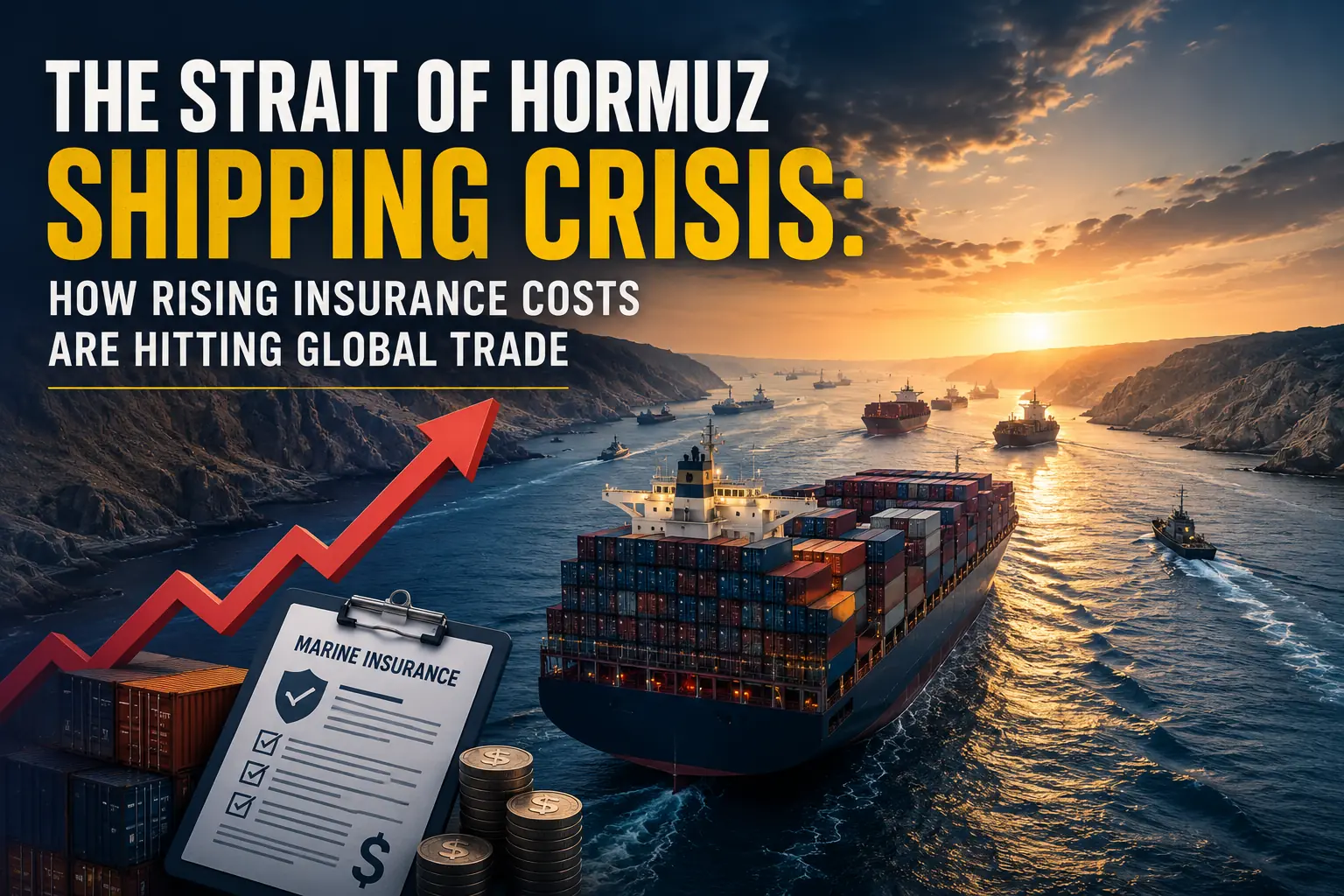
War risk insurance premiums for tankers transiting the Strait of Hormuz surged from around 0.25 percent of hull value before the crisis to between 5 and 10 percent by mid-2026, according to insurance brokerage Marsh, translating into insurance bills of 3 million to 8 million dollars for a single large tanker transit. Bloomberg reported the cost of coverage has leaped to about 5 percent of a vessel’s value, roughly five times the level seen in the earliest days of the conflict, meaning insuring a 100 million dollar oil tanker now costs around 5 million dollars for one voyage.
The corridor handles roughly 20 percent of global oil and LNG seaborne flows and saw more than 130 daily transits before the Middle East conflict began. Traffic has since collapsed, with S&P Global Commodities at Sea recording just 10 transits on 21 July 2026, down from 16 the previous day. This explainer breaks down what is driving the cost spike, what it means in dollar terms, and why the shipping industry now treats this as a permanent repricing rather than a temporary spike.
How Much Insurance Now Costs Per Hormuz Transit
Marsh’s global head of marine, cargo and logistics, Marcus Baker, told S&P Global that additional war risk premiums in the region jumped from 1 to 3 percent of hull value in the weeks before the escalation to 7.5 to 10 percent currently. Separate analysis from Fairway ETA found that pre-crisis war risk premiums on Hormuz VLCC transits sat around 0.25 percent of hull value, moving into the 1 to 3 percent range within a week of escalation, with some quotes higher still. For a 150 million dollar tanker, that shift alone translates to a single-transit insurance bill moving from roughly 375,000 dollars to between 1.5 million and 4.5 million dollars.
| Period | Premium (% of hull value) | Cost on $100M tanker |
| Pre-crisis (Feb 2026) | ~0.25% | ~$250,000 |
| Early escalation | 1% to 3% | $1M to $3M |
| Mid-2026 (current) | 5% to 10% | $5M to $10M |
Why Traffic Through Hormuz Has Collapsed
Daily transits through the strait fell to as low as 10 on 21 July 2026, down from more than 130 daily transits before the Middle East war broke out in late February. Howden Re estimated at least 9 to 15 tankers have sustained damage since the conflict began, with roughly 7 tankers hit at an average value of 250 million dollars each, implying up to 1.75 billion dollars in industry losses before cargo damage is even factored in.
Some vessels are now coordinating directly with Iranian authorities to secure safe passage, a process that adds delay on top of cost. Thailand confirmed one of its oil tankers, owned by Bangchak Corporation, passed through the strait only after talks with Iranian officials, while a second Thai vessel remained waiting for clearance alongside other ships in the queue.
How the Cost Spike Ripples Into Freight Rates
Insurance is only part of the added cost. Shipowners are demanding sharply higher freight fees to move crude out of the Gulf at all. South Korea’s Sinokor sought about 700 Worldscale points to transport Middle East crude to China on very large crude carriers, a level shipbrokers said translates to roughly 20 dollars a barrel for cargoes discharged in eastern China, compared with an average of about 2.50 dollars a barrel just a year earlier. A tanker controlled by Greece’s Dynacom Tankers Management was provisionally leased at 525 Worldscale, equivalent to daily earnings of about 350,000 dollars.
Why This Looks Like a Permanent Repricing
Insurers describe the shift as structural rather than temporary. A Howden Re analysis framed the combined effect of the Red Sea disruptions in 2024 and 2025 and the Hormuz crisis in 2026 as creating a new baseline for marine war risk pricing, rather than a spike that reverts once the conflict cools. Even a reopening of commercial traffic through the strait is unlikely to bring costs down quickly, since underwriters typically demand months of sustained stability before restoring normal coverage terms, according to Khaleej Times reporting on the market.
Energy insurers covering Gulf offshore platforms and refineries are repricing at similarly elevated rates, with some offshore platforms within or adjacent to the strait zone now effectively uninsurable at standard market terms. War risk extensions for Gulf energy infrastructure are being withdrawn or renegotiated at multiples of prior pricing, extending the cost impact well beyond tanker transits alone.