

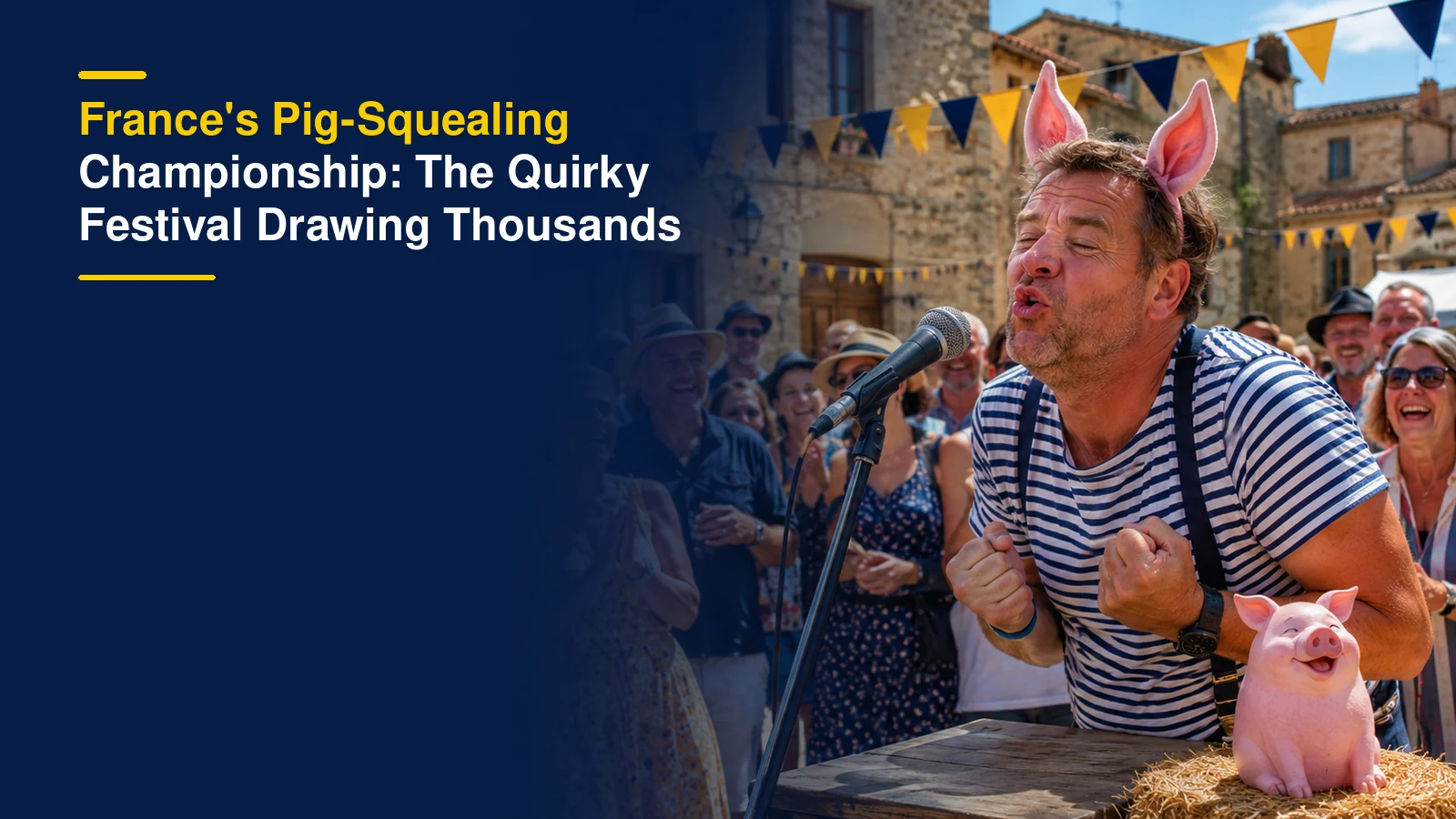
Trie-sur-Baise, a farming village of roughly 1,000 people in the Hautes-Pyrenees department of southwest France, drew around 4,000 visitors, four times its own population, for the 43rd edition of La Pourcailhade in August 2026. The festival’s centerpiece is the Championnat de France du Cri de Cochon, the French Pig-Squealing Championship, in which competitors take turns imitating the noises pigs make at various stages of life, from birth to slaughter, hoping to impress a panel of judges.
Organized since 1975 by La Confrerie du Cochon, the Brotherhood of the Pig, the festival has become one of rural France’s most recognizable oddities, once even featured on Channel 4’s Eurotrash. This piece covers what actually happens at the festival, how the championship works, and why a small farming village has spent five decades keeping this tradition alive.
What Happens at La Pourcailhade
Held annually on the second Sunday of August, La Pourcailhade, also known as La Fete du Cochon or Festival of the Pig, runs a full program of pig-themed events beyond the headline squealing contest. These include piglet races known locally as le Trie-Porc, a sausage-cutting contest, a ham-weighing competition, an eating contest, and even a World Championship of Pig Throwing. Local markets and artisan food stalls showcase pork dishes and regional specialties throughout the day, turning the festival into as much a celebration of the village’s agricultural identity as a comedy spectacle.
Inside the Pig-Squealing Championship Itself
Contestants step up individually, some in improvised pig costumes, to perform a sequence of grunts, squeals and snuffles meant to mimic a pig’s sounds across different stages of life, often building to a theatrical climax. Judges score performances on realism and showmanship, with past winners earning the official title of French Pig-Squealing Champion. In one notable past edition, a duo from a nearby village entered on a whim the night before the competition and won first prize, a butchered pig, beating out several regular contenders in the process.
The Euronews coverage of the 2026 edition described competitors taking turns to impress judges as part of a contest that has become the festival’s signature draw, pulling in visitors and media attention from well beyond the Hautes-Pyrenees region.
Why a Small Village Keeps the Tradition Alive
The festival began in 1975 partly as a way to preserve the memory of the region’s agricultural past, according to local organizers quoted in past coverage of the event. Trie-sur-Baise sits in an area where pork farming has faced real economic pressure, with some producers shifting toward beef or higher-value black pig breeds as pork prices have fluctuated. Tourism generated by events like La Pourcailhade has become an increasingly important source of income for a rural community balancing agricultural tradition with the practical need to diversify its local economy.
Villagers involved in running the festival have said they are aware the event draws a degree of ridicule internationally, but treat that attention as part of the joke rather than something to be defensive about. The festival’s willingness to lean fully into its own absurdity is, in many ways, exactly what has kept it running for nearly five decades while countless other small-town festivals have quietly disappeared.