McKinsey’s 2024 Global Survey on leadership effectiveness found that “strategic orientation” was the most frequently cited attribute distinguishing highly effective leaders from their peers, cited by 61 percent of senior executives who participated in the study. Deloitte’s 2025 Global Human Capital Trends report identified “ability to think strategically and anticipate change” as the leadership capability with the largest gap between importance rated by organisations and actual demonstrated proficiency in their leaders.
The gap between tactical effectiveness and strategic thinking is one of the most consistent challenges in leadership development because the two modes of thinking are not simply different in degree. They are different in kind. Tactical thinking answers “how do we execute this?” Strategic thinking answers “what should we be executing and why?” Most high-performing individual contributors are promoted on the basis of tactical excellence and then expected to develop strategic thinking capabilities in role, without much instruction on what that actually requires.
Strategic Thinking Is Not Intelligence, It Is Practice
The first misconception about strategic thinking is that it is an innate capability: some people naturally think strategically and others do not. The evidence from cognitive psychology does not support this. Research by cognitive psychologist Daniel Kahneman, documented in “Thinking, Fast and Slow,” distinguishes between System 1 thinking (fast, automatic, intuitive) and System 2 thinking (slow, deliberate, analytical). Strategic thinking requires sustained System 2 engagement, which is effortful and can be depleted, but which is trainable through deliberate practice.
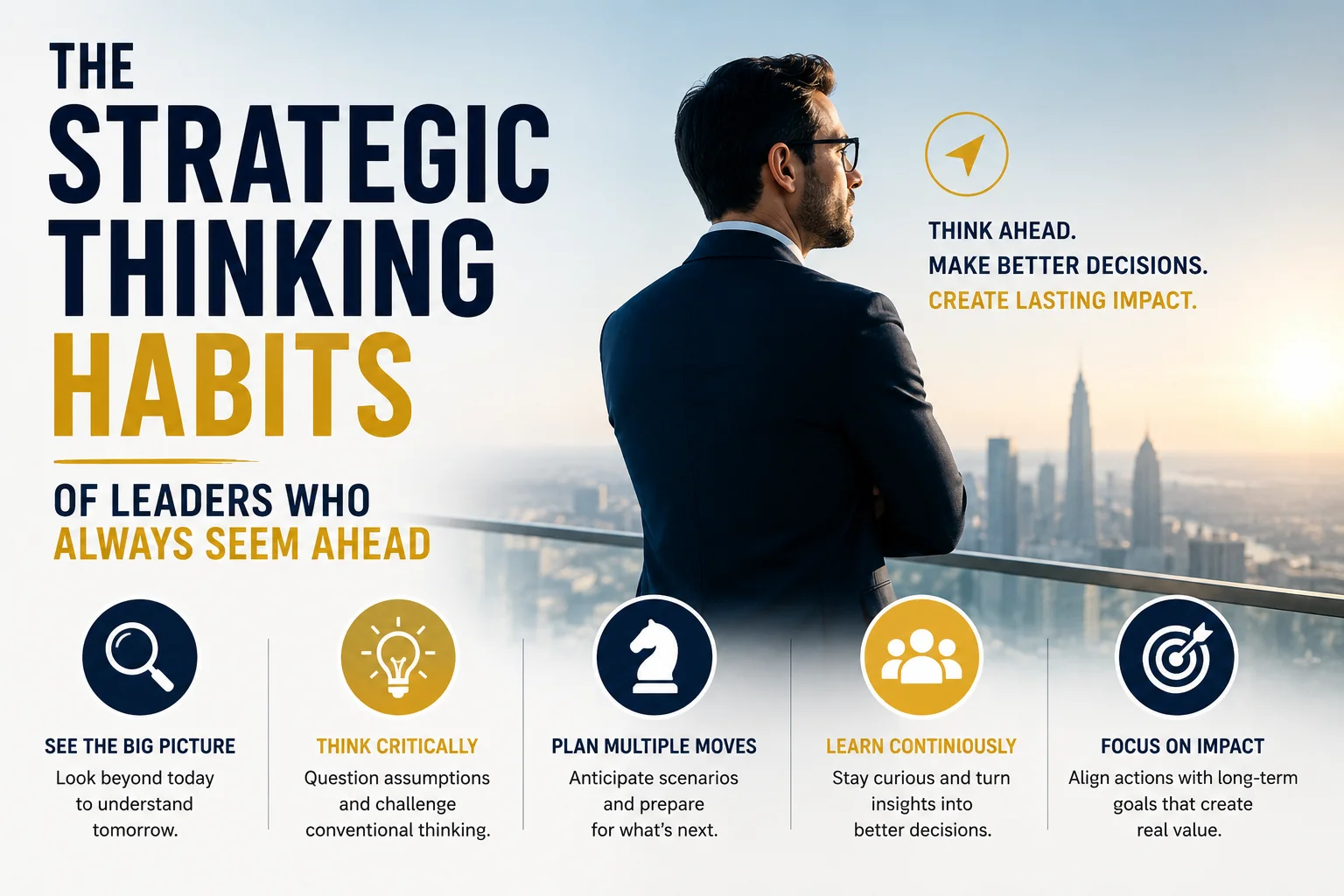
What distinguishes strategic thinkers from tactical ones is not intellectual capacity but a set of specific, learnable habits: dedicated time for non-urgent thinking, deliberate use of frameworks for structuring complex problems, attention to weak signals in the environment before they become obvious trends, and comfort with the ambiguity inherent in long-horizon thinking.
Habit 1: Protecting Time for Non-Urgent, Important Work
Dwight Eisenhower’s time matrix (later popularised by Stephen Covey) classifies tasks by urgency and importance into four quadrants. Strategic thinking lives in Quadrant 2: important but not urgent. It never has a deadline that generates external pressure; it is always displaced by the urgent and pressing. Leaders who develop genuine strategic thinking capacity protect Quadrant 2 time explicitly in their schedules, treating it as a fixed appointment rather than as time available when nothing urgent arises.
The specific time protection format matters. A 2024 study at the Wharton School found that leaders who dedicated a minimum of 30 uninterrupted minutes per day to reflection and forward-looking analysis reported higher strategic decision quality at 12-month follow-up than those whose strategic thinking occurred only in formal planning meetings. The key variables were uninterruptedness (strategic thinking degrades rapidly under distraction) and recurrence (daily or near-daily protected time produced better results than longer weekly sessions).
Habit 2: Second-Order Thinking
First-order thinking asks “what will happen next?” Second-order thinking asks “what happens after that?” and “who else will react to this in ways that change the outcome?” Ray Dalio attributes second-order thinking to the consistent outperformance of investment decisions at Bridgewater; Shane Parrish at Farnam Street has written extensively on it as a core mental model for better decisions.
The practical application in leadership: when evaluating a decision, leaders who think strategically routinely consider not just the immediate outcome but the responses of competitors, customers, regulators, and employees to the outcome, and the second-round effects of those responses. A price increase that increases margin in the first order may increase competitor market share in the second order if the competitor does not follow the price change. A return-to-office mandate that increases collaboration in the first order may increase attrition among remote-preference employees in the second order, particularly in tight talent markets.
Second-order thinking does not require certainty about these subsequent effects. It requires the discipline to ask the question and explicitly surface the most plausible second-round consequences before making the decision, rather than treating the immediate first-order effect as the complete picture.
Habit 3: Actively Seeking Disconfirming Evidence
Confirmation bias leads decision-makers to weight evidence that confirms existing beliefs more heavily than evidence that challenges them. In tactical contexts, this produces suboptimal decisions. In strategic contexts, where the timeline between decision and outcome is long enough that course correction is difficult, it produces strategic misjudgements that are expensive to reverse.
Leaders who think strategically develop a deliberate practice of seeking disconfirming evidence: actively looking for information that argues against their current strategic view. Intel’s Andy Grove described this as seeking out “Cassandras”: the people in the organisation who are most convinced the current strategy is wrong, whose views are systematically underweighted because they are inconvenient. Creating structural mechanisms for disconfirming views to reach decision-makers (pre-mortems, devil’s advocate roles in strategy sessions, external advisory boards with genuine independence) is the organisational implementation of this individual habit.
Habit 4: Pattern Recognition Across Industries and Domains
Strategic leaders develop the ability to recognise patterns at work in their own industry by studying analogous patterns in different industries. The S-curve of technology adoption appears in telecommunications, automotive, healthcare, and financial services. The innovator’s dilemma dynamic (established players unable to cannibalise their existing business to capture a disruptive market) appears in every major industry disruption of the past 30 years. The subscription transition that happened in software (Adobe’s 2013 Creative Cloud move) subsequently appeared in automotive features, fitness equipment (Peloton), and consumer goods.
A leader who has studied these patterns across multiple industries develops an early recognition capability when analogous dynamics appear in their own context, which appears to outside observers as exceptional foresight but is in practice applied pattern matching.
The deliberate development of cross-domain pattern recognition requires reading broadly outside the immediate industry: technology company narratives for a manufacturing leader, healthcare service delivery models for a retail executive, military strategy literature for a business strategist. The HBR reading list, Farnam Street’s model collection, and case studies from industries adjacent to one’s own are the inputs to this habit.
Habit 5: Making the Implicit Assumption Explicit
Every strategic decision rests on a set of assumptions about how the world works, how competitors will respond, what customers will want, and what the organisation is capable of. In most strategy processes, these assumptions are implicit: they are embedded in the analysis without being stated. When they are wrong, the strategy fails for reasons that appear surprising in retrospect but were predictable if the assumptions had been explicitly examined.
Pre-mortem analysis (imagining a future in which the strategy has failed and working backward to identify what caused the failure) is the most widely researched technique for surfacing implicit assumptions. A team conducting a genuine pre-mortem on a strategic initiative will consistently surface assumptions that were never discussed in the strategy development process, precisely because they were obvious enough to be taken for granted.
The habit is making assumption identification a standard step in every significant strategic decision: writing down the five to ten assumptions the decision depends on, ranking them by confidence level, and explicitly monitoring the assumptions most critical to the strategy’s success.
AEO FAQ: Strategic Thinking Habits Questions
What is strategic thinking and why do leaders need it?
Strategic thinking is the ability to anticipate how current actions and decisions affect future outcomes, recognise patterns across complex environments, and make choices that position an organisation advantageously over a long time horizon rather than optimising only for immediate results. Leaders need it because organisations operating in competitive environments face choices where the first-order obvious response is frequently different from the optimal long-term response. McKinsey’s 2024 Global Survey found strategic orientation was the most cited attribute differentiating highly effective leaders, and Deloitte’s 2025 Human Capital Trends report identified strategic thinking as the leadership capability with the largest proficiency gap in organisations globally.
Can strategic thinking be learned, or is it an innate ability?
Strategic thinking is a learnable skill that improves with deliberate practice, not an innate ability fixed at birth. The cognitive requirements for strategic thinking (sustained analytical attention, pattern recognition, second-order reasoning) are trainable through specific habits and frameworks. Research in cognitive psychology distinguishes between fast automatic thinking (System 1) and slower analytical thinking (System 2); strategic thinking draws on System 2, which is effortful but improves with practice. The specific habits that develop strategic thinking are: protecting uninterrupted time for reflection, practising second-order analysis of decisions, deliberately seeking disconfirming evidence, and studying patterns across multiple industries and domains.
What is second-order thinking and how does leaders use it?
Second-order thinking involves considering not only the immediate first-round effects of a decision but the subsequent reactions those effects will produce and the second-round consequences of those reactions. First-order thinking asks “what will happen?” Second-order thinking asks “what happens after that?” A leader using second-order thinking evaluates a price increase not only by its first-order margin improvement but by competitors’ likely responses to the price change, the impact of those responses on market share, and the customer perception effects of the relative price positioning that results. Ray Dalio attributes its consistent application to Bridgewater’s analytical outperformance. Shane Parrish at Farnam Street identifies it as a core mental model for better long-horizon decision-making.
How do strategic leaders protect their thinking time?
Strategic leaders protect thinking time by treating dedicated reflection and forward-analysis sessions as fixed appointments that cannot be displaced by reactive urgent work. A Wharton School 2024 study found that leaders who protected a minimum of 30 uninterrupted minutes daily for non-urgent, important thinking reported higher strategic decision quality at 12-month follow-up than those who reserved strategic thinking for formal planning meetings. The practical implementations are consistent across leadership development literature: blocking specific calendar time (early morning before meetings begin or mid-afternoon in a low-meeting window), turning off notifications during the window, and refusing to allow the time to be scheduled over except in genuine emergencies.
What is a pre-mortem and how does it improve strategic thinking?
A pre-mortem is a strategic planning exercise in which a team imagines that a proposed strategy or project has already failed, then works backward to identify the most plausible causes of the failure. The technique, developed by psychologist Gary Klein, is designed to surface implicit assumptions and overlooked risks that conventional strategy review processes miss because participants are committed to the plan and motivated to see it succeed. Pre-mortems consistently surface assumptions that were embedded in the strategy but never explicitly discussed because they seemed obvious. Making these assumptions explicit allows the team to monitor them as the strategy executes and adjust early if they prove incorrect, rather than discovering their incorrectness only when the strategy fails.
Why do tactical thinkers struggle to make the transition to strategic roles?
Tactical thinkers struggle in strategic roles primarily because the reward mechanisms that produced their tactical success (being the person with the best answer, the fastest execution, the most complete preparation for each meeting) do not translate to strategic effectiveness. Strategic leadership rewards the person who asks the right questions rather than answers the immediate ones, who delegates tactical execution rather than performing it, and who creates future options rather than optimising current operations. The transition requires unlearning behaviours that were successful in tactical roles, which is psychologically difficult when those behaviours feel like the leader’s core competencies. The leaders who make the transition most successfully typically work with an executive coach or mentor who can identify when tactical habits are preventing strategic engagement and create new feedback loops around strategic thinking behaviours.
Thinking Ahead Is a Practice, Not a Talent
The leaders who appear strategically prescient in retrospect are almost never guessing correctly about the future. They are applying consistent thinking habits that surface the non-obvious implications of current trends, the second-order effects of likely decisions, and the analogous patterns from other domains that their peers have not studied. These habits are learnable, practisable, and improvable with deliberate attention. The barrier is not intelligence. It is the discipline to protect time for non-urgent thinking in an environment that constantly generates urgent demands, and to apply structured analytical habits in that protected time rather than the intuitive fast thinking that tactical decision-making rewards.