
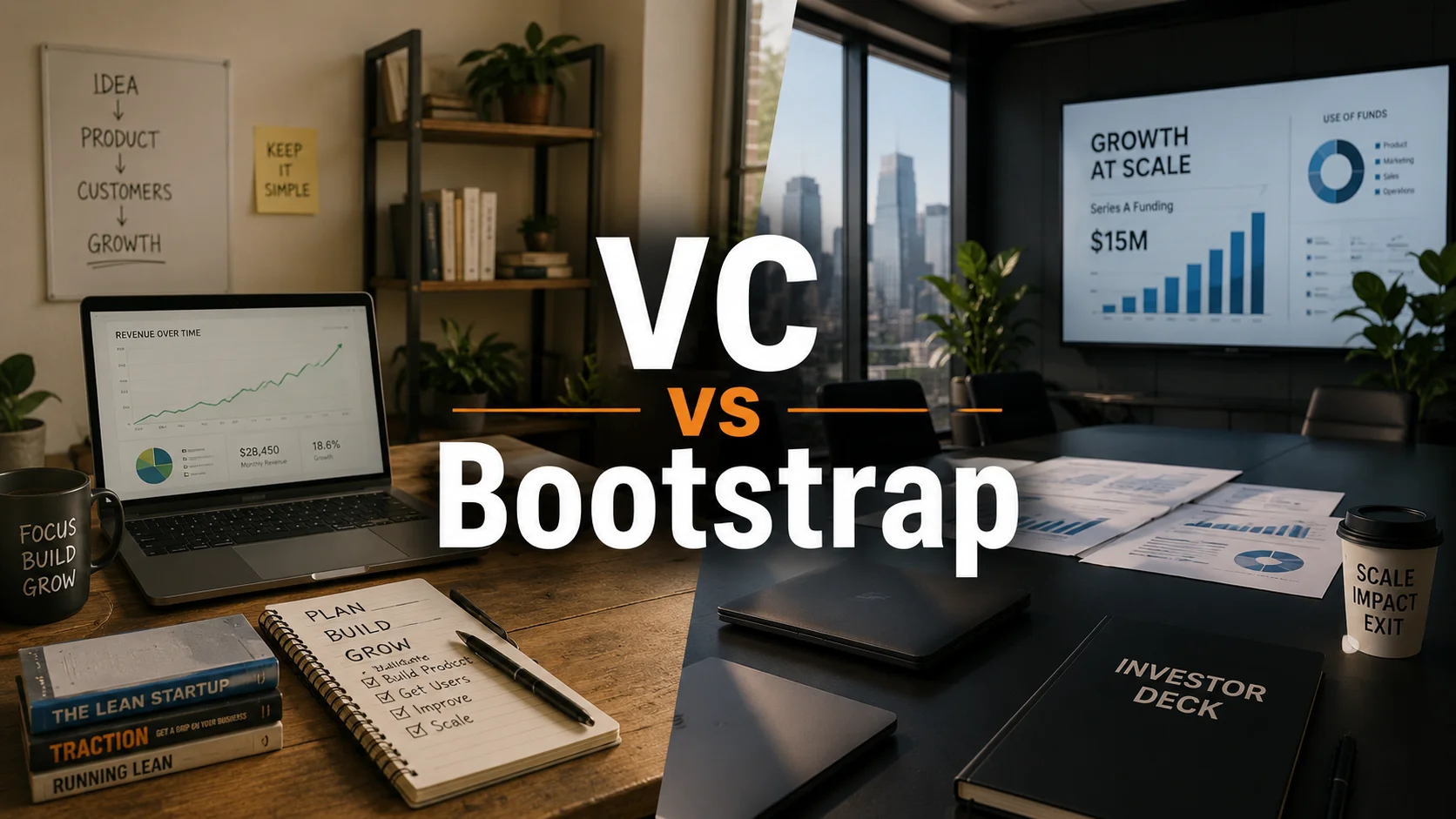
The question of how to fund a startup is not primarily a financial question. It is a question about what kind of company you want to build, how much control you want to keep, how much pressure you can operate under, and what your honest assessment of the market opportunity actually is.
Venture capital and bootstrapping are both legitimate paths that have produced great companies. They are also genuinely different in ways that matter long before you reach an exit or a scale milestone. Understanding those differences clearly helps founders choose the path that fits their situation, rather than the one that sounds more impressive.
What You Are Actually Choosing Between
| Dimension | Venture Capital | Bootstrapping |
|---|---|---|
| Capital available | Large, fast | Limited to revenue and personal funds |
| Equity retained | Typically 20-40% diluted per round | 100% until any exit |
| Growth speed expected | Very fast (hockey stick) | Sustainable, revenue-paced |
| Pressure to exit | High (VC funds need exits in 7-10 years) | None |
| Founder control | Reduced by board composition | Full |
| Failure mode | Run out of runway, forced shut down | Slow decline or pivot |
| Success definition | Very large outcome (unicorn or acquisition) | Profitable business at your chosen scale |
The Case for Venture Capital
Venture capital makes sense when three conditions hold simultaneously. The market opportunity is large enough to support a company worth at least 10 to 30 times the investment (VCs need outsized returns to make the fund model work). The business can grow faster with capital than without it, and speed genuinely matters for competitive position. The founding team is willing to accept the constraints that come with institutional investment: board oversight, dilution, and the implicit commitment to pursue a large outcome.
When those conditions hold, VC accelerates things that would otherwise take years. Hiring goes from one person a month to ten. Product development timelines compress. Sales teams can be built before the business has proven revenue. Distribution deals can be bought through strategic partnerships.
The 2024 to 2025 funding environment was significantly tighter than the 2020 to 2021 peak. Valuations corrected sharply, and investors became more selective. In 2026, the market has stabilised but not returned to peak-era generosity. Founders raising now should expect more rigorous due diligence and more conservative valuations than two years ago.
The Honest Costs of Venture Capital
Dilution is the obvious cost and the one founders fixate on. But it is not the most important cost for most founders. The more significant cost is the shift in who the company is ultimately being built for. A VC-backed company has investors whose financial model requires a specific type of outcome within a specific timeframe. That constraint shapes every significant decision.
Many successful founders report that the hardest part of VC-backed building was not the pressure of growth targets, it was the misalignment between what they personally found meaningful and what the board needed the company to do to generate returns.
The failure rate and failure mode also change. A bootstrapped company that stops growing can often become a stable profitable business. A VC-backed company that stops growing typically faces a board that pushes for a sale, a pivot, or a shut down, because standing still costs them their fund’s return.
The Case for Bootstrapping
Bootstrapping is not a second-choice path for founders who could not raise money. Several of the most respected technology companies of the past decade, including Basecamp, Mailchimp (before its Intuit acquisition), Notion (in its early years), and Fastly, either bootstrapped entirely or stayed bootstrapped far longer than the convention suggested.
The core advantage is alignment. Every decision in a bootstrapped company is made by the people who will live with it. There is no investor whose thesis you are proving, no board whose concerns must be managed, no fundraising cycle pulling attention away from the product.
Profitability from early in the life of the business is both a constraint and a discipline. Bootstrapped companies must find paying customers quickly, which means they often discover product-market fit more directly than companies that can survive for years on investment capital without testing their value proposition against real willingness to pay.
When Bootstrapping Becomes the Wrong Choice
Some markets have genuine winner-take-most dynamics where being second is almost as bad as failing. Ride-sharing, food delivery, and social media all showed this pattern. In those markets, moving fast enough to establish network effects before a competitor does requires capital that bootstrapping cannot provide.
Regulatory-heavy industries, including fintech, healthtech, and insurtech, often require significant capital to navigate licensing, compliance, and regulatory approval before generating any revenue. Bootstrapping through a two-year licensing process is feasible only with very specific financial circumstances.
Enterprise sales with long cycles create cash flow problems for bootstrapped companies. An enterprise customer who takes 18 months to close and pays on 90-day terms after contract signature creates funding gaps that can sink a bootstrapped business even when the product and the pipeline are strong.
A Third Path: Revenue-Based Financing and Alternatives
Revenue-based financing (RBF) has grown significantly as an alternative to both VC and pure bootstrapping. RBF investors provide capital in exchange for a percentage of monthly revenue until a defined repayment multiple is reached. No equity is sold. No board seats are given.
Clearco, Pipe, and Capchase are the major RBF platforms in 2026. The model suits SaaS businesses with predictable MRR and a specific need for growth capital, typically for sales team expansion or marketing spend, that they expect to repay from the incremental revenue generated.
Angel investment, strategic partnerships, and government grants provide other alternative capital sources that sit between the extremes of VC and pure bootstrapping. Many successful companies combine multiple sources across their early years rather than committing exclusively to one model.
Questions to Answer Before Choosing a Path
What is the realistic total addressable market? If the honest answer is £20 million to £50 million, bootstrapping to profitability is a better fit than pursuing VC, which needs outcomes of several hundred million minimum to generate acceptable returns on a fund.
How important is speed to market? If you have six months before a well-funded competitor closes the market, bootstrapping is not the right pace. If you can grow methodically and the competitive dynamics allow it, bootstrapping’s discipline is an advantage.
What does success mean to you personally? Some founders want to build a large company with impact at scale and are willing to give up equity and control to get there. Others want to build a profitable company they own entirely and can run on their own terms. Both are legitimate ambitions. They require different funding strategies.
FAQs
Can I switch from bootstrap to VC later?
Yes, and many successful companies did exactly that. Shopify bootstrapped for several years before raising venture capital. Mailchimp ran entirely on revenue for over a decade before its acquisition. Starting bootstrap and raising VC once you have product-market fit and revenue traction gives you significantly better terms and significantly less dilution than raising on an idea.
How much equity do VCs typically take in a seed round?
Seed rounds in 2026 typically involve 15 to 25% dilution for the founders, depending on the pre-money valuation and the amount raised. At Series A, an additional 20 to 25% dilution is common. Founders who raise multiple rounds before an exit often end up with 15 to 30% of the company at exit.
What do VCs actually look for in 2026?
In the current market, VCs prioritise evidence of product-market fit over vision alone. They look for early revenue traction, strong retention metrics, a clear path to unit economics improvement, and a founding team with specific domain expertise. The days of raising large pre-revenue rounds on a slide deck are largely over for most sectors.
The Decision Framework
If your market is large, speed matters, and you can accept the constraints: raise venture capital. If your market is specific, you can grow profitably, and control matters to you: bootstrap and build a company that serves you as well as it serves its customers.
Either path requires clear eyes about what you are signing up for. The founders who struggle most are the ones who raise VC expecting to keep a bootstrapped company’s autonomy, or bootstrap a winner-take-all market expecting to compete with well-funded rivals.
For more startup strategy, funding mechanics, and founder decision frameworks, WritoryBuzz covers the full range of early-stage company building throughout 2026.