
A January 2026 meta-analysis tested 9 AI detection tools across ChatGPT, DeepSeek, Gemini, and Grok outputs alongside human writing. The results revealed an uncomfortable truth: the best tools achieve impressive headline accuracy on raw AI text, but detection rates drop sharply when content has been lightly edited by a human.
AI content detection has become one of the most scrutinised areas of applied machine learning. Educators use these tools to enforce academic integrity. Publishers use them to verify content authenticity. Employers use them to screen applications. But the tools themselves exist in a fundamental arms race: as AI writing improves, detection becomes harder. As detection improves, AI writing adapts.
Understanding what these tools actually measure, where they fail, and what they can and cannot prove is essential for anyone relying on them to make consequential decisions.
How AI Detection Tools Work
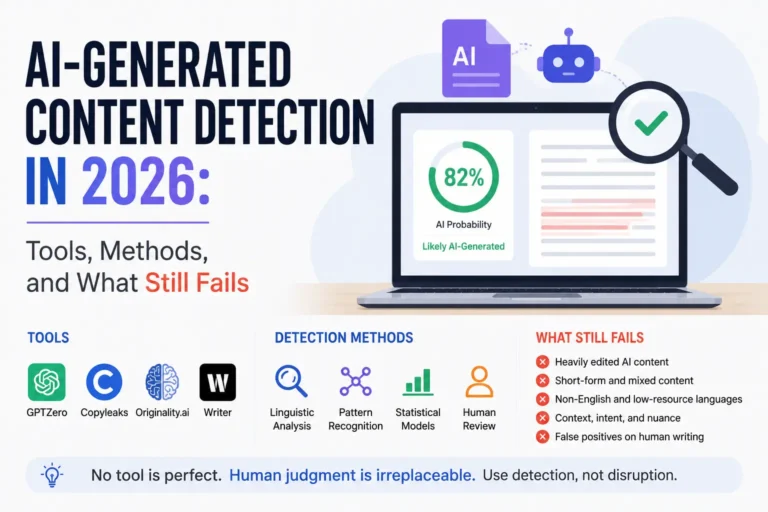
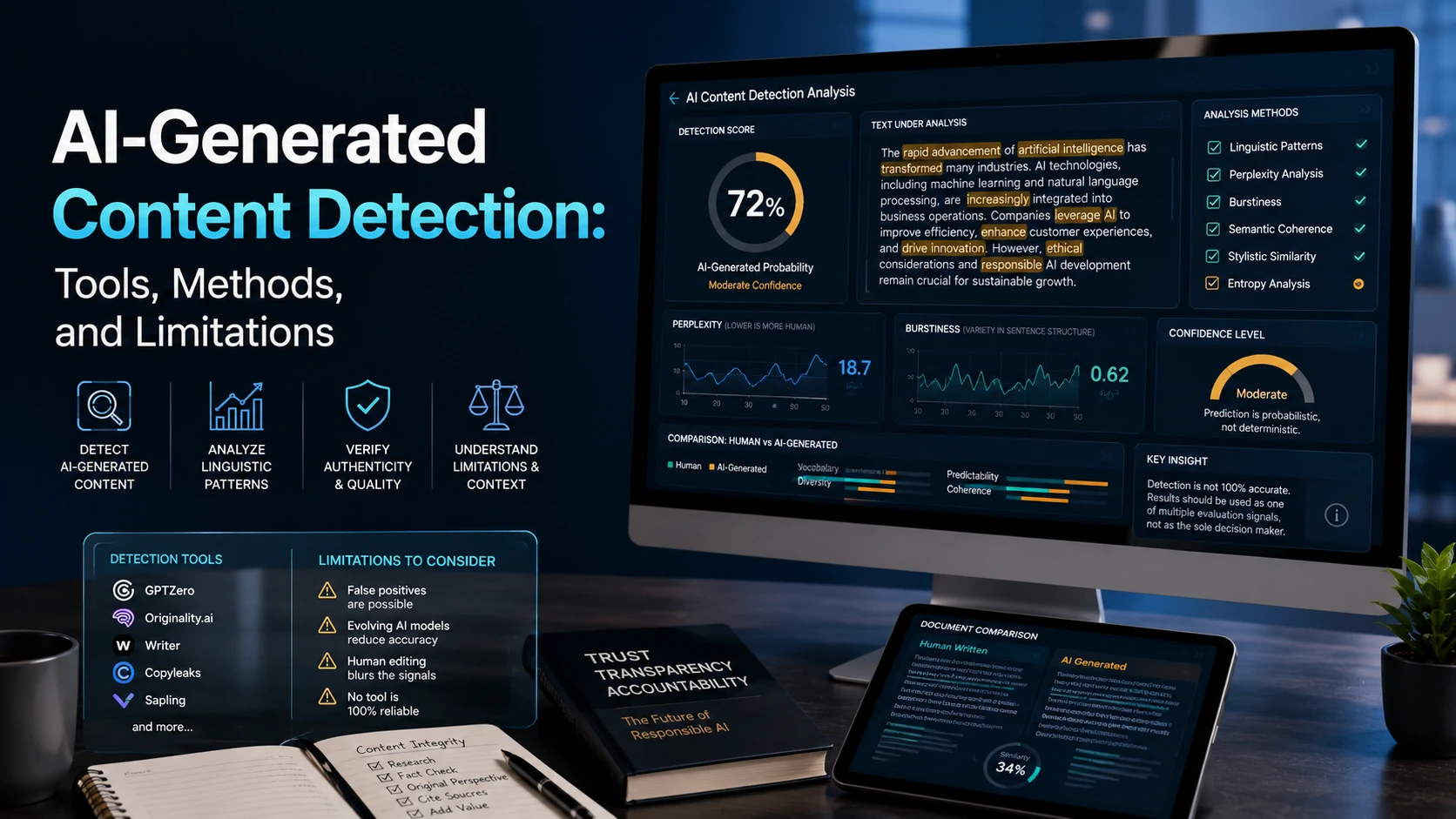
Most AI detection tools use some combination of two core signals: perplexity and burstiness. Perplexity measures how predictable text is. AI-generated text tends to be more predictable than human writing because language models generate statistically likely continuations. Burstiness measures variation in sentence complexity. Human writers naturally alternate between simple and complex sentences. AI writing tends toward more uniform sentence structure.
Modern detectors have expanded beyond these two signals to include semantic pattern analysis, vocabulary distribution, contextual consistency markers, and comparison against training data patterns. Some tools like Turnitin also compare submissions against a database of student papers and published content to identify matches.
The Major Tools: Real Accuracy Numbers
Turnitin
Turnitin serves over 16,000 institutions and processes 280 million papers annually. Its AI detection module claims 98 percent accuracy for essays over 300 words on raw AI-generated text. Independent testing by ProofreaderPro.ai in March 2026 found actual performance of 72 percent overall accuracy across their test set, with performance dropping significantly on humanised text (only 3 of 10 humanised samples scored above the 20 percent threshold).
False positive problem: Turnitin’s false positive rate on human-written academic text reaches up to 18 percent for non-native English speakers. A formal academic writing style, which produces structured, low-variance prose, scores higher for AI probability regardless of actual authorship.
GPTZero
GPTZero serves over 10 million users and was the first widely accessible AI detection tool. It processes essays in 12 to 18 seconds and offers a free tier up to 10,000 words per month. Benchmark accuracy claims reach 99.3 percent on raw AI text. Independent testing found it caught 10 of 10 pure AI texts but also flagged 4 human-written texts and 5 non-native English texts as predominantly AI-generated, producing a false positive rate of 12 percent in the test set.
Copyleaks
Copyleaks supports over 100 languages and claims a false positive rate of 0.03 percent, the lowest of major detection tools. It correctly identified 8 of 10 AI texts in independent testing but caught only 4 of 10 humanised samples, making it the best performer against humanisation but still missing more than half of edited AI content.
Originality.ai
The January 2026 Journal of Advances in Information Technology study evaluated 9 detection tools across 4 LLMs and human text. Originality.ai achieved what the study described as perfect accuracy across all test conditions. This is a strong result, though the study was partially funded by the tool’s developer. Independent verification of this claim across diverse text samples remains limited.
| Tool | Claimed Accuracy | False Positive Rate | Humanised Text Detection | Best For |
| Turnitin | 98% (300+ words) | Up to 18% (non-native English) | Low (3/10 in tests) | Institutional deployment, plagiarism context |
| GPTZero | 99.3% | ~12% in tests | Moderate | Fast screening, education |
| Copyleaks | High | 0.03% (claimed) | Best (4/10 in tests) | Multilingual, diverse populations |
| Originality.ai | 100% (2026 study) | Low (claimed) | Not independently tested | Content publishing, SEO |
| ZeroGPT | 80-85% | Higher | Low | Zero-cost quick checks |
The Core Problem: Humanised Text Bypasses Detection
The most significant limitation of all current AI detection tools is consistent and well-documented: lightly edited AI text routinely evades detection. When AI-generated text is paraphrased, restructured, or mixed with human writing, detection rates fall dramatically across all tools. This is not an edge case. It is the standard workflow for anyone deliberately attempting to pass AI content as human-written.
This creates an asymmetry that undermines the use of these tools for high-stakes decisions. Tools perform well on naive, unedited AI output. They perform poorly on the kind of AI-assisted writing that represents most real-world use.
The False Positive Problem and Its Consequences
A false positive in AI detection means human-written work is incorrectly flagged as AI-generated. The consequences for the wrongly accused are serious: academic penalties, failed applications, damaged professional reputation. Several documented cases exist of students and academics being penalised for work they wrote themselves.
The populations most affected by false positives are consistently non-native English speakers, writers with highly structured and formal styles, and writers whose work closely matches common patterns in professional or academic writing. These groups overlap substantially with international students and early-career researchers, making the equity implications of AI detection policies significant.
| What AI Detection Tools Cannot Prove
No AI detection tool can prove that a specific human wrote or did not write a piece of text. They produce probability scores based on stylistic features. A high AI probability score means the text has characteristics associated with AI writing. It does not mean AI wrote it. Courts, academic institutions, and employers making consequential decisions based solely on detection tool scores are relying on evidence that is probabilistic, context-blind, and known to produce significant error rates. |
The Right Way to Use These Tools
- Use them as screening signals, not as proof. A high AI probability score warrants further investigation, not automatic penalty.
- Always combine tool output with human assessment. A teacher who knows a student’s writing history has more useful signal than any detection tool.
- Apply higher skepticism to flagged results from non-native English writers. The false positive rate for this group is disproportionately high.
- Do not rely on a single tool. Different tools use different methods and produce different results on the same text. Consistent flags across multiple tools carry more weight.
- Consider the detection tool’s limitations when setting institutional policies. Policies with serious consequences should require more than a tool score.
How accurate are AI detection tools in 2026?
Accuracy varies significantly by tool and text type. On raw, unedited AI text, major tools achieve 72 to 99 percent accuracy in independent testing. On humanised or lightly edited AI text, detection rates drop to 40 to 60 percent across most tools. False positive rates range from 0.03 percent (Copyleaks claimed) to 18 percent for non-native English speakers (Turnitin).
Can AI detection tools be fooled?
Yes, consistently. Lightly paraphrasing AI text, restructuring sentences, or mixing AI and human writing significantly reduces detection rates across all major tools. Detection rates on humanised text average 40 to 60 percent in independent tests. This is well-documented and represents the most significant limitation of current tools.
What is a false positive in AI detection?
A false positive occurs when a detection tool classifies human-written text as AI-generated. False positive rates are highest for non-native English speakers, formally structured academic writing, and text following patterns common in professional writing. False positives can have serious consequences for wrongly flagged individuals.
Which AI detection tool is most accurate in 2026?
According to a January 2026 study in the Journal of Advances in Information Technology, Originality.ai achieved perfect accuracy across all tested LLMs and human text samples. Copyleaks has the lowest reported false positive rate. GPTZero has the highest recall on raw AI text. Independent verification of extreme accuracy claims remains limited.
Should schools use AI detection to catch student cheating?
With significant caution. AI detection tools can identify likely AI text but cannot prove authorship. High false positive rates for non-native speakers create equity concerns. The most effective approach combines tool signals with teacher knowledge of individual student work and focuses on process assessment (drafts, discussions, documented research) alongside final product evaluation.
What does perplexity measure in AI text detection?
Perplexity measures how predictable or surprising text is at the word and sentence level. AI-generated text tends to produce statistically probable continuations, resulting in lower perplexity scores. Human writing introduces more unexpected word choices and structural variation. AI detectors use low perplexity as one signal indicating possible AI generation.
A Tool That Supplements, Not Replaces, Judgment
AI content detection tools are useful screening instruments. They are not evidence in the judicial or academic sense. The most responsible use treats their output as one input among several, always combined with human review, contextual knowledge, and a commitment to not penalising individuals based on probabilistic scores alone.