
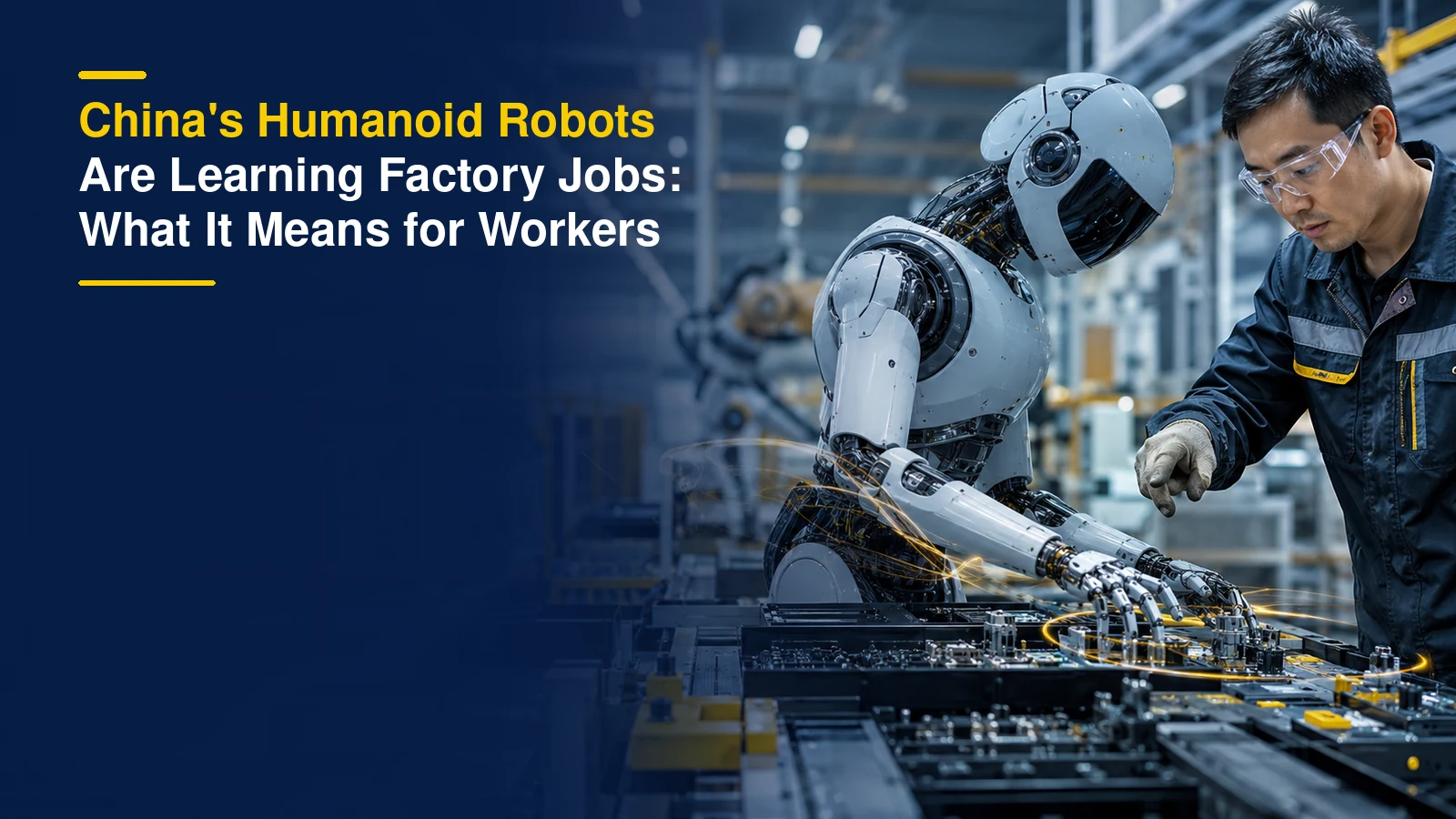
China’s Ministry of Industry and Information Technology has set a target of deploying humanoid robots at 10,000-unit scale by the end of 2026, moving the technology from laboratory testing into real factory operation. In Zhejiang province, a training facility launched in mid-May now runs 40 embodied AI robots through simulated scenarios drawn from nine local industries, including home appliances, automobiles and textiles, generating an average of more than 90 hours of training data per robot. In Guangxi, 11 UBTech Walker S1 robots are interning at a Dongfeng Liuzhou Motor factory, sorting parts and moving bins under human supervision.
The industry widely regards 2026 as the year humanoid robots move from prototype to production. China had more than 140 humanoid-robot manufacturers and over 330 distinct robot models by 2025, according to the Ministry of Industry and Information Technology, and a new production line developed by Leju Robotics and Dongfang Precision in Guangdong can now build up to 10,000 humanoid robots a year. This explainer covers how the training works, where robots are already on factory floors, and what it means for the workers alongside them.
How China Is Training Humanoid Robots for Factory Work
The core bottleneck is not hardware but data. Robots need enormous volumes of real-world movement data to learn tasks reliably, which is why China has built dedicated training centers rather than relying purely on simulation. At a facility in Jinan, Shandong, dozens of humanoid robots mimic human engineers by carrying trays, folding clothes and fetching bottled water from shelves as part of training across 11 categories of application scenarios, from factory logistics to home care.
Instructors guide the robots through repeated actions using cameras, controllers and motion capture. In Beijing, technology consultant Kenneth Ren described the process to CNBC as teaching robots to think on their own, starting with fully manual control before the robot’s own generated movement data lets it perform tasks independently. The work is repetitive by design, since consistency across thousands of repetitions is what produces usable training data.
Where Humanoid Robots Are Already Working in China
Aitu, an intelligent sewing technology company based in Zhejiang, has deployed robots at garment manufacturers including Sunrise Group, Eifini and Chenfeng Group, where they load and unload fabric at template sewing machines, position material for pocket setters, and pick and place cut pieces at fusing press machines. In Guangzhou, a humanoid robot now sorts parcels at the Jianggao logistics site under China Post Group, while a separate high-capacity production line in Guangdong, built through a partnership between Leju Robotics and Dongfang Precision, integrates 24 precision assembly stages and 77 inspection checkpoints to manufacture the robots themselves.
Jobs Lost, Jobs Created: The Labor Question
Factory operators cite labor shortages as a primary driver of adoption. One manager told Xinhua that factories cannot recruit enough people or persuade them to stay in physically demanding, repetitive roles. Xiong Rong, chief scientist at the Zhejiang Humanoid Robot Innovation Center and a professor at Zhejiang University, argues that wider robot use will also create jobs in maintenance, debugging and secondary development, categories that barely existed five years ago.
The current reality is closer to human-robot collaboration than full automation. At Dongfeng Liuzhou Motor, general manager Lin Changbo described the robots as still apprentices, expecting them to improve efficiency and take on physically demanding or high-risk tasks over time rather than replace the workforce immediately. That collaborative framing is likely to persist through 2026, since even the most advanced humanoid systems still rely on human instructors to correct errors and validate new tasks before deployment.
The Race to Mass Production
China’s push is part of a broader industrial strategy. The country’s recommendations for the 15th Five-Year Plan, covering 2026 to 2030, name embodied AI as a priority future industry intended to generate new economic growth engines. Government analysts told Rest of World that local officials are being pushed by Beijing to provide tangible, on-the-ground support to robotics companies, with some of the largest current orders for humanoid robots coming from the public sector rather than private manufacturers.