
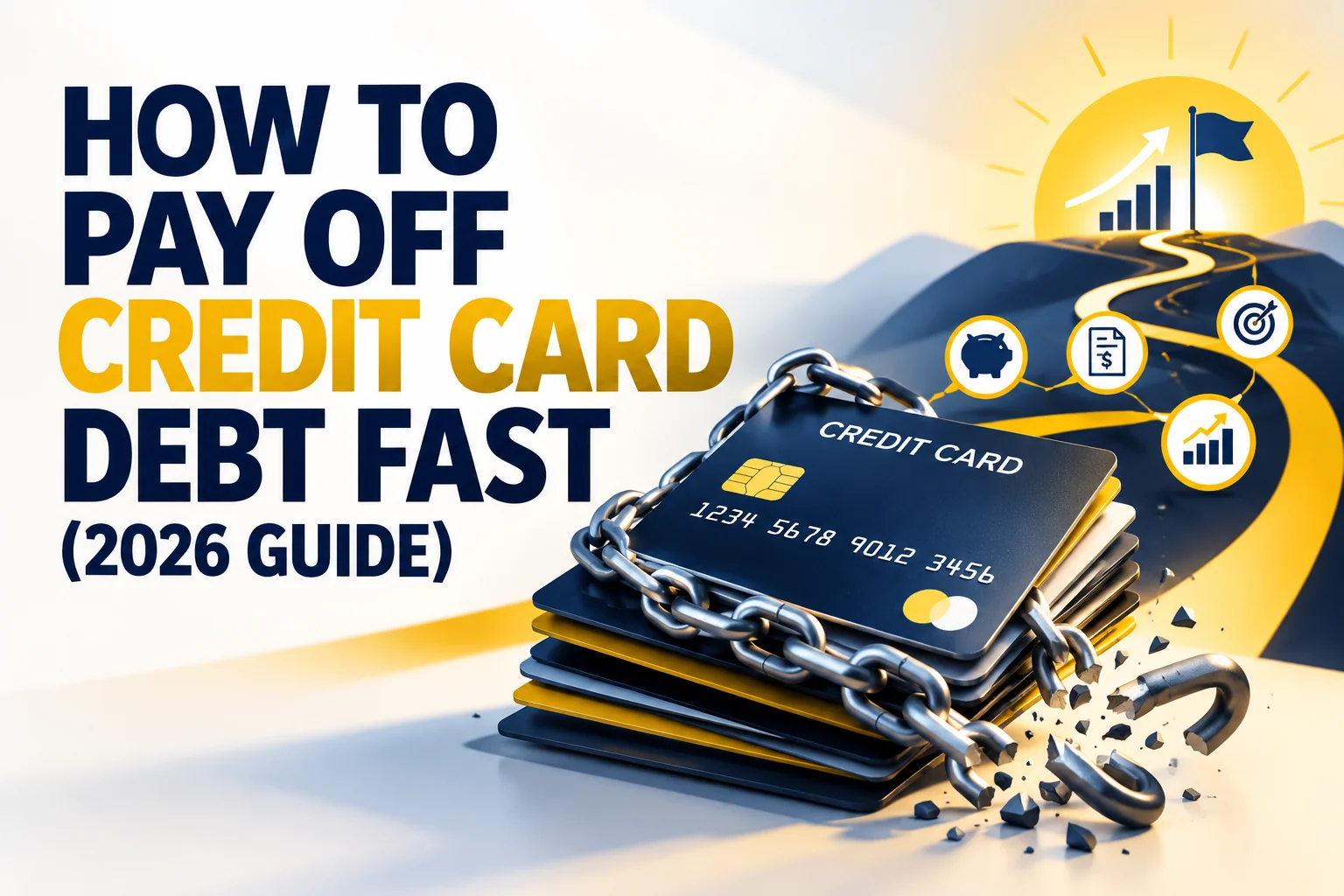
US credit card debt reached 1.26 trillion US dollars in the second quarter of 2026, according to Federal Reserve Bank of New York household debt data, with the average cardholder carrying a balance of roughly 6,610 dollars. Average credit card APRs have stayed above 20 percent through 2026, meaning a cardholder making only minimum payments on a 6,610 dollar balance can pay more in interest over several years than the original purchases cost. Most payoff guides stop at the debt snowball versus debt avalanche comparison and dismiss balance transfer cards, issuer negotiation, and nonprofit credit counseling as side notes rather than genuine tools, leaving readers without a complete picture of what is actually available. This guide covers the full toolkit: which payoff method clears debt fastest, when a 0 percent APR balance transfer genuinely helps instead of just moving the problem, how to negotiate directly with a card issuer, and when nonprofit credit counseling or a hardship program is the right call rather than a last resort.
Why Credit Card Debt Is Harder to Escape in 2026
Average credit card APRs sitting above 20 percent as of 2026 mean that roughly a fifth of a cardholder’s balance effectively regenerates as interest every year if payments do not consistently exceed that rate of growth, a dynamic that makes minimum-payment-only strategies mathematically close to standing still. A 6,610 dollar balance at 20 percent APR accrues over 1,300 dollars in interest annually before a single dollar of principal moves, which is why the specific payoff method chosen, and the size of the extra payment above the minimum, matters more for credit card debt than for most other debt types.
Debt Snowball vs. Debt Avalanche: Which Clears Credit Cards Faster
The debt snowball method lists balances from smallest to largest, pays minimums on everything except the smallest, and throws all extra money at that smallest balance until it is gone, then rolls the freed-up payment into the next smallest. The debt avalanche method instead targets the highest-interest-rate balance first regardless of its size, which minimizes total interest paid in pure mathematical terms. Comparative analysis from Experian using a mixed-debt scenario found the snowball method cleared debt in 25 months with 2,251 dollars in interest savings, against 26 months and 2,213 dollars for the avalanche method, a near-identical result that undercuts the common assumption that avalanche always wins decisively.
Debt Snowball vs. Debt Avalanche: Side-by-Side
| Factor | Debt Snowball | Debt Avalanche |
|---|---|---|
| Payoff order | Smallest balance first | Highest interest rate first |
| Best for | Motivation, early visible wins | Minimizing total interest paid |
| Typical interest cost | Slightly higher in most cases | Slightly lower in most cases |
| Where it tends to fail | Rarely abandoned mid-plan | Often abandoned when the largest balance takes months to show progress |
The practical difference between the two methods is usually small in dollar terms but large in follow-through, since the snowball method’s early wins keep a payoff plan on track longer than the avalanche method’s more abstract interest savings. Cardholders who have stuck with a budget before and do not need the motivational boost tend to do marginally better with avalanche; those who have abandoned a payoff plan before are consistently better served by snowball’s faster early progress.
Balance Transfer Cards: When the 0 Percent APR Window Actually Helps
Many payoff guides dismiss balance transfer cards outright on the reasoning that they move debt rather than eliminate it, but this skips the specific math that determines whether a transfer genuinely helps. A 0 percent introductory APR balance transfer, typically offered for 12 to 21 months with a transfer fee of 3 to 5 percent of the balance, pauses interest accrual entirely for that window, meaning every payment made during it goes directly to principal rather than partly to interest. A 6,610 dollar balance moved to an 18-month 0 percent card with a 4 percent transfer fee costs roughly 264 dollars upfront but saves well over 2,000 dollars in interest compared to staying at 20 percent APR for the same period, provided the full balance is paid off before the promotional window closes.
The transfer only helps when the cardholder has a realistic plan to clear the balance within the promotional window, since the APR on an unpaid remainder typically jumps to a standard rate at or above the original card once the introductory period ends. Calculating the required monthly payment before applying, balance divided by the number of promotional months, confirms whether the transfer is a genuine accelerant or just a temporary pause that delays the same problem.
How to Negotiate a Lower APR With Your Card Issuer
Calling a card issuer directly to request a lower APR is a tactic most payoff guides skip entirely, despite consistently producing results for cardholders with a history of on-time payments, since issuers would rather reduce a rate than lose a customer to a competitor’s balance transfer offer. Framing the call around a specific lower-rate offer from a competing card, and a clear statement of intent to transfer the balance if the rate is not adjusted, meaningfully improves the odds of a successful negotiation compared to a general request. Even a 3 to 5 percentage point reduction, sustained over a multi-year payoff timeline, can save hundreds of dollars without requiring a balance transfer, a fee, or a new account at all.
Nonprofit Credit Counseling and Hardship Programs: When to Use Them
Nonprofit credit counseling agencies, typically accredited through the National Foundation for Credit Counseling, can negotiate reduced interest rates and consolidated payment plans directly with card issuers on a cardholder’s behalf, a resource most payoff guides mention only in passing or skip to avoid alongside debt settlement companies, despite being a fundamentally different and reputable service. A debt management plan arranged through accredited nonprofit counseling typically reduces APRs to single digits across all enrolled cards and consolidates payments into one monthly amount, though it usually requires closing the accounts involved. Card issuer hardship programs, offered directly by the bank during documented financial difficulty, a job loss or medical emergency specifically, can also temporarily reduce rates or pause payments without the credit impact of a formal debt management plan, making a direct call to the issuer worth trying before enrolling in third-party counseling.
Finding the Extra Payment: Where the Money Actually Comes From
The single biggest factor in how fast any payoff method clears a balance is the size of the extra payment above the minimum, which means the search for that extra money matters as much as which method is chosen. WritoryBuzz’s guide to saving $10,000 in 6 months breaks down concrete ways to free up 200 to 600 dollars monthly without a second job, money that goes directly to accelerating a credit card payoff when applied consistently. A couple planning a wedding while also carrying credit card debt should generally prioritize the debt first, since wedding costs are discretionary and credit card interest compounds in the meantime, a sequencing question covered in more detail in WritoryBuzz’s guide to saving money on a wedding without it looking cut-rate to guests.