

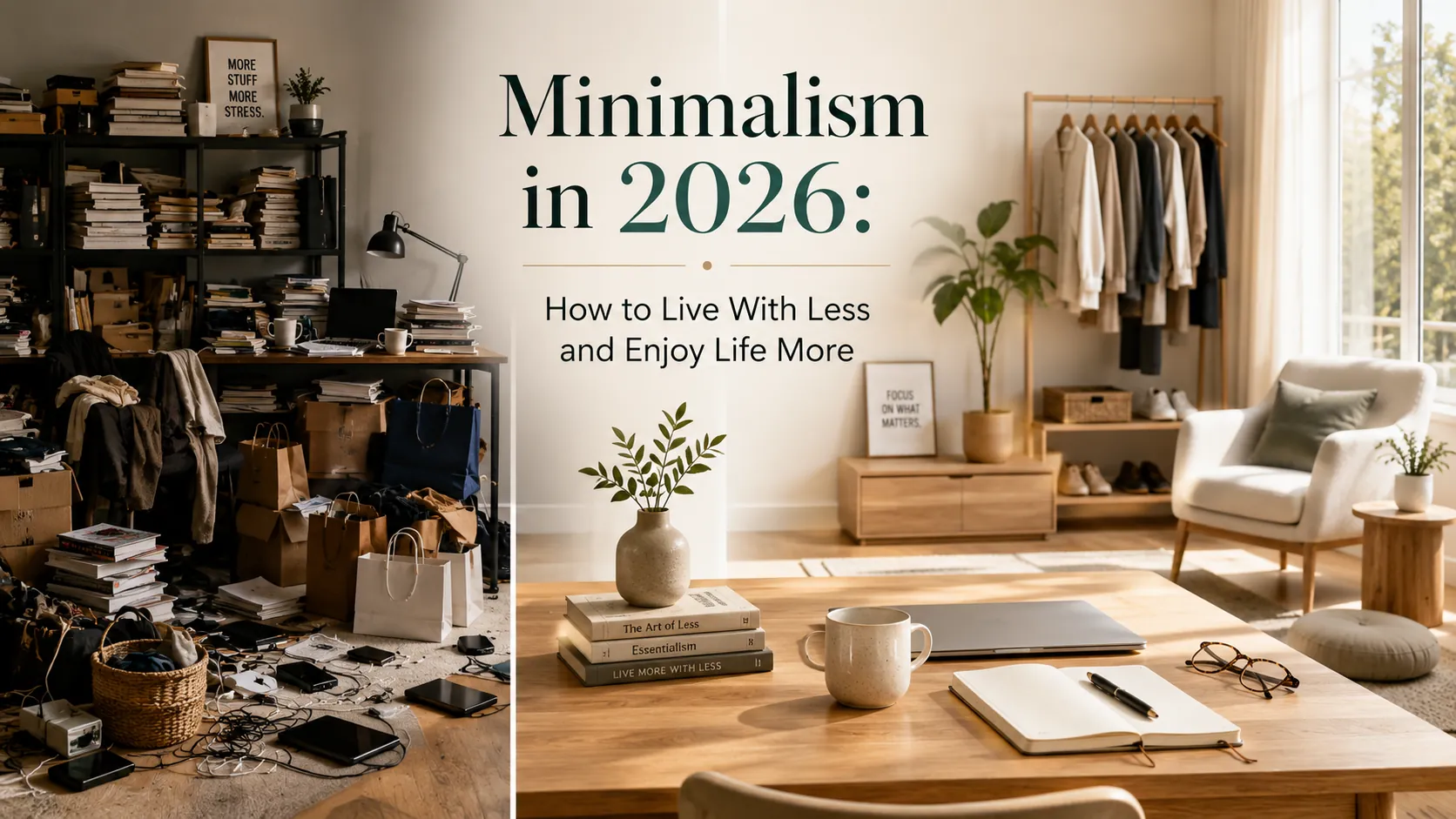
Minimalism has a branding problem. The word conjures bare white rooms, capsule wardrobes of identical grey t-shirts, and a certain austere aesthetic that most people correctly identify as not what they want from their home or life. The functional version of minimalism is quite different and considerably more useful.
Minimalism as a practice is not about owning fewer things as an end in itself. It is about reducing the volume of decisions, objects, and commitments that demand cognitive and emotional attention so that the things that genuinely matter receive more of both.
The 2026 context adds a digital dimension that the original minimalism writing of the 2010s could not fully address. The attention demands of constant notification, infinite scroll, and always-available entertainment have created a new category of clutter that is harder to see than physical objects and considerably more difficult to address.
Why Minimalism Produces Wellbeing (The Research Behind It)
Decision fatigue is well-documented in psychology research. The quality of decisions deteriorates after a sufficient number of choices have been made, regardless of the stakes involved. Barack Obama famously described his practice of wearing only grey or blue suits to reduce daily decision-making load. The mechanism is real: every trivial decision draws from the same cognitive resource pool as important ones.
Physical environment research consistently shows that cluttered environments elevate cortisol, reduce focus, and increase anxiety. A study from Princeton Neuroscience Institute found that physical clutter competes for attention with whatever task you are trying to perform, reducing working memory capacity and increasing cognitive load. This is not a style preference. It is a cognitive performance finding.
Barry Schwartz’s paradox of choice demonstrates that beyond a threshold, more options produce less satisfaction, more anxiety about choosing incorrectly, and greater regret after decisions are made. Simplifying the available choices in domains from clothing to food produces measurably better decision outcomes and higher satisfaction.
Physical Minimalism: Where to Actually Start
The minimalism literature consistently fails beginners by starting with clothing, which is an emotionally loaded category for most people, rather than the easiest starting category.
Start with duplicates: Identify anything you have multiple of that serves the same purpose. Five spatulas, three can openers, twelve mismatched cups, four sets of bedsheets you rotate through. Keeping the best two of each, or one of the most useful, removes friction without requiring any difficult decisions about sentiment or identity.
The expiry rule: Anything that has an expiry date that has passed, anything that has been broken and not used in 12 months despite not being repaired, and anything that has not been used in two years regardless of condition, is a reasonable default for removal from a home without the emotional processing of intentional decluttering.
The one-in-one-out principle: Before bringing any new object into the home, one existing object in that category leaves. This prevents the gradual re-accumulation that makes decluttering feel cyclical rather than progressive.
Digital Minimalism: The Higher Leverage Version
Cal Newport’s Digital Minimalism framework proposes treating digital tools with the same intentionality applied to physical possessions: use technology that serves your values and eliminate or severely constrain tools that do not, regardless of their incidental value.
Audit your phone’s home screen: Which apps did you open intentionally today? Which opened reflexively? The apps opened reflexively are the ones consuming attention without providing proportional value. Moving them off the home screen to a secondary location is a low-effort change that reduces reflexive opening by 30 to 50 percent in most cases.
Notification audit: Most notifications are not time-sensitive enough to justify the interruption cost. The cognitive recovery time after an interruption is 23 minutes according to Gloria Mark’s research at UC Irvine. Turn off all notifications except those from specific people or truly time-critical applications. The default should be no notifications.
The designated phone-free contexts: Choose two or three regular contexts to be genuinely phone-free: meals, the first 30 minutes after waking, and the hour before sleep are the most evidence-supported choices for improving mood, sleep quality, and real-life presence.
Minimalism for Time: The Commitment Audit
Overcommitment is the time equivalent of clutter. The appropriate response to a new commitment request is not ‘is there room in my schedule?’ but ‘is this important enough to displace what I am already doing?’ The default is often yes, which gradually fills time with obligations that prevent the spaciousness that makes life genuinely good.
The Hell Yes or No filter: Derek Sivers’ framework suggests that any commitment that is not an enthusiastic yes should be treated as a no. This sounds extreme but corrects for the systematic underweighting of future time cost that makes most people consistently overcommit.
Protect unstructured time deliberately: Creativity, genuine rest, and the experiences that produce the most life satisfaction consistently require unscheduled time. Paradoxically, this is the first category eliminated when calendars fill up. Blocking unstructured time in the calendar is the only way to preserve it.
What Minimalism Is Not
Minimalism is not deprivation, aesthetic constraint, or a moral stance about consumption. It is not about having fewer possessions than your neighbours, or about the visual appearance of your home. A person who owns 400 books in their favourite category, reads widely, and has removed the dead weight from every other area of their life is practicing minimalism more authentically than a person with bare shelves and 45 identical white garments.
The question minimalism asks of every object, commitment, and digital tool is the same: does this genuinely serve what I care about, or is it just taking up space, time, and attention? The answer to that question, applied consistently, is what the practice actually is.
What is minimalism and what is it not?
Minimalism as a practice is intentionally reducing objects, commitments, and digital inputs to those that genuinely serve your values and goals. It is not an aesthetic of bare white spaces or a moral stance on consumption. The measure of minimalism is whether your physical, digital, and time environments support the life you want.
Where should you start with minimalism?
Start with the easiest, lowest-emotional-investment category: duplicate functional items and things you know are unused or expired. Avoid starting with sentimental items or clothing. Getting the early wins from obvious clutter removal builds the habit and the skill before tackling emotionally complex possessions.
Does minimalism actually improve wellbeing?
Research supports the wellbeing benefits of reduced physical clutter (lower cortisol, better focus), simplified choice environments (better decision quality, less regret), and reduced notification exposure (lower anxiety, better presence). The wellbeing benefits are most pronounced when minimalism reduces genuine friction in areas of daily life rather than being applied as an aesthetic constraint.
What is digital minimalism?
Digital minimalism, popularised by Cal Newport, applies minimalist principles to technology use: intentionally using only the digital tools that genuinely serve your values and eliminating or severely constraining those that do not, regardless of their occasional value. The primary targets are social media applications, notification volume, and reflexive smartphone use.
How do you maintain minimalism once you have decluttered?
The one-in-one-out principle prevents re-accumulation: before any new object enters the home, an existing object in that category leaves. Regular seasonal reviews (twice yearly) identify objects that have become unused since the last review. The digital equivalent is quarterly app and subscription audits.
Can you be a minimalist with children?
Yes, with adjusted standards. Children’s spaces accumulate objects rapidly and children have legitimate developmental needs for more tactile variety than minimalist adults. Age-appropriate toy rotation (keeping some toys stored and rotating monthly) produces more engaged play and less overwhelm than having all toys available simultaneously. Adult spaces within the home can maintain minimalist principles regardless of children’s spaces.
The Point Is More, Not Less
The confusion about minimalism comes from focusing on the subtraction rather than what the subtraction creates. Removing the things that do not matter is not the goal. The goal is more time, attention, and resources for the things that do.
Start small. Pick one category. Apply the question: does this serve what I actually care about? The answers are usually clearer than people expect, and the relief that follows acting on them is immediate.