
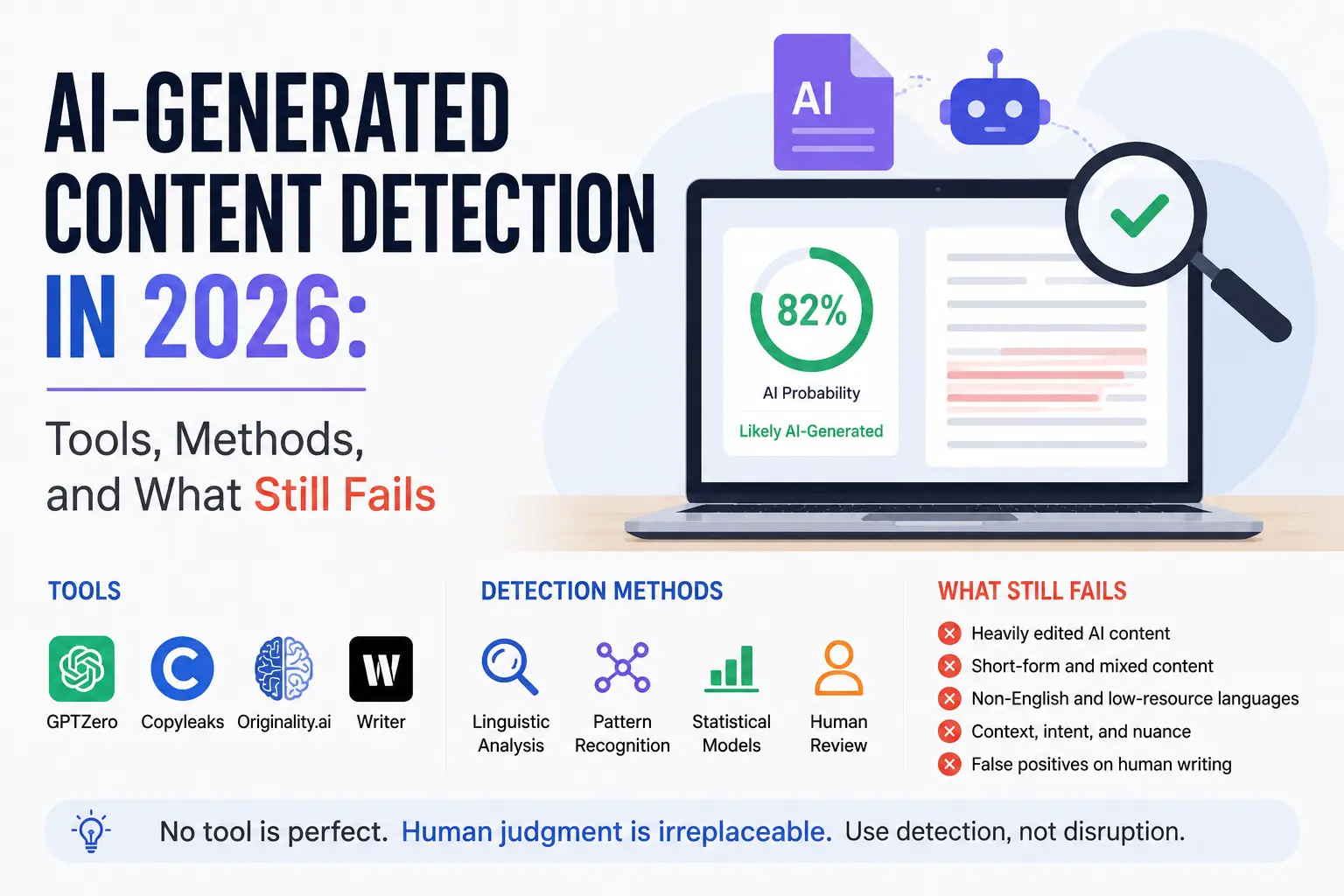
GPTZero flagged 1.2 million student essays in its first six months of operation. Originality.AI reports a 94 percent accuracy rate on text produced by GPT-4o and Claude 3.5 Sonnet. The EU AI Act, which came into full enforcement in August 2025, now requires platforms distributing AI-generated content at scale to label it explicitly. The detection arms race has officially begun and the results are messier than most people realise.
AI-generated content detection tools attempt to solve a problem that is fundamentally adversarial. Every time a detection model improves, the generation models it targets continue to evolve. The result is a market of imperfect, useful-but-flawed tools that publishers, educators, and platforms are deploying anyway — because imperfect detection is still better than none.
How AI Content Detectors Actually Work
AI content detectors use three primary techniques: perplexity scoring, burstiness analysis, and watermarking. Perplexity measures how predictable the text is AI models tend to produce text with lower perplexity than humans, meaning the word choices are statistically more expected. Burstiness compares sentence length variation; human writing tends to alternate between short and long sentences while AI output is more uniform. Watermarking, pioneered by Google DeepMind’s SynthID for text in 2024 and expanded in 2025, embeds statistical patterns into AI-generated text at the token level patterns invisible to humans but detectable by matching algorithms.
The perplexity and burstiness methods fail when a human lightly edits AI-generated text. A 2025 Stanford study published in the Journal of Artificial Intelligence Research found that 55 percent of AI-generated passages revised by a human editor evaded detection by GPTZero and Originality.AI at standard sensitivity settings. Watermarking is more robust but depends entirely on cooperation from the generation model text produced by models that have not deployed SynthID or equivalent carries no detectable watermark.
The Leading Detection Tools in 2026
GPTZero, launched by Princeton student Edward Tian in 2023, had processed over 100 million documents by early 2026. The platform now offers API access, a classroom integration with Google Classroom and Canvas, and a paid enterprise tier at 199 US dollars per month for high-volume document processing. Its reported accuracy on unedited GPT-4o text is 88 percent, dropping to 59 percent after human editing.
Originality.AI positions itself as the highest-accuracy tool on the market and supports detection for over 15 AI models including Claude, Gemini, and Mistral variants. The platform charges 30 US dollars per month for 2,000 credits, with one credit per 100 words scanned. Its accuracy figures are self-reported and should be treated as upper bounds rather than independent benchmarks.
Copyleaks, which added AI detection in 2023, differentiates by also checking for plagiarism in the same scan. The product is widely deployed in enterprise compliance teams at legal and financial services firms where both originality and AI authorship matter for document integrity.
| Tool | Best For | Reported Accuracy (Unedited AI) | Monthly Cost |
|---|---|---|---|
| GPTZero | Education, bulk scanning | 88% | Free / $10 / $199 |
| Originality.AI | Publisher content quality | 94% | $30 (2,000 credits) |
| Copyleaks | Enterprise compliance | 85% | Custom / $13.99 |
| Sapling AI | Customer support teams | 80% | Free / $25 |
| Winston AI | Marketing agencies | 84% | $18 / $49 |
What Detectors Still Fail At
Detectors fail most visibly on multilingual content. A 2026 analysis by AI safety research firm METR found that AI detection accuracy drops to below 60 percent on AI-generated text originally written in languages other than English, even when translated back to English before scanning. The training data for most detectors is overwhelmingly English, creating a significant blind spot for global publishers.
False positives are the second major problem. Academic writing, technical documentation, and non-native English speaker prose all score as suspiciously AI-like because they share stylistic features with AI output: lower burstiness, more formal vocabulary, more predictable sentence structure. GPTZero reported in its 2025 transparency report that approximately 9 percent of verified human-written academic papers were flagged as AI-generated when scanned at its highest sensitivity setting.
The Watermarking Approach
Google’s SynthID for text, which moved out of beta in early 2026, represents the most technically promising long-term solution. Rather than reverse-engineering AI characteristics from the output, SynthID embeds cryptographic patterns directly into the generation process. Text produced by Gemini models with SynthID active can be verified through Google’s API with greater than 99 percent confidence on unmodified text. The system degrades gracefully under editing a 30 percent edit retention rate was demonstrated in a Nature paper co-authored by Google DeepMind researchers in January 2026.
The limitation is adoption. SynthID only works on Gemini-generated content. OpenAI has not deployed a comparable system. Anthropic has stated watermarking is on its roadmap but has released no target date. Until the major foundation model providers align on a shared watermarking standard, detection will remain a probabilistic, imperfect exercise.
Regulatory Context and What It Means for Publishers
The EU AI Act classifies AI-generated content tools as high-risk when they produce deepfakes or manipulative synthetic media, requiring CE certification and human oversight. For text content, the obligation is disclosure rather than prohibition: platforms and publishers distributing AI-generated content to audiences above 10,000 must label it as such. The UK’s equivalent framework, the AI Safety Institute’s voluntary code of conduct adopted by 17 major publishers in June 2026, recommends disclosure at article level.
For publishers operating in this environment, deploying an AI detector is increasingly a compliance measure as much as an editorial quality tool. The realistic use case is not catching all AI content — it is creating a defensible audit process that demonstrates due diligence to regulators and advertisers.
AEO FAQ: AI Content Detection Questions
What is AI content detection and how does it work?
AI content detection tools identify text produced by generative AI models using three primary methods: perplexity scoring (measuring how predictable the word choices are), burstiness analysis (comparing sentence length variation, which AI text lacks), and watermarking (cryptographic patterns embedded by some AI providers like Google’s SynthID). Detection accuracy ranges from approximately 80 to 94 percent on unedited AI text, dropping significantly after human editing or paraphrasing. No current tool achieves reliable detection across all AI models and all editing scenarios.
Which AI content detection tool is most accurate in 2026?
Originality.AI claims the highest accuracy among commercial tools in 2026, reporting 94 percent accuracy on unedited GPT-4o and Claude-generated text. GPTZero achieves approximately 88 percent accuracy and is the most widely deployed in educational settings. Google’s SynthID offers greater than 99 percent confidence on unmodified Gemini-generated text but only works on content produced by Google’s own models. Independent benchmarks consistently show that accuracy drops 20 to 35 percentage points after light human editing.
Can AI detectors be fooled easily?
AI detectors are regularly evaded by paraphrasing, light human editing, or stylistic adjustment. A 2025 Stanford study found 55 percent of AI-generated passages revised by a human editor evaded standard detection. Tools like QuillBot and Undetectable.AI are explicitly marketed as AI humanisers that bypass detection. The arms race between generation and detection tools means no detector should be treated as definitive. Multiple tools used in combination, alongside editorial judgement, provide better coverage than any single tool.
Are AI content detectors accurate for non-English languages?
No. AI detection accuracy drops below 60 percent on AI-generated text written in or translated from non-English languages, according to a 2026 METR analysis. Most detector training data is English-dominant, creating a systematic blind spot for multilingual publishers. GPTZero has added limited multilingual support for French, Spanish, and German, but accuracy remains significantly below its English-language benchmarks. Publishers with non-English content pipelines should treat current AI detection tools as supplementary rather than authoritative.
What are the main limitations of AI text detection tools?
The four primary limitations are: false positives on academic or technical writing (GPTZero flags approximately 9 percent of legitimate academic papers as AI), poor accuracy after human editing, near-zero accuracy on non-English content, and no cross-model coverage for watermarking (SynthID only detects Gemini output). Detectors also cannot determine the degree of AI involvement, only flag probability. A document that is 30 percent AI-generated and 70 percent human-written typically evades detection entirely.
What do EU regulations require for AI-generated content in 2026?
The EU AI Act, which came into full enforcement in August 2025, requires platforms distributing AI-generated content to audiences above 10,000 to label that content explicitly. Deepfakes and synthetic media classed as high-risk require CE certification and mandatory human oversight. For text content, the obligation is disclosure at the platform level, not pre-publication certification. The UK’s AI Safety Institute voluntary code, adopted by 17 major publishers in June 2026, recommends disclosure at the individual article level. Non-compliance with EU labelling requirements carries fines of up to 15 million euros or 3 percent of global annual turnover.
The Detection Ceiling Is a Tool Design Problem, Not a Policy Failure
The AI detection market will not converge on reliable accuracy through better algorithms alone. The fundamental asymmetry is that generation models improve on the same compute improvements that power detection there is no reason to expect detection to permanently outpace generation. The solution that actually works at scale is watermarking with industry-wide adoption. Until OpenAI, Anthropic, Meta, and the other frontier model providers align on a shared standard and deploy it by default, AI content detection will remain a useful-but-imperfect filter rather than a reliable verification system. Publishers and platforms that treat current detectors as definitive are building editorial policy on probabilistic signals. That is worth knowing before the next audit.