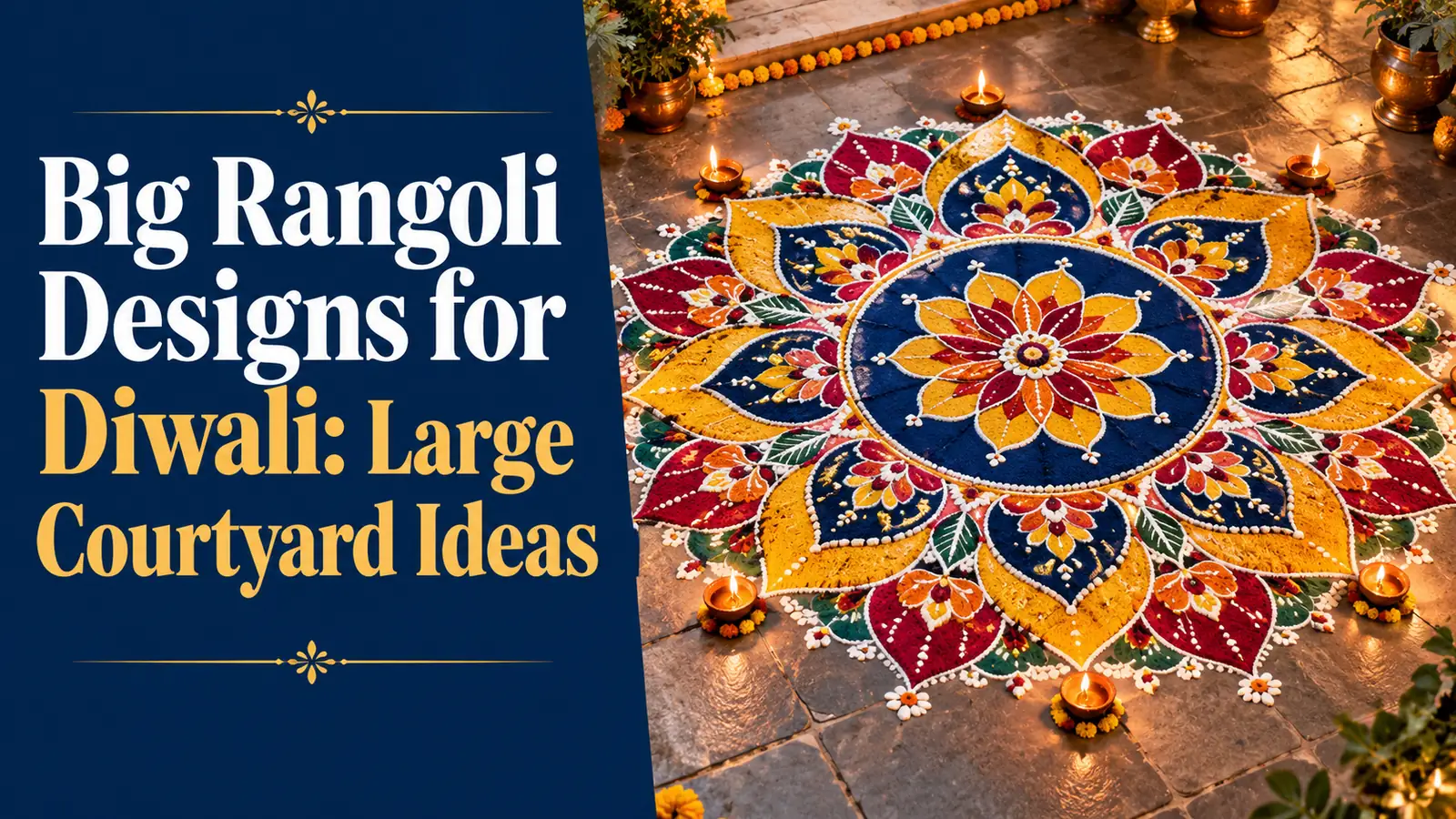
Wikipedia’s entry on kolam notes that in the month of Margazhi, young women show their skill by drawing large kolams, and that some cover the entire width of a road with one big design. That tradition of working at street scale is the best proof that a big rangoli is a matter of method, not talent, and that a courtyard-sized design can be built by following a few simple steps.
This guide gives you big rangoli designs for Diwali, including large courtyard ideas, a method for scaling any pattern, a string-and-chalk way to draw perfect circles, a materials estimate, a team plan, safety tips and ways to protect the design from wind and foot traffic. Diwali falls on Sunday, November 8, 2026, according to Dekho Panchang.
Big Rangoli Designs for Diwali: What Changes at Scale
A big rangoli is not a small one made larger. At courtyard scale, fine detail disappears, and bold shapes, strong outlines and repeated patterns matter more. Wikipedia describes the basic method as marking a centre point and cardinal points and building outward, and that is exactly the method that works for large floors.
| Feature | Small rangoli | Big rangoli |
|---|---|---|
| Detail | Fine lines work | Use bold shapes and thick lines |
| Time | 20 to 40 minutes | 2 to 6 hours with a team |
| Tools | Fingers, cone | String, chalk, tape, cones, scoops |
| Colour | Many small fills | Large blocks of contrasting colour |
| People | One or two | Three to eight, each with a role |
Large Courtyard Rangoli Ideas
The ideas below are chosen because they read well from a distance and can be broken into simple steps. Pick one based on your space and team size.
| # | Design | What it looks like | Team | Level |
|---|---|---|---|---|
| 1 | Giant lotus | Eight to twelve petals around a golden centre | 3 to 5 | Medium |
| 2 | Concentric mandala | Five or six rings of patterns, widening outward | 4 to 6 | Hard |
| 3 | Peacock | Fan-shaped tail with large feather eyes | 4 to 6 | Hard |
| 4 | Sunburst | Radiating triangles in warm colours | 3 to 5 | Medium |
| 5 | Diya circle | Ring of lamps with a central flower | 3 to 6 | Medium |
| 6 | Star in a square | Eight-point star inside a bordered square | 3 to 5 | Medium |
| 7 | Kalash and leaves | Large pot at the centre with leaf sprays | 3 to 5 | Medium |
| 8 | Elephant pair | Two large elephants facing a lotus | 5 to 8 | Hard |
| 9 | Rangoli carpet | Full rectangle of repeated motifs with a border | 6 to 8 | Hard |
| 10 | Floral wreath | Ring of petals in two to three colours | 2 to 4 | Easy |
How to Scale a Rangoli Design
Start on paper with a small grid. Draw your design on graph paper, then decide how large each square will be on the floor. If one square is 2 centimetres on paper and you want it 20 centimetres on the floor, you multiply everything by ten. Mark the floor grid with chalk, then copy the design square by square.
| Step | What to do |
|---|---|
| 1 | Draw the design on graph paper |
| 2 | Choose the floor size and work out the scale |
| 3 | Mark the centre and the four main directions on the floor |
| 4 | Draw the grid lines lightly in chalk |
| 5 | Copy the design square by square |
| 6 | Trace outlines with white flour, then fill colour |
The String-and-Chalk Method for Perfect Circles
Large circles are hard to draw free-hand, but a string and a piece of chalk solve the problem. Fix one end of the string at the centre with a nail or by holding it, tie chalk to the other end and swing it around, keeping the string tight. Change the string length to draw each ring.
| Circle | String length from centre | Use |
|---|---|---|
| Centre flower | 20 cm | Core of the design |
| Ring 1 | 50 cm | First pattern ring |
| Ring 2 | 80 cm | Second pattern ring |
| Ring 3 | 110 cm | Border pattern |
| Outer ring | 140 cm | Edge of the design |
Adjust the lengths to suit your own courtyard. Wikipedia notes that many designs begin with a marked centre, and this method gives you accurate rings from that point.
How Much Material You Need
Estimating materials stops you running out halfway. The amounts below are rough planning figures only, because coarse flour, fine powder and petals all cover differently. Always buy a little extra and test a patch first.
| Material | Rough planning amount per square metre | Notes |
|---|---|---|
| White rice flour | 150 to 250 g for outlines and fill | More if you fill large white areas |
| Coloured powder | 100 to 200 g per colour | Depends on the thickness of the layer |
| Flower petals | 250 to 500 g | Layer evenly for full coverage |
| Diyas | One per 30 to 50 cm along the border | Place last |
Roles for a Rangoli Team
Big designs go faster with roles. One person leads the design and checks symmetry from a distance. Two or three people draw the grid and outlines. Others fill the colours, working outward from the centre so no one steps on finished sections. One person manages supplies and refills bowls.
| Role | Task |
|---|---|
| Design lead | Checks the layout and corrects mistakes |
| Outliners | Draw grid and outlines in chalk and flour |
| Colour team | Fill sections one colour at a time |
| Supply helper | Keeps bowls full and tools tidy |
| Light keeper | Places and lights diyas at the end |
Use stepping boards or planks so people can reach the centre without walking on the design.
Wind, Rain and Foot Traffic
A courtyard rangoli faces the weather. Sprinkle the floor lightly with water before you begin so powder sticks, as kolam artists do in Wikipedia’s description of damp floors. Work in the early morning or the late afternoon when wind is lower, and keep a spray bottle handy. Cover the design with a light net if birds or wind are a problem. Wikipedia notes that kolams are often walked on or washed away by rain and are redrawn the next day, so treat the design as temporary.
Safety Around Diyas and Large Designs
South Yorkshire Fire and Rescue advises placing diyas, tea lights and candles on heat-resistant surfaces and well away from curtains and decorations, and supervising children and pets at all times near flames. In a big rangoli, keep diyas along the border or on separate trays and not on flower petals, paper or fabric.
Mark a clear path for guests, keep young children away from the powder area, and keep a bucket of water or a fire extinguisher accessible if you use many lamps.