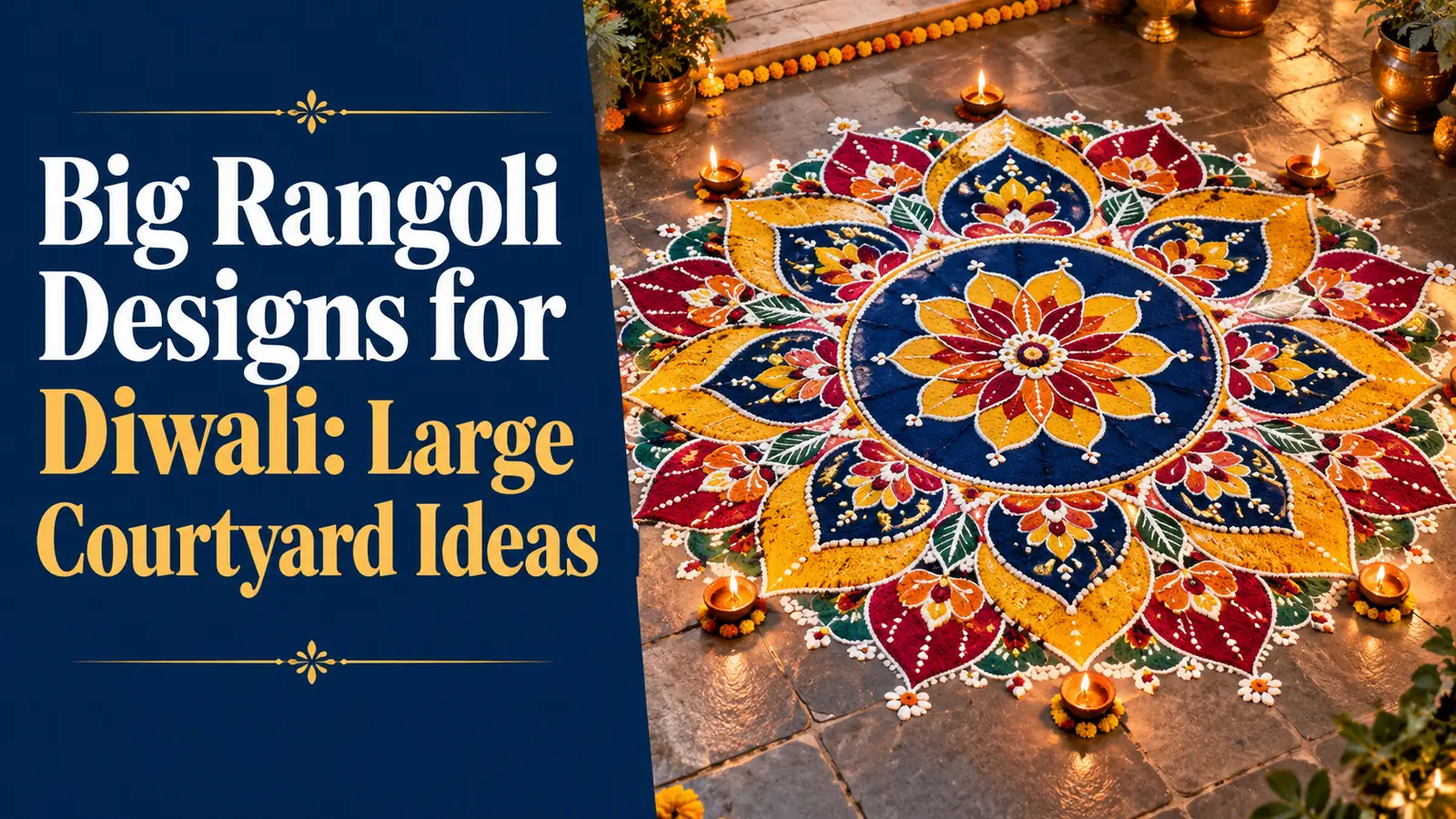
Wikipedia’s entry on rangoli notes that placement at the entrance is common, and that in Maharashtra and Karnataka designs on doors are said to repel evil forces. A border rangoli is the simplest way to follow that tradition, because a repeating band along a threshold or around a larger design takes less time than a full floor picture and frames the entrance cleanly.
This guide gives you border rangoli designs for Diwali, including corner designs, doorway borders, large frame patterns, a measuring method, step-by-step drawing instructions, colour plans and diya safety tips. Diwali falls on Sunday, November 8, 2026, according to Dekho Panchang.
Border Rangoli Designs for Diwali: Where Borders Work Best
Borders suit narrow spaces and large spaces equally well. Use a thin band along the threshold of the door, a strip along both sides of a pathway, a frame around a central rangoli or a quarter-circle in each corner. Britannica describes rangoli as creating an auspicious space, and a border helps to define that space clearly.
| Location | Border style | Width |
|---|---|---|
| Doorway threshold | Straight repeating band | 10 to 20 cm |
| Around a central rangoli | Circular or square frame | 10 to 15 cm |
| Along a pathway | Two parallel strips with a motif between | 10 cm each |
| In corners | Quarter circle, fan or diya | 20 to 30 cm radius |
| Around a puja area | Square frame with corner motifs | 15 cm |
Easy Border Rangoli Patterns
Easy borders use a single motif repeated along a line. Mark equal spacing with chalk, draw the first repeat carefully and copy it along the band.
| # | Border pattern | How it looks | Level |
|---|---|---|---|
| 1 | Wave | Smooth S-curve repeated along the line | Easy |
| 2 | Triangle chain | Row of triangles pointing up or down | Easy |
| 3 | Dot and dash | Alternating dots and short lines | Easy |
| 4 | Petal row | Series of rounded petals | Easy |
| 5 | Diya chain | Small lamps joined by a line | Medium |
| 6 | Zigzag | Sharp repeated peaks | Easy |
| 7 | Scallop | Row of semicircles | Easy |
| 8 | Leaf vine | Curving stem with leaves on both sides | Medium |
| 9 | Lotus chain | Small lotus flowers along the band | Medium |
| 10 | Peacock feather border | Row of feather eyes | Hard |
Corner Rangoli Designs for Diwali
Corner designs soften the edges of a frame and give you a place for a diya. A quarter-circle fan in each corner is the simplest, and you can build it from nested arcs.
| # | Corner design | How to draw it | Level |
|---|---|---|---|
| 11 | Quarter fan | Draw three nested arcs from the corner and fill with colour | Easy |
| 12 | Corner diya | Lamp shape tucked into the corner | Easy |
| 13 | Corner lotus | Half lotus opening toward the centre | Medium |
| 14 | Peacock tail corner | Fan of feathers radiating from the corner | Hard |
| 15 | Leaf spray | Group of leaves from one point | Easy |
| 16 | Dot triangle | Triangle of dots with a centre flower | Easy |
| 17 | Scroll | Curling spiral that fills the corner | Medium |
| 18 | Petal burst | Half sunburst from the corner | Medium |
Doorway and Entrance Rangoli Ideas
The entrance is where guests first look, so a bold design pays off. Wikipedia notes that rangoli is placed at the entrance of the home, where it is meant to welcome Lakshmi and represent happiness and prosperity. A border design can frame the doorway as a whole or sit beside a central motif.
| # | Entrance idea | Description | Level |
|---|---|---|---|
| 19 | Threshold band | Straight pattern across the full width of the door | Easy |
| 20 | Welcome arch | Curved border over a doorway-sized rangoli | Medium |
| 21 | Footprint path | Lakshmi footprints inside a border | Easy |
| 22 | Double frame | Two rectangles, one inside the other, filled with different patterns | Medium |
| 23 | Diya border | Row of lamps along the edge of the rangoli | Medium |
| 24 | Floral frame | Border of petals around a central motif | Easy |
| 25 | Mandala with border | Circular design inside a square frame | Hard |
| 26 | Pathway lanterns | Two strips of repeated motifs leading to the door | Medium |
How to Measure and Draw a Border Rangoli
Neat borders depend on measuring. Measure the length, choose the width of one repeat, and divide so the pattern fits an exact number of times. If it does not divide evenly, adjust the repeat width slightly instead of cutting the last motif.
| Step | What to do |
|---|---|
| 1 | Measure the length of the space |
| 2 | Choose a repeat width, such as 10 cm, and divide the length to get the number of repeats |
| 3 | Draw two parallel chalk lines for the edges of the band |
| 4 | Mark equal points along the centre line |
| 5 | Draw the first motif in chalk, then copy it at each point |
| 6 | Trace with white flour, then fill with colour |
A strip of card cut to the repeat width makes a simple spacing guide. Slide it along the line and mark each repeat.
Colour Plans for Border Rangoli
Borders often look best in two or three colours that match the central design. Use a darker colour on the outer edge to define the frame, a lighter colour inside and white lines to separate them.
| Plan | Outer | Middle | Inner |
|---|---|---|---|
| Classic | Red | Yellow | White |
| Fresh | Green | Pink | White |
| Royal | Blue | Gold | White |
| Warm | Orange | Yellow | Red dots |
Materials and Flower Borders
Wikipedia lists traditional rangoli materials including dry rice flour, coloured sand, flower petals and seeds, so a border can be made from almost anything. A petal border is a quick option: lay a line of marigold petals along the edge and add green leaves for contrast. A border of dry lentils or rice in two colours adds texture.
For a long border, use a cone or a squeeze bottle to draw clean lines. Fine powders can irritate the eyes and nose, so work in a ventilated space and avoid blowing powder.
Diya Placement and Safety
A row of diyas along a border looks beautiful, but needs care. South Yorkshire Fire and Rescue advises placing diyas, tea lights and candles on heat-resistant surfaces and well away from curtains and decorations, and supervising children and pets at all times near flames. Keep diyas at the corners and on the edge of the design, not directly on petals or paper.
Light them only when you are present, and extinguish them before leaving the house. Keep a clear path for guests so no one brushes against a lamp.