
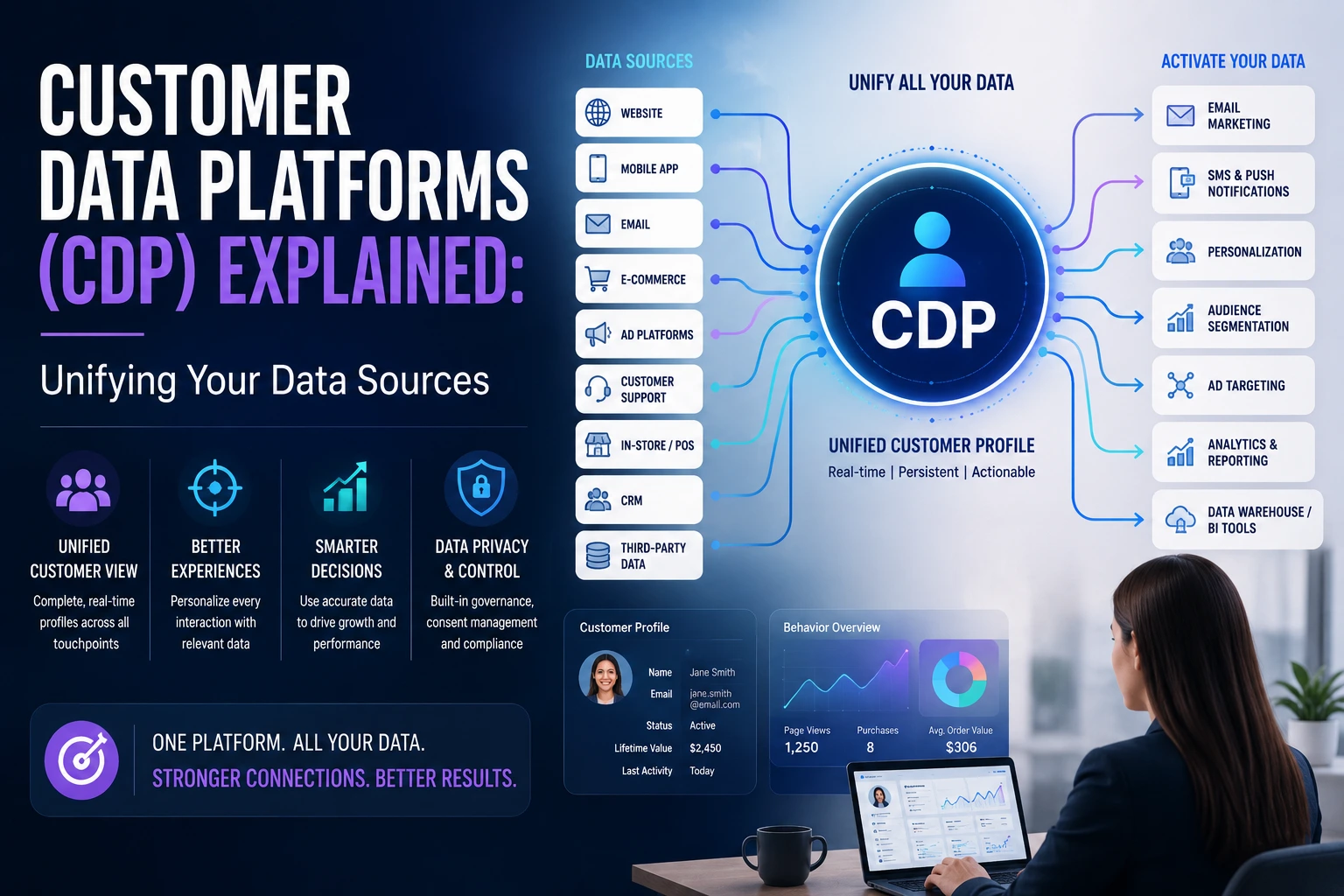
A CDP stitches together customer data from every touchpoint — website, mobile app, email, CRM, point of sale, customer service — into a single persistent customer profile. In a world where third-party cookies are deprecated and privacy regulations require first-party data strategies, a CDP is increasingly the infrastructure layer that makes personalisation, attribution, and AI-driven marketing possible at scale.
Customer Data Platforms are one of the most misunderstood and misrepresented software categories in marketing technology. Many organisations believe they need a CDP when they actually need better CRM data hygiene. Others have a genuine CDP use case but are evaluating the wrong vendors. Understanding what CDPs actually do, and when they genuinely solve a problem, prevents expensive mismatches between need and investment.
What a CDP Actually Does
A CDP collects event and attribute data about individual customers from multiple sources, resolves that data to a single persistent customer identity (identity resolution), and makes that unified customer profile available to downstream tools and systems in real time or near-real time.
Data collection: CDPs ingest data from web and mobile events (JavaScript pixel or server-side), CRM records, point-of-sale systems, email marketing platforms, customer service systems, and offline sources. Each data source contributes attributes and events to the customer record.
Identity resolution: A customer might interact with your brand as a website visitor (anonymous), then provide an email address (known), then purchase with a loyalty card (matched to a physical identity). Identity resolution links these interactions to a single customer record across sessions, devices, and channels. This is the CDP’s core technical capability.
Profile activation: The unified customer profile is made available to downstream systems: marketing automation, personalisation engines, advertising platforms, customer service tools, and analytics. The CDP enables consistent, real-time customer context across every system that touches the customer.
How CDPs Differ From CRMs and DMPs
| Platform | Primary Use | Data Type | Real-Time | Identity |
| CRM (HubSpot, Salesforce) | Sales and service management | Declared, structured | Limited | Known customers only |
| DMP (Data Management Platform) | Audience targeting, advertising | Third-party, anonymous | Yes | Device/cookie ID (deprecated) |
| CDP | Unified customer profile | First-party, all types | Yes | Cross-device, cross-session |
| Data Warehouse (Snowflake, BigQuery) | Analytics, reporting | All data, batch | No | Analyst-defined |
CDP vs CRM: A CRM manages known customer relationships: contacts, deals, tickets, and interactions. It stores data you have explicitly captured. A CDP captures all customer interactions including anonymous pre-conversion behaviour and creates a complete behavioural profile. Many organisations with mature CRMs need a CDP to capture the pre-CRM customer journey.
CDP vs DMP: DMPs used third-party cookie data for advertising audience targeting. As third-party cookies are deprecated, DMPs have lost their primary data source. CDPs use first-party data owned by the brand, which is privacy-compliant and not subject to cookie deprecation. The CDP is functionally replacing the DMP for brands building first-party data strategies.
Leading CDP Vendors in 2026
Segment (Twilio): The market-defining CDP for developer-forward companies. API-first, strong integration ecosystem with 400-plus native connections. Best for engineering-led organisations that want to build custom CDP implementations. Acquired by Twilio in 2020.
mParticle: Strong mobile-first CDP with enterprise-grade data governance. Best for companies with significant mobile app traffic requiring sophisticated identity resolution across app and web.
Salesforce Data Cloud: Salesforce’s CDP product deeply integrated with Marketing Cloud, Service Cloud, and Commerce Cloud. Best for organisations heavily committed to the Salesforce ecosystem that want a CDP without additional vendor relationships.
Adobe Experience Platform: Enterprise CDP with strong AI and ML capabilities through Adobe Sensei. Best for large enterprises running Adobe Experience Cloud products.
RudderStack: Open-source CDP alternative. Self-hosted option provides full data control and eliminates per-event pricing that makes cloud CDPs expensive at scale. Growing adoption among engineering-forward companies with data sovereignty requirements.
Do You Actually Need a CDP?
CDPs are right for organisations that have multiple data sources creating fragmented customer views that prevent personalisation at scale, that are investing in first-party data strategies post-cookie-deprecation, and that need real-time customer context available across multiple downstream systems simultaneously.
CDPs are not right for organisations where a CRM with better data hygiene would solve the problem, where data volumes are insufficient to justify the implementation and licensing cost, or where there is no downstream use case that requires a unified real-time customer profile.
The honest question to ask before buying a CDP: What specific decision or workflow would be improved if you had a unified customer profile in real time? If you cannot answer this specifically, the problem is more likely upstream data quality or downstream tool capability than CDP absence.
Implementation Reality
CDP implementations are significantly more complex than vendor demos suggest. Identity resolution at scale requires data engineering expertise, clean source data, and ongoing maintenance as data structures evolve. CDP value is proportional to the quality of data flowing into it. A CDP fed by poorly structured, incomplete source data produces a poorly structured, incomplete customer profile.
What is a customer data platform (CDP)?
A CDP collects data about individual customers from multiple sources (website, app, CRM, email, POS), resolves that data to a single persistent customer identity through identity resolution, and makes the unified customer profile available to downstream marketing, service, and analytics systems in real time. It enables consistent customer context across every system that touches the customer.
What is the difference between a CDP and a CRM?
A CRM manages known customer relationships: contacts, deals, tickets, and explicit interactions. It stores data you have deliberately captured. A CDP captures all customer interactions including anonymous pre-conversion behaviour and creates a complete behavioural profile across sessions and devices. CDPs are more powerful for understanding the full customer journey; CRMs are more powerful for managing active relationships.
Why are CDPs replacing DMPs?
DMPs (Data Management Platforms) relied on third-party cookie data for advertising audience targeting. As third-party cookies are deprecated across browsers and privacy regulations restrict third-party data use, DMPs have lost their primary data source. CDPs use first-party data owned by the brand, which is privacy-compliant and not subject to cookie deprecation.
What are the leading CDP vendors in 2026?
Segment (Twilio) leads for developer-forward companies with API-first architecture. mParticle is strong for mobile-first enterprises. Salesforce Data Cloud integrates deeply with Salesforce ecosystem. Adobe Experience Platform serves large enterprises in the Adobe stack. RudderStack is the open-source alternative for data sovereignty requirements.
How much does a CDP cost?
CDP pricing is typically based on monthly tracked users (MTUs) or events processed. Segment’s Team plan starts around $120/month for small volumes. Enterprise pricing for mid-large deployments runs $50,000 to $500,000-plus annually. RudderStack open-source eliminates licensing costs but requires self-hosting infrastructure. Implementation costs (often $50,000 to $200,000 for enterprise) frequently exceed annual licensing for the first year.
Do small businesses need a CDP?
Generally not. CDPs are designed for organisations with significant data volumes, multiple distinct data sources creating fragmented customer views, and downstream use cases requiring real-time unified profiles. Small businesses are typically better served by improving CRM data quality, ensuring marketing automation tools are properly integrated, and building first-party email list capture before investing in CDP infrastructure.
Start With the Use Case, Not the Technology
The right order of operations for CDP evaluation: identify the specific downstream use case (personalised email sequences, real-time website personalisation, cross-channel attribution, AI recommendation engine) that requires a unified customer profile. Then evaluate whether your current data infrastructure supports that use case without a CDP. If not, the use case justifies the CDP investment. If yes, spend the budget on the downstream tool instead.