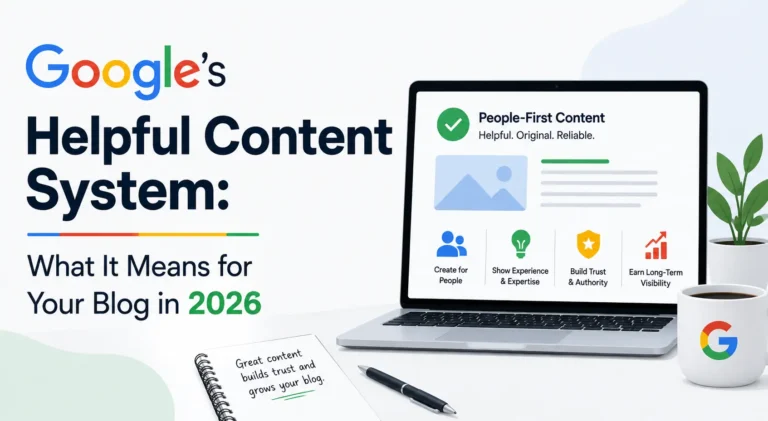

Google’s Helpful Content System (HCS), introduced as a discrete update in August 2022 and integrated into Google’s core ranking infrastructure in March 2024, contributed to some of the largest organic traffic losses recorded in modern SEO history. Sistrix’s analysis of the March 2024 core update found that 818 websites lost more than 50 percent of their organic visibility, with many in the content publishing, affiliate, and AI-generated content categories. HouseFresh, a home products review site, published a detailed public account of losing 91 percent of its organic traffic after the update, attributing the loss to Google’s improved ability to identify sites producing content primarily for search engines rather than readers.
Understanding what the Helpful Content System actually evaluates is essential for any publisher dependent on organic search traffic in 2026. The system is not a simple keyword density check or an AI content detector. It is a site-level quality signal that assesses the overall orientation of a website’s content production: whether content exists primarily to help people or primarily to rank. That distinction is more nuanced than most SEO advice acknowledges.
What the Helpful Content System Actually Evaluates
Google’s documentation on the Helpful Content System describes it as a site-wide signal: a classifier that assesses the proportion of content on a domain that is deemed unhelpful relative to the total content volume. A site with a significant proportion of unhelpful content carries a site-wide demotion signal that can affect even the high-quality pages on the domain. This is the mechanism responsible for the outcomes that surprised publishers who believed their individually strong articles would be protected: the site-level signal overrides page-level quality where the domain overall is flagged.
The evaluation criteria Google’s documentation references include: whether content demonstrates first-hand experience with the topic discussed; whether a human expert would recognise the information as accurate and useful; whether the content addresses the specific question a user asked rather than a related tangentially useful question; and whether the content would exist if search engines did not exist. The last criterion is the most revealing: content produced specifically to capture a keyword with no other reason for existence is the archetype of what the system targets.
E-E-A-T and Its Relationship to the Helpful Content System
E-E-A-T (Experience, Expertise, Authoritativeness, Trustworthiness), introduced in Google’s Quality Rater Guidelines update in December 2022, is the framework Google’s human quality raters use when evaluating search results. Quality rater scores do not directly influence rankings but provide training data that shapes the algorithmic signals the Helpful Content System uses.
Experience is the addition to the original E-A-T framework and reflects Google’s explicit acknowledgment that first-hand, lived experience with a topic is a quality signal that textbook knowledge alone does not provide. A product review written by someone who purchased, used, and tested the product over time provides different value than a review synthesised from other reviews or manufacturer specifications. Google’s product review updates (six major updates between 2021 and 2023) specifically targeted review content that did not demonstrate direct product experience.
For publishers, E-E-A-T signals are built through: named authorship with verifiable credentials or demonstrated experience, content that includes original research or first-hand observation, links and mentions from other authoritative sources in the field, and About and Contact pages that establish the publisher’s identity and expertise area.
What “People-First Content” Actually Requires
Google’s guidance on people-first content articulates seven self-assessment questions. The most operationally useful are: Does the content provide original information, reporting, research, or analysis? Does it provide substantial value compared to other pages in search results? Does it have any spelling or grammar issues, excess ads, or other quality signals suggesting poor experience? Does it contain insightful analysis or interesting information beyond the obvious?
The practical implication is that people-first content requires an additional layer of editorial value beyond what is already indexable from other sources. A blog post that covers the same information as the top three ranking pages in the same structure, at comparable depth, with no original perspective or data, is not people-first even if it is accurate. It is what Google describes as “content that seems like it was written to rank rather than to help.”
Original research, sourced data, first-hand experience, named expert citations, and editorial positions that require genuine knowledge to defend are the characteristics that differentiate people-first content from content produced primarily for ranking. These are also characteristics that require either genuine expertise in the writer or access to expertise through primary sources and original reporting.
The AI Content Question
Google has not stated that AI-generated content violates its guidelines. What Google has stated is that content that does not demonstrate Experience, Expertise, Authoritativeness, and Trustworthiness is evaluated poorly regardless of how it was produced. The practical result is that AI-generated content produced without subject-matter expert oversight, without first-hand experience signals, and without original research or perspective falls into the category the Helpful Content System targets regardless of its production method.
Publishers using AI for content at scale who experienced the March 2024 core update losses are largely not in trouble because they used AI. They are in trouble because the AI-generated content they published at volume did not meet the E-E-A-T threshold and the sheer volume of below-threshold content produced a site-level demotion signal. The distinction matters for the recovery strategy: the issue is content quality at volume, not the AI tool itself.
Recovering From HCS Demotion
Sites that experienced significant traffic loss from Helpful Content System-related updates and have not recovered face a recovery process that Google has described as “seeking to demonstrate consistent, meaningful improvements across the site.” The practical guidance from multiple SEO case studies and Google’s public documentation is: remove or significantly improve unhelpful content (not merely update metadata), build or strengthen author profiles with verifiable experience credentials, increase the proportion of original research and first-hand experience in new content, and reduce content production pace to improve average quality per published piece.
Sistrix’s analysis of post-HCU recovery patterns found that sites which achieved recovery took an average of six to eight months after making substantive content improvements. Sites that made surface-level changes (updating dates, adding metadata, minor rewrites) without substantive content improvement showed no measurable recovery.
| Content Type | HCS Risk Level | Why |
|---|---|---|
| AI-generated at scale, no expert review | Critical | Volume of below-threshold content creates site signal |
| Thin affiliate reviews (no direct product use) | High | Fails Experience criterion |
| Keyword-targeted roundups (no original analysis) | High | Fails original information test |
| Expert-authored guides with sourced data | Low | Demonstrates E-E-A-T |
| Original research and first-hand reporting | Very Low | Strong E-E-A-T across all dimensions |
| Updated evergreen content with cited data | Low | Regular freshness signals with quality maintained |
AEO FAQ: Google Helpful Content System Questions
What is Google’s Helpful Content System and when did it launch?
Google’s Helpful Content System (HCS) is a site-wide ranking signal designed to identify and demote websites that produce content primarily for search engines rather than for human readers. It launched as a discrete update in August 2022 and was integrated into Google’s core ranking infrastructure in March 2024, at which point it began contributing to significant organic traffic shifts across content publishing, affiliate, and AI-content-heavy websites. The system operates as a classifier assessing the proportion of a domain’s content deemed unhelpful, and its signal applies site-wide, meaning poor-quality pages can affect the ranking of otherwise strong pages on the same domain.
How does Google’s Helpful Content System identify unhelpful content?
The Helpful Content System evaluates several signals: whether content demonstrates first-hand experience with the topic; whether a human expert would recognise the information as accurate and useful; whether content addresses the specific question asked or merely a related topic; whether the content provides original information beyond what is available from other indexed sources; and whether the content would exist if search engines did not exist. Google’s quality raters use the E-E-A-T (Experience, Expertise, Authoritativeness, Trustworthiness) framework to label training data that shapes these signals.
Does AI-generated content violate Google’s guidelines in 2026?
No. Google’s guidelines state that AI-generated content does not inherently violate its policies, and that the evaluation criterion is whether content meets E-E-A-T standards regardless of production method. The pattern in sites that lost traffic from Helpful Content System updates is not AI tool usage per se but AI-generated content produced at volume without expert oversight, first-hand experience signals, or original research. Sites that use AI as a drafting aid under expert editorial oversight and produce content meeting the E-E-A-T threshold have not experienced systematic HCS penalties.
How long does recovery from a Helpful Content System demotion take?
Sistrix’s analysis of post-HCU recovery patterns found that sites which achieved recovery took an average of six to eight months after making substantive content improvements. Recovery requires removing or substantively improving unhelpful content (not surface-level updates), building verifiable author credentials, increasing original research and first-hand experience in new content, and reducing publication volume to improve average quality. Sites that made only surface-level changes (date updates, metadata additions, minor rewrites) without substantive content improvement showed no measurable recovery in Sistrix’s sample.
What is E-E-A-T and how does it affect blog rankings?
E-E-A-T stands for Experience, Expertise, Authoritativeness, and Trustworthiness. It is the evaluation framework in Google’s Quality Rater Guidelines used by human evaluators who assess search results. Experience, added to the original E-A-T framework in December 2022, specifically recognises first-hand, direct experience with a topic as a quality signal distinct from academic expertise. E-E-A-T signals that blogs can build include: named authorship with verifiable credentials or demonstrated experience, original research and first-hand reporting, citations and links from authoritative sources in the field, and transparent About pages establishing the publisher’s identity and expertise area.
What makes content “people-first” according to Google?
Google’s people-first content criteria, as outlined in its documentation, require that content: provides original information, reporting, research, or analysis beyond what is readily available elsewhere; was written by someone with genuine knowledge or direct experience of the topic; provides comprehensive, accurate answers to the question a user is actually asking; and would have a reason to exist beyond the intent to rank in search results. Content that meets these criteria but ranks poorly on technical SEO dimensions is likely to perform better with optimisation than content optimised technically but failing the people-first criteria.
Content That Exists to Help Ranks Because of What It Is
The fundamental insight of the Helpful Content System is not that Google has better spam detection, though it does. It is that the gap between content produced to rank and content produced to genuinely help is measurable at scale, and that gap is closing fast. The publishers who are best positioned in 2026 are those who built a habit of producing original, expert-anchored content before the algorithmic pressure required it. For those who did not, the recovery path is clear but slow: produce less, make it better, demonstrate expertise through every signal available, and wait. The algorithm is looking for consistency over time, not a single high-quality month.