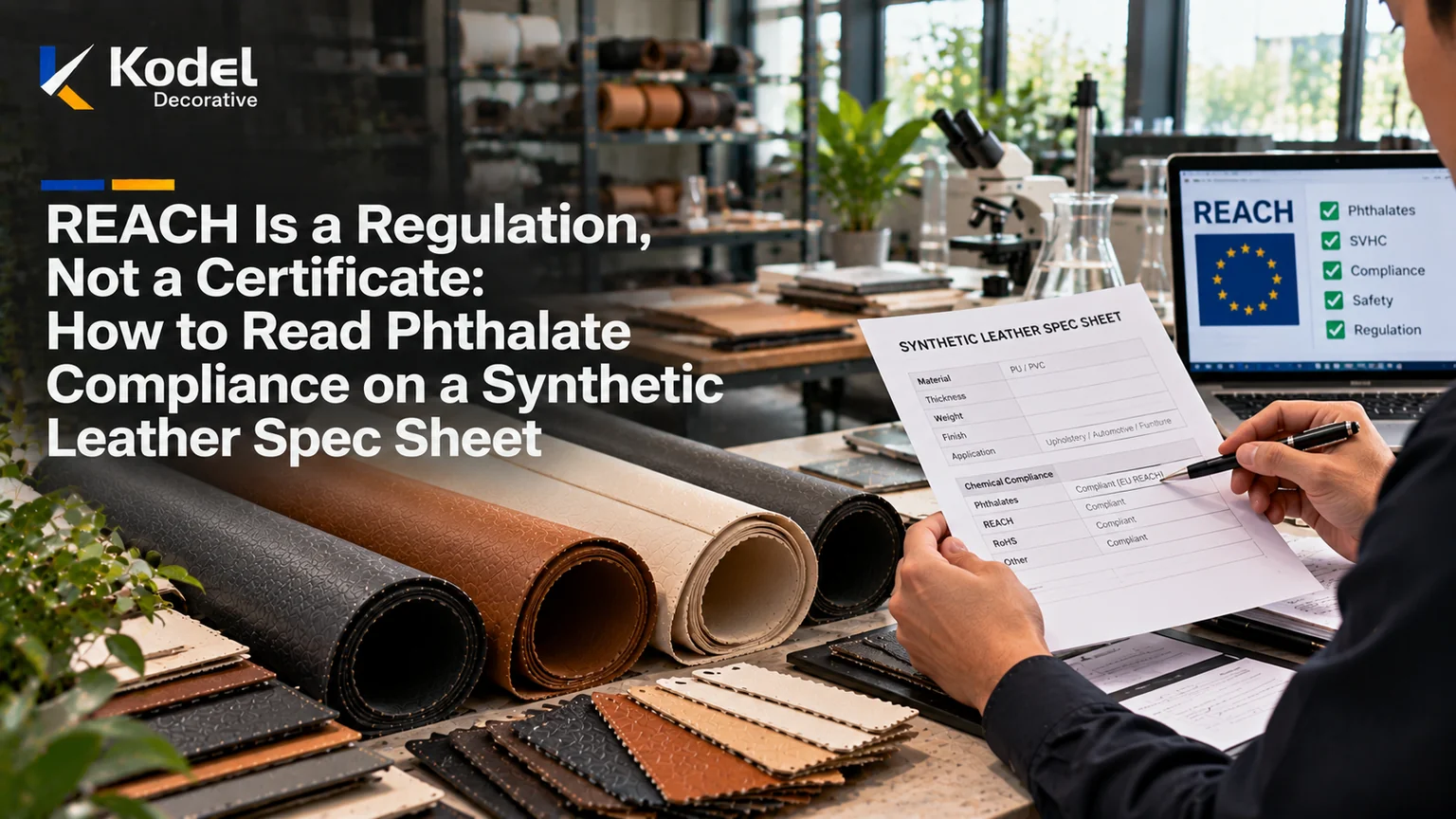
Regulation (EU) 2018/2005, published on 18 December 2018, extended the EU’s restriction on four phthalates to plasticised material in most articles placed on the market. The limit is 0.1% by weight of the plasticised material, and the rule applied to all covered articles from 7 July 2020.
Six years on, buyers of synthetic leather, including those ordering from a wholesale PU leather fabric supplier, still receive spec sheets that say “REACH certified” and treat the phrase as proof. It is not. This article explains what the rule restricts, what documents actually show compliance, and how to read a test report before you place a bulk order.
What the 2018 rule restricts
The regulation replaced entry 51 of Annex XVII to REACH. It restricts four phthalates: DEHP, DBP, BBP and, newly added, DIBP. Taken together, they must stay below 0.1% by weight of the plasticised material in the article.
“Plasticised material” is defined broadly. It includes PVC and polyurethane, other polymers, coatings, adhesives and inks. That wording matters for synthetic leather, because both PVC leather and PU leather sit inside it.
The rule entered into force on 7 January 2019. Toys and childcare articles were covered first, and the wider restriction on articles placed on the market followed on 7 July 2020.
Why a missing report is a business risk, not a paperwork gap
It is tempting to file phthalate paperwork under administration. That undersells it. National market surveillance authorities can ask a business to show evidence for a product on sale, and non-compliant goods can be stopped or withdrawn.
Retailers add their own pressure. Many require test reports as a condition of listing, and a brand that cannot produce one can lose a retail slot long before a regulator calls.
The cost of being wrong also lands late. By the time a problem surfaces, the material has been cut, sewn and shipped, so the loss is the finished product rather than the fabric.
Why “REACH certified” is shorthand, not a status
REACH is Regulation (EC) No 1907/2006. It sets obligations for registering, evaluating, authorising and restricting chemicals. No EU body issues a single REACH certificate that a fabric or a finished article can hold.
What exists is a set of duties. Annex XVII restricts certain substances, including the four phthalates above. Article 33 requires suppliers of an article containing a substance of very high concern above 0.1% by weight to pass that information to their customers.
So when a supplier writes “REACH certified”, the honest reading is “we believe this product meets the REACH obligations that apply to it, and here is some evidence”. The evidence is what a buyer should examine.
Four documents a supplier may send
Suppliers tend to hand over one of four things. They are not equal, and the table sets out what each one can and cannot show.
| Document | What it can show | What it cannot show | Check before accepting |
| Third-party lab test report | A tested sample met the limit for the four phthalates | That other colours, lots or later production also meet it | Lab accreditation, test method, detection limit, sample description, date |
| Compliance certificate from a testing company | A sample passed at the time of testing | The full result values, unless the report is attached | The underlying report, the scope and the issue date |
| Supplier self-declaration | The supplier’s statement of its own view | Independent verification | What data the statement rests on, and who signed it |
| SVHC statement | Whether the supplier believes any substance on the Candidate List is above 0.1% by weight | Phthalate compliance under Annex XVII, which is a separate rule | The Candidate List version date the statement refers to |
The last row causes the most confusion. An SVHC statement and a phthalate test answer different legal questions, and one does not replace the other.
Reading a phthalate test report line by line
Start with the sample description. Does it match the product you are buying, including the coating type, the backing and the colour? A report on a white sample says little about a dark red one, because pigments, inks and additives can differ.
Check the date and the lot. A report dated 14 months before your order describes an older production run. Ask whether the formulation has changed since then.
Look at the laboratory. Is it accredited to ISO/IEC 17025 for this specific test method? Accreditation for one method does not cover every method the lab offers.
Then read the numbers. A limit of 0.1% equals 1,000 mg/kg. A competent report lists each of the four phthalates with a result and a detection limit well below that figure.
If the detection limit is close to the legal limit, a “not detected” result proves little.
Where PU and PVC differ
Flexible PVC relies on plasticisers to stay soft, which is why phthalates have a long history in that material. Many producers have moved to other plasticisers, but a buyer still needs a test to confirm it.
Polyurethane coatings generally rely on different chemistry. That is no reason to skip testing, because the rule explicitly covers polyurethane, as well as the coatings, inks and adhesives layered onto it. “PU, so no phthalates” is an assumption, not evidence.
Exemptions and edge cases
The 2018 regulation lists several exemptions. They include articles for industrial or agricultural use under certain conditions, food contact materials, medical devices, and electrical and electronic equipment covered by separate legislation.
Motor vehicles and aircraft placed on the market before 7 January 2024 were also exempt. A buyer working with an automotive upholstery supplier in Thailand, or anywhere else, should not assume that exemption continues for newer vehicles.
The safe approach is to assume the restriction applies and to check the exact text before relying on any exemption.
Batch, colour and date
A test report describes a sample, not a supply. For an ongoing relationship, agree how often evidence is renewed. Many buyers ask for a fresh report once a year, or sooner if the supplier changes a formulation, a mill or a colour series.
Ask whether the report covers the whole colour range or one reference colour. If it covers one, ask for a plan to test the others or to explain why the result carries across.
An illustrative scenario
Imagine a small furniture brand ordering 3,000 metres of PU leather in eight colours for a sofa range sold in Europe. The supplier sends a one-page “REACH certified” sheet and a lab report for one colour, dated the previous year.
The brand’s buyer asks three questions. Does the report cover all eight colours? Is the lab accredited for the method used? Has the formulation changed since the sample was tested?
The answers decide the next step. If the supplier can show coverage, the file is complete. If it cannot, the brand can pay for its own test on the delivered lot before cutting any fabric, which costs far less than withdrawing finished sofas.
Questions to ask a supplier before the first order
Begin with scope. Which product codes and colours does the evidence cover, and who tested them? Ask for the full report, not a one-page summary.
Move on to change control. Will the supplier tell you before it changes a coating, a mill or a plasticiser? A supplier that treats formulation changes as a notification event is easier to trust than one that treats them as internal business.
Finish with renewal. How often is the product retested, and will the supplier share the new report without being asked? If the answer is “on request”, set the reminder yourself.
When to pay for your own test
Supplier reports are a starting point, and sometimes they are not enough. Commission an independent test if you are using a new supplier for the first time, if the order is large, or if the finished product will be used by children.
The same applies if the material was dyed or finished in a new colour after the report was issued. A test on the delivered lot, before cutting, is the cheapest point in the process to catch a problem.
Choose a laboratory accredited for the method you need, and give it a sample from the actual shipment rather than a swatch the supplier chose.
Building a compliance file
Keep one folder per material. It should hold the spec sheet, the latest test reports, any declarations, the supplier’s contact for technical questions, and a log of when each document expires or needs renewal.
Store the lot number against each shipment. If a regulator or retailer asks about a product on sale, the folder lets you answer in an afternoon rather than a month.
None of this is complicated. It is the habit of asking for evidence and filing it, applied to a material that rarely gets the same scrutiny as a finished product.
How suppliers can make this easier
Good suppliers do not wait to be asked. They keep current reports on file, label each one with the product codes it covers, and send them with the first quotation.
They also explain what each document does and does not prove, which saves the buyer a round of emails. A supplier that can do this is usually one that also controls its formulations tightly, and that is the property a buyer cares about most.
Limits of this guide
This article summarises one restriction. REACH contains many others, and national market surveillance authorities enforce them. It is not legal advice, so check the regulation text for your product and market.
Where to start
Buyers comparing an artificial leather supplier in Thailand with other sources can use the questions above as one checklist and send the same list to every shortlisted supplier. The replies show quickly who keeps evidence on file and who only keeps adjectives.