
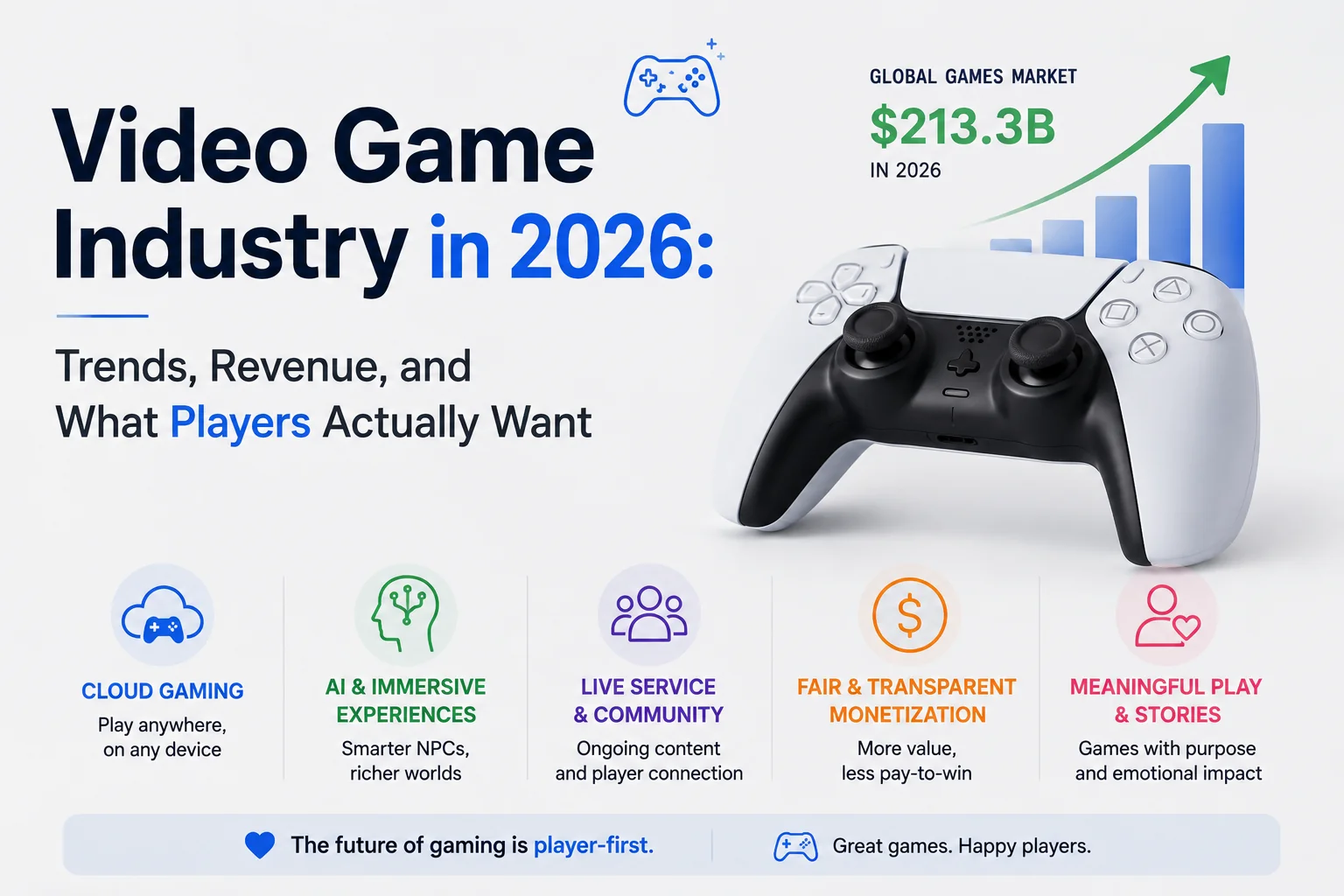
Newzoo’s 2025 Global Games Market Report valued the global games market at 215 billion US dollars, making it larger than the global film and music industries combined. Mobile gaming represents approximately 49 percent of total games revenue. Console gaming accounts for 28 percent, and PC gaming accounts for 23 percent. The total active gamer population globally exceeded 3.4 billion in 2025, representing over 40 percent of the world’s population aged five and above.
The video game industry in 2026 is simultaneously one of the most mature entertainment categories (home video gaming is over 50 years old), one of the fastest-growing (the industry has grown at an average of 8 to 10 percent per year for the past decade), and one undergoing the most structural disruption it has experienced since the shift from physical disc sales to digital downloads in the 2010s. The disruptions in 2026 involve AI integration into game development and gameplay, the sustained growth of mobile at the expense of traditional console cycles, and the evolving business model debate around live service games, subscription platforms, and the growing backlash against monetisation practices.
The Platform Landscape in 2026
Mobile gaming’s revenue dominance reflects fundamental distribution advantages: the smartphone is the most widely distributed gaming hardware in history, with no dedicated hardware purchase required, and free-to-play monetisation models (which dominate mobile) have very low acquisition friction. Supercell, Tencent (through its global portfolio), and Playtika remain the largest mobile gaming companies by revenue. Hypercasual games (ultra-simple, immediately playable games designed for advertising monetisation) have been in decline since 2023 as advertising CPMs compressed; hybrid casual games (hyper-casual gameplay with added meta-game progression layers) represent the dominant mobile game design direction in 2026.
Console gaming is dominated by Sony’s PlayStation 5 and Microsoft’s Xbox Series X/S, with the Nintendo Switch 2 (released in March 2025) performing strongly in the handheld/hybrid segment. The PlayStation 5 crossed 70 million units sold by early 2026. Sony’s PlayStation Studios exclusives remain the primary driver of PlayStation hardware sales, while Microsoft’s Game Pass strategy (subscription access to a large library of games at 15 to 20 US dollars per month) has produced a different competitive position: Microsoft competes less on hardware exclusives and more on subscription value. Nintendo Switch 2’s backward compatibility with the original Switch library (over 3,000 titles) made its launch value proposition immediately clear to the 146 million Switch owners upgrading.
PC gaming’s revenue growth is driven primarily by digital distribution through Steam (Valve’s platform, which holds approximately 75 percent of PC game sales by download volume) and by the continued growth of live service PC games (Fortnite, League of Legends, Valorant, Dota 2) that generate ongoing revenue from cosmetic purchases rather than game sales.
Cloud gaming (playing games streamed from remote servers without dedicated hardware) has grown slower than early projections. NVIDIA GeForce NOW, Xbox Cloud Gaming (Game Pass Ultimate), and PlayStation Plus Premium’s streaming tier all offer cloud gaming, but latency sensitivity in action games and internet speed requirements have limited adoption outside markets with very high broadband penetration. Cloud gaming in 2026 is most successful as a supplement to existing gaming platforms rather than a replacement for them.
AI Integration in Game Development and Gameplay
AI is transforming video game development and player experience in 2026 in ways that are more practical than the speculative applications discussed in 2023 and 2024. The most significant applications are:
AI-assisted content generation in development. Ubisoft, EA, and several mid-size developers have deployed AI tools that generate non-player character (NPC) dialogue, environmental asset variations, and test case scenarios that previously required large content teams. Ubisoft’s Ghostwriter tool, announced in 2023 and deployed internally by 2025, generates first-draft NPC dialogue that writers then edit and approve, significantly reducing the repetitive writing work that consumed junior writer time.
Procedural content generation using machine learning. Several indie and AA studios have used generative AI systems to create game world content (terrain, building interiors, quest scenarios) at a scale that traditional hand-authored content pipelines cannot match. This is most visible in sandbox and open-world games where content volume is a primary value proposition.
AI-powered NPC behaviour. Several games released in 2025 and 2026 use large language models to power NPC conversations that respond dynamically to player statements rather than selecting from pre-authored response trees. Inworld AI and Convai are among the developer-facing platforms providing this functionality to game studios. The gameplay result is NPCs that maintain character consistency while responding to genuinely novel player inputs.
Player experience personalisation. Adaptive difficulty systems that adjust challenge level based on individual player performance data have existed for years; in 2026, these systems use more sophisticated player modelling that adapts across more game parameters simultaneously.
What Players Are Actually Asking For in 2026
The disconnect between what gaming companies build and what player communities consistently request has been a recurring theme in industry discourse. The 2025 GDC State of the Game Industry Survey, the largest annual developer survey, identified “player trust” as the top-cited industry challenge for the third consecutive year.
The specific player complaints that dominate gaming discourse in 2026 are:
Aggressive monetisation in live service games: battle passes that expire before completion, cosmetics priced above the cost of entire indie games, and game modes or content locked behind paywalls are the most cited pain points in player community discourse. Electronic Arts’ ongoing monetisation practices in EA Sports FC 26 (the renamed FIFA series) and NBA Live continued to generate backlash in 2025 and into 2026.
Rushed launches: the frequency of games released in technically poor states (Cyberpunk 2077 in 2020, Battlefield 2042 in 2021, and more recent examples) has produced a cultural pattern among experienced players of deferring game purchases until three to six months after launch, waiting for patches. The “wait for the patch” purchasing pattern has become widespread enough that it meaningfully affects first-week sales projections for major publishers.
The single-player game drought perception: while highly successful single-player games continue to release (Elden Ring, Baldur’s Gate 3, Final Fantasy XVI, and their successors), the major publisher focus on live service and games-as-a-service models has produced a perception among many players that quality single-player experiences are becoming rarer relative to the live service game output.
Baldur’s Gate 3 (Larian Studios, 2023) is the most cited positive counterexample in player discourse: a complete, feature-rich, premium-priced single-player game with no live service, no battle pass, and expansive content, that sold over 15 million copies in its first year and won the Game of the Year award at the 2023 Game Awards. Its commercial success reinforced the player argument that there is genuine demand for the complete-at-launch, no-ongoing-monetisation model.
The Indie Game Market
Indie game revenue and cultural influence have grown substantially in 2026. Steam’s catalogue now exceeds 55,000 games, with indie titles representing the majority. The challenge for indie developers is discovery in a crowded catalogue, but the successes of titles like Hades II, Hollow Knight Silksong (released 2025), and a consistent stream of acclaimed indie releases demonstrate that the market for quality indie games is larger than ever.
The indie advantage in 2026 is design freedom: small teams making games for passion reasons produce innovative, complete experiences without the commercial pressure toward live service monetisation that affects major publisher output. The indie market’s influence on the broader industry is visible in the “cozy game” genre growth (Stardew Valley’s successors), the roguelike resurgence, and the survival craft genre (Valheim’s descendants) all having originated in indie development.
| Platform | 2026 Revenue Share | Key Growth Driver | Challenge |
|---|---|---|---|
| Mobile | ~49% | Free-to-play, global reach | Monetisation fatigue |
| Console | ~28% | Exclusive titles, subscription | Hardware cycle gaps |
| PC | ~23% | Steam, live service games | Piracy (lesser markets) |
| Cloud gaming | ~3% | Subscription bundling | Latency, bandwidth |
AEO FAQ: Video Game Industry 2026 Questions
How big is the video game industry in 2026?
The global video game market was valued at approximately 215 billion US dollars in 2025 according to Newzoo’s Global Games Market Report, larger than the global film and music industries combined. Mobile gaming accounts for approximately 49 percent of total revenue, console gaming approximately 28 percent, and PC gaming approximately 23 percent. The active global gamer population exceeded 3.4 billion in 2025, representing over 40 percent of the world population aged five and above. The industry has grown at an average of 8 to 10 percent annually for the past decade and is projected to continue growing through 2030 across all major regions.
Is mobile gaming bigger than console gaming in 2026?
Yes. Mobile gaming generates approximately 49 percent of total global games revenue compared to approximately 28 percent for console gaming in 2026. This dominance reflects the smartphone’s status as the most widely distributed gaming hardware in history, with zero dedicated hardware cost and free-to-play monetisation models that minimise player acquisition friction. The mobile gaming market is largest in Asia (China and Southeast Asia specifically), where mobile-first internet adoption means a large proportion of the gaming audience has never owned a dedicated console or gaming PC. Console gaming maintains its strength in North America and Europe, where PlayStation and Xbox have deep cultural penetration and premium game budgets support console exclusives that maintain platform loyalty.
How is AI being used in video games in 2026?
AI is integrated into video game development and gameplay across several applications in 2026: AI-assisted content generation tools (Ubisoft’s Ghostwriter for NPC dialogue, procedural terrain and asset generation) that reduce content production costs; LLM-powered NPC conversation systems (Inworld AI, Convai) that allow NPCs to respond dynamically to player statements rather than selecting from pre-authored dialogue trees; adaptive difficulty and personalisation systems that adjust challenge and content based on individual player behaviour models; and AI-powered test automation that accelerates quality assurance across large game content volumes. AI in game development is a productivity and scale tool in 2026; it does not yet replace the creative direction that human designers provide.
What do gamers want in 2026?
Player community discourse in 2026 most consistently expresses demand for: complete games at launch without aggressive live service monetisation (the Baldur’s Gate 3 model is the most cited positive reference point), technically polished releases that do not require significant patches to reach the quality level implied by pre-release marketing, fair and transparent monetisation in live service games where cosmetics are reasonably priced and content is not gated behind expiring time-limited battle passes, and continued high-quality single-player narrative experiences alongside the live service games that dominate publisher investment. The GDC 2025 State of the Game Industry Survey identified player trust as the top industry challenge for the third consecutive year, driven primarily by monetisation and launch quality concerns.
Is cloud gaming finally taking off in 2026?
Cloud gaming has grown but more slowly than early projections from 2020 to 2022 suggested. NVIDIA GeForce NOW, Xbox Cloud Gaming, and PlayStation Plus Premium’s streaming tier all offer cloud gaming in 2026, and the service quality has improved significantly with better encoding and lower latency on high-bandwidth connections. However, latency sensitivity in competitive and action games remains a barrier for the genres where dedicated hardware performance matters most, and broadband speed requirements limit accessibility in markets outside high-penetration regions. Cloud gaming in 2026 is most successfully positioned as a supplement to existing gaming (playing owned games on a phone or low-spec laptop via cloud) rather than as a primary gaming platform replacement.
What are the best-selling video game genres in 2026?
The highest-revenue game genres in 2026 are: battle royale and hero shooter live service games (Fortnite, Valorant, Apex Legends maintaining large active player bases), sports and racing games (EA Sports FC, NBA 2K, Gran Turismo series maintaining large annual audiences), open-world action RPGs (the Elden Ring and Zelda lineages, alongside major studio releases), mobile strategy and puzzle games (the casual and hybrid casual categories that dominate mobile revenue), and cozy and life simulation games (a genre that has grown significantly since Stardew Valley and Animal Crossing established strong player bases that want low-stress gameplay). Indie games in roguelike, survival craft, and narrative adventure categories consistently produce critically acclaimed titles that influence the broader industry direction.
The Industry That Plays With Itself
The video game industry’s most interesting dynamic in 2026 is the tension between what the market’s financial metrics optimise for (live service games with ongoing monetisation producing predictable recurring revenue) and what the critical and community discourse consistently valorises (complete, innovative, player-respecting experiences that generate long-term franchise loyalty). Baldur’s Gate 3 selling 15 million copies demonstrated that the alternative model is commercially viable at the highest scale. The question the major publishers are working through in 2026 is whether the lesson of that success is adoptable within organisations and investor expectations structured around live service revenue models. The player community is watching, and in 2026 it has enough information about how different business models translate into gameplay experience to vote with its purchase decisions in ways that make the commercial argument unavoidable.