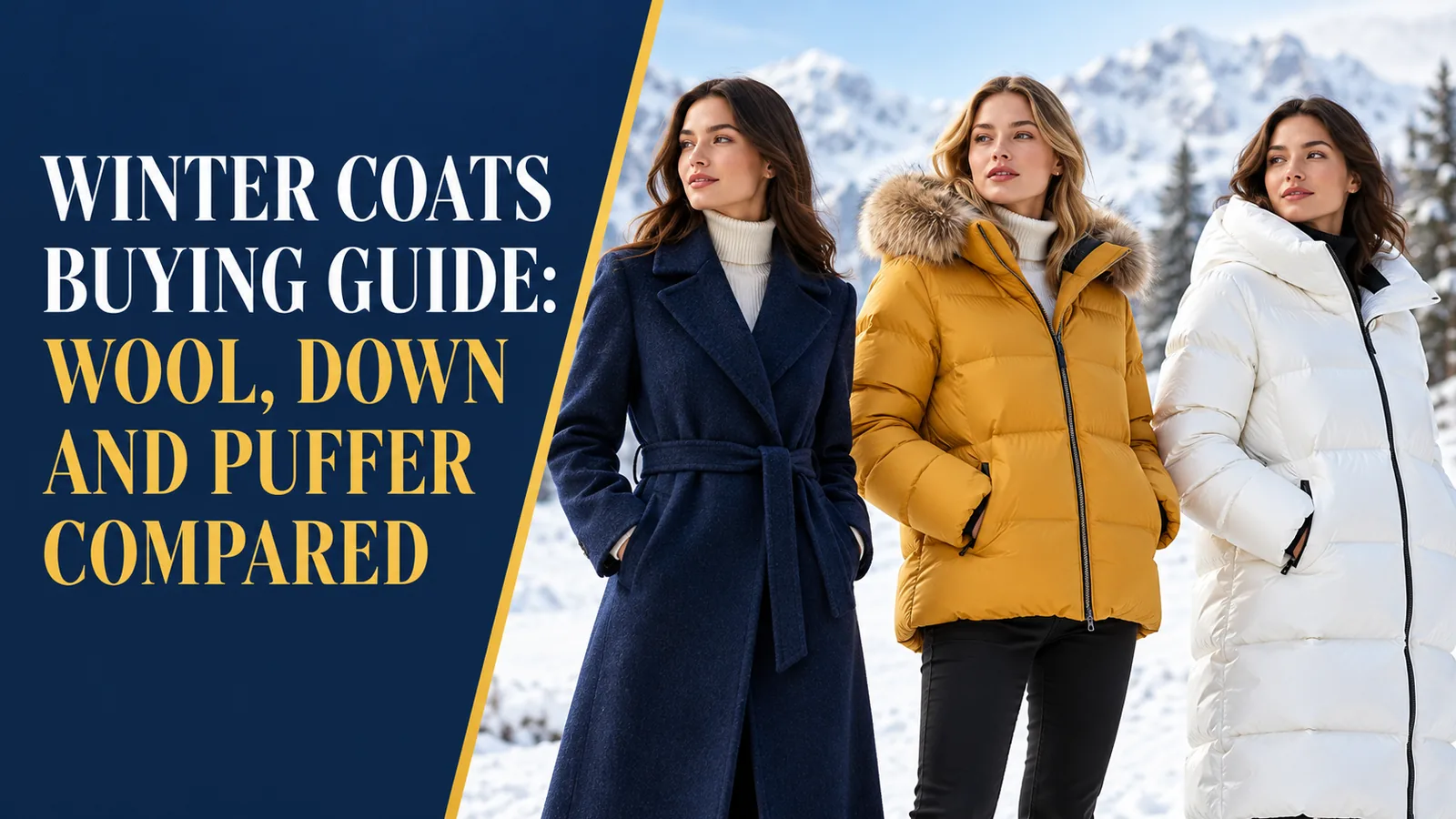
REI’s layering guidance for cold weather makes a point that most coat shopping ignores: down is very warm for its weight but loses insulating power when wet, while synthetic insulation keeps working when damp, which suits rainy conditions. That single trade-off decides more coat purchases than any brand name, because the coat you buy has to match the winter you actually live in.
This winter coats buying guide compares wool coats, down jackets and synthetic puffers by warmth, wet-weather performance, weight and style. It also gives a fit checklist, a table for choosing by climate, care tips and ways to make a coat last. The goal is to help you choose one good coat instead of three disappointing ones.
Start With Your Climate and Daily Routine
Before comparing materials, answer three questions. How cold does it get where you live, is the cold dry or damp, and how do you spend the day: walking to a train, standing at a stadium, driving or commuting by bike? A coat for a short city commute can be lighter and more stylish than a coat for waiting at a bus stop for twenty minutes in sleet.
The same logic applies to layers. REI describes a three-layer system: a base layer that wicks sweat, a middle layer that insulates and an outer layer that protects against wind, rain and snow. A winter coat usually combines the middle and outer layers, so the sweater you wear underneath is part of the system. If you build a wardrobe around a few key pieces, our capsule wardrobe guide shows how a coat fits in.
Wool vs Down vs Synthetic Puffer: Side by Side
| Type | Strengths | Weaknesses | Best for |
|---|---|---|---|
| Wool coat | Classic look, dresses up or down, good with layers | Heavier, can feel less warm in very cold or windy weather without layers, needs careful care | City commutes, work and moderate cold |
| Down jacket or puffer | Very warm for its weight, packs small (REI) | Loses insulating power when wet (REI), needs a water-resistant shell | Dry, very cold weather |
| Synthetic puffer | Keeps working when damp (REI), easier care | Often heavier or bulkier for the same warmth | Wet, cold or changeable climates |
| Fleece mid-layer | Stays warm when damp and dries quickly (REI) | Wind passes through it (REI), so pair with a shell | Layering under a shell |
Wool is natural, breathable and timeless, and it pairs well with scarves and tailored pieces. A wool coat is a good choice for office wear and city life, but in freezing wind you will want a warm layer underneath. Down puffers are the warmest for their weight and compress well for travel, but they need dry cold or a protective shell. Synthetic puffers are the practical choice where winters are damp. Our men’s style guide for 2026 and fall fashion preview for 2026 show how each silhouette is being styled this season.
What to Look For When You Try a Coat On
| Check | What good looks like |
|---|---|
| Fit through shoulders | Seams sit at the shoulder point; you can reach forward without pulling |
| Room for layers | Enough space for a thick sweater without feeling tight |
| Length | Mid-thigh or longer for extra warmth; shorter for ease of movement |
| Collar and hood | Collar closes against wind; hood fits over a hat if you need it |
| Closures | Strong zipper plus storm flap or buttons; wind cannot slip through |
| Pockets | Deep enough for gloves and a phone, with a secure pocket if you travel |
| Sleeves and cuffs | Long enough to cover wrists when your arms are raised; cuffs close against drafts |
| Care label | Check whether it is machine washable, dry clean only or needs special down care |
Try coats on in the afternoon, wearing the layers you plan to use, and move around: sit, reach and raise your arms. If you plan to style the coat over tailored pieces, our guide to how to style oversized blazers explains how to manage volume and proportions.
Choosing by Climate and Budget
For dry, very cold winters, a down puffer with a water-resistant shell is the best warmth for the money. For damp winters, choose synthetic insulation or a waterproof shell over a warm layer. For mild, windy winters, a wool coat with a thick sweater is often enough. Think in cost per wear: a coat you wear every day for five winters costs less than three cheap coats. Our guide to affordable luxury fashion shows how to spot quality at a sensible price.
| Your winter | Choose | Add |
|---|---|---|
| Dry and very cold | Down puffer with a water-resistant shell | Hat, gloves and warm base layers |
| Cold and wet | Synthetic puffer or waterproof shell | Fleece or sweater underneath |
| Cool, windy city | Wool coat | Scarf and thermal layer |
| Changeable weather | Shell plus removable insulated layer | Packable vest |
Care and Making a Coat Last
Follow the care label. Wool coats usually need brushing and occasional professional cleaning, down jackets need gentle washing and thorough drying, and synthetic jackets are generally easier to clean. Hang coats on wide hangers, air them after wet days, and repair small tears early. Store coats cleaned and dry at the end of winter. Quality zips, strong seams and replaceable buttons are worth a premium.