Home
Categories
Free Tools
Write For UsAbout UsContact

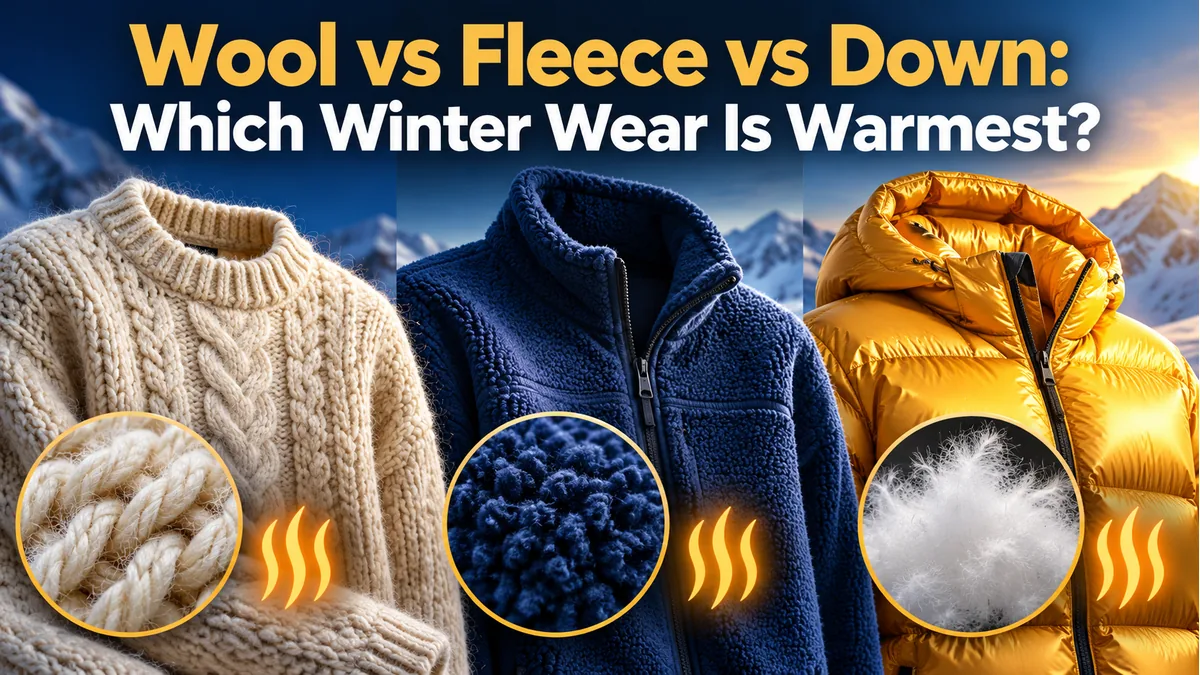
Wool vs Fleece vs Down: Which Winter Wear Is Warmest?

Wool vs fleece vs down: which is warmest? Compare warmth, wet performance, drying time, wind and care using REI guidance, with a pick-by-situation table.

November 12, 2026 Updated November 11, 2026 7 min read
Wool vs Fleece vs Down: Which Winter Wear Is Warmest?

Down is the warmest of the three for its weight, but only while it stays dry. REI’s layering guide calls down the warmest for its weight and adds that it loses insulation when wet, while fleece stays warm when damp and dries quickly, and wool resists odour and does not chill you when it holds a little moisture.

So the real answer depends on weather, activity and budget. Below is a side-by-side table built from REI’s guides, a note on where Advnture’s fleece and wool comparison lands, and a decision list for common situations. For the full fabric tour, read winter fabrics explained, and for the wardrobe context start with the winter clothes for women guide.

The Head-to-Head Table

FactorWool (merino)FleeceDownSource
Warmth for weightGoodGoodBestREI (down); others ours
When wetDoes not chill you with moisture in its core; dries slowlyStays warm when damp; dries quicklyClumps and loses loft; slow to dryREI
WindNot covered in sources we readWind passes throughDepends on the outer shellREI (fleece)
OdourResists odour-causing bacteriaNot covered in sources we readNot coveredREI (wool)
DurabilityModerate (merino base layer)Not coveredNeeds careful careREI
PriceVaries; not verifiedVaries; not verifiedHigher fill power costs moreREI jacket guide
CareFollow label; dries slowlyNot covered in sources we readDetergent-free cleaner, low-heat drying with tennis balls, hang to storeREI

Where the table says ‘ours’ or ‘not covered’, we did not find the claim in the sources we read, so treat those cells as general guidance only. We have not tested garments ourselves.

Which Is Warmest for Everyday Winter Days?

For dry, cold days, down. REI says fill power ranges from about 450 to 900, and higher numbers trap more air. For a normal commute, a 650-fill jacket can be much cheaper than loftier ones. For wet or changeable days, synthetic insulation or fleece may keep you warmer in practice, since both keep working when damp. If your coat is the main concern, compare options in the best winter jackets for women guide.

Is Wool or Fleece Better?

Advnture’s 13 January 2024 comparison of the two says there is no clear winner, and that matches REI’s notes. Fleece wins on drying speed and damp warmth. Wool wins on odour resistance and feel. Fleece also arrived late: Advnture says it was introduced as Polartec in 1979. If you wear one layer for several days, choose wool. If you sweat and need quick drying, choose fleece.

Which Should You Choose in Each Situation?

SituationOur pickWhy
Dry, very cold commuteDown jacket over a wool knitWarmest for weight
Rainy winter citySynthetic jacket over fleeceBoth keep working when damp
Office all dayMerino base and wool knitResists odour; neat look
Walk or light exerciseSynthetic base, fleece, shellFast drying and wind protection
Long trip with limited luggagePackable down or synthetic jacket, merino basePacks small and layers well
Tight budgetSynthetic fill and fleeceREI says synthetic is generally cheaper

The picks are our recommendations. Climate, body temperature and activity change the best answer, so use them as a starting point. For examples of how to combine these pieces without bulk, read how to layer winter clothes without looking bulky.

Can You Combine Them?

Yes, and that is usually best. REI’s three-layer system pairs a moisture-wicking base with an insulating middle and a protective outer. A merino base, a fleece middle and a down or wool outer combine the strengths and cover the weaknesses. Use our winter wardrobe checklist to see which jobs you already cover.

What About Price?

REI says synthetic insulation is generally less expensive than down, and gives a 650-fill down jacket as costing about half as much as loftier options. We did not verify fleece and wool prices across brands. If you want a discount, compare prices over time. Our price history tracker guide explains how.

What Should You Look for on Labels?

Check the main fabric percentage, the fill type for jackets and the fill power for down. REI says fill power is the cubic inches filled by one ounce of down, and that duck down generally tops out at 750 or 800. Premium goose down can reach 900 or higher.

Look for care instructions you can follow at home. A jacket that needs special cleaning may cost more over time. For help with the style side of the decision, read winter fashion trends for women and the winter coats buying guide.

Related readWinter Fabrics Explained: Wool, Fleece, Down and ThermalRead →

Free tools for Fashion & Beauty

FAQs

Is down warmer than wool or fleece?

For its weight, yes. REI says down is the warmest of the insulating options, but it loses insulation when wet and takes longer to dry. Wool and fleece are usually heavier for the same warmth, but they handle damp better. Pick by weather rather than by a single warmth score. If you are unsure, buy the most versatile piece first, such as a mid-weight fleece or knit, and add a specialised piece later.

Is fleece or wool better for winter?

Advnture’s comparison concludes there is no clear winner. Fleece dries quickly and stays warm when damp, and wind passes through it. Merino wool resists odour and does not chill you with moisture in its core, but it dries slowly. Choose based on weather, activity and how many days you wear it. Both are useful in layers, and many people wear a fleece under a shell on cold, damp days to keep the warmth without bulk.

What is warmer, a fleece or a down jacket?

A down jacket is usually warmer for the same weight, according to REI, as long as it stays dry. A fleece is bulkier but keeps working when damp and dries faster. In wet weather, fleece plus a shell can outperform down. For dry cold, down is hard to beat. For long walks or exercise, choose breathable layers that you can open or remove, because overheating can make you damp and cold later.

Does wool keep you warm when wet?

REI says merino wool does not chill you when moisture stays in its core, but it feels less dry than synthetics and takes longer to dry. It is not waterproof. Wet wool can still feel heavy and cool, so wear a shell over it in rain or snow. Add a wind-blocking outer layer if it is breezy, and dry wool completely before storing it so it stays fresh for the next day.

Which is cheaper: down, fleece or wool?

REI says synthetic insulation is generally cheaper than down, and that a 650-fill down jacket costs about half as much as loftier ones. We did not verify fleece and wool prices. Prices vary widely by brand and sales, so compare models and check price history. Check the label and the fill details before buying, and compare similar models, since the same fabric can vary widely in cost.

What should I wear for very cold weather?

Use a heavyweight base layer, as REI suggests for below-freezing temperatures, then a warm middle layer and an insulated jacket. Down gives the best warmth for weight in dry cold, while synthetic insulation is safer in damp conditions. Add a hat, gloves and wool socks. Ensure your boots are roomy enough for thick socks, because tight footwear reduces circulation and can leave your feet colder.

The Warmest Choice Is the One That Suits Your Day

No single fabric wins every day. Use down for dry cold, fleece for damp activity and wool where odour and feel matter, and layer them for the best of each.

Look at your current coat and middle layers, name their fabrics and note the weather each one handles best.

Sources: REI: Layering Basics (reviewed 23 August 2024); REI: Down vs Synthetic Insulation; REI: The 6 Best Insulated Jackets of 2025 (updated 18 November 2025); REI: How to Choose Base Layers (updated 1 August 2024); Advnture: Fleece vs wool (13 January 2024)

Was this guide helpful?
Jinal Mistry
Written by

Jinal Mistry

Jinal Mistry is the Founder of WritoryBuzz and an SEO & Digital Growth Specialist with 5+ years of experience in Technical SEO, AI SEO, International SEO, and organic growth strategy. She helps businesses improve search visibility through data-driven SEO, content optimization, search experience enhancement, and AI-focused search strategies.Having worked with clients across multiple industries and international markets, Jinal specializes in building sustainable organic growth through technical excellence, user-focused optimization, and future-ready digital marketing practices. Through WritoryBuzz, she shares insights on SEO, AI search, content strategy, digital marketing, and emerging search trends to help businesses and marketers stay ahead in the evolving digital landscape.

More from this author

More in Fashion & Beauty

View all in Fashion & Beauty →

Keep exploring

Have expertise to share? Write for WritoryBuzz.Read the guidelines and send us your pitch.
Become a contributor
Free tools

63 free tools for writers, SEOs and developers

Open one in your browser and start. Nothing to install, and your text stays on your device.

PrivateInstant resultsNo sign up
Write for us

Have expertise to share?

  • Original, well researched guides
  • Reviewed by our editors
  • 29 categories to publish in
Submit a guest post
© 2026 WritoryBuzz. All rights reserved.Back to top