Home
Categories
Free Tools
Write For UsAbout UsContact

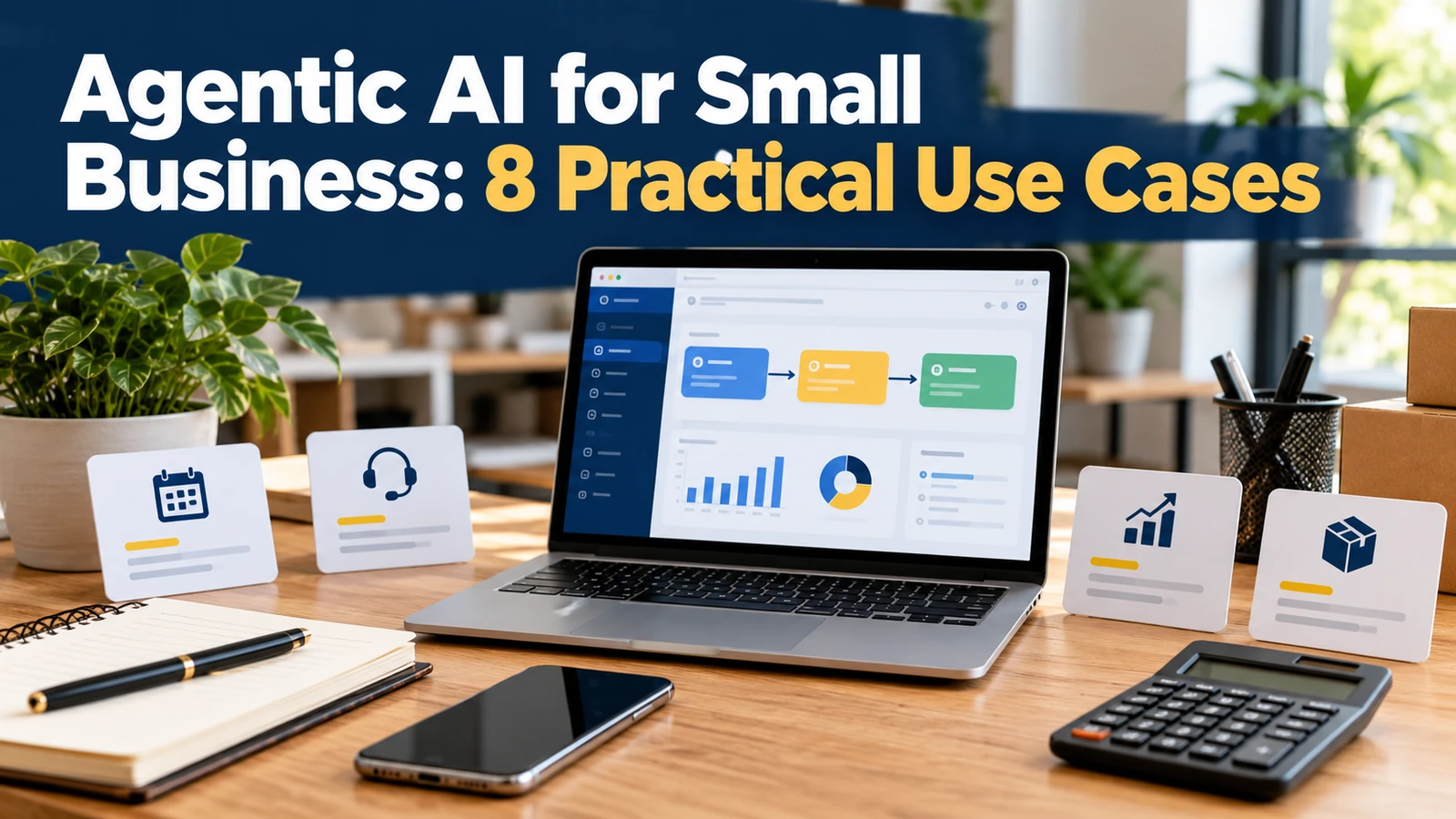
Agentic AI for Small Business: 8 Practical Use Cases

Agentic AI for small business made practical: 8 use cases, how to start with one agent, what to automate first and the human checks that keep customers...

October 27, 2026 Updated November 4, 2026 6 min read
Agentic AI for Small Business: 8 Practical Use Cases

Key takeaways

  • Rework, citing the US Chamber of Commerce, says almost 60 percent of small firms use AI for operations and 58 percent use generative AI.
  • The eight use cases are reminders, inbox and chat replies, review responses, social media, collections, lead follow-up, email marketing and content drafting.
  • Rework advises picking your costliest problem, writing the rules down and running one agent first.
  • Keep a human in the loop and escalate sensitive cases such as complaints, refunds and anything with legal or health risk.
  • If an agent records or transcribes calls, notify people, since the same consent rules apply when an AI tool does the recording, per Reed Smith.

Rework’s guide to AI agents for small business, updated on October 8, 2026, cites the US Chamber of Commerce as saying almost 60 percent of small businesses use AI for operations, and that 58 percent use generative AI, up from 40 percent in 2024. Adoption is no longer the question; the question is which jobs an agent should take first.

This guide covers agentic AI for small business through eight practical use cases, a simple way to start with one agent, and the checks that keep a human in charge. It draws on Rework and Reed Smith’s legal note on AI recording and transcription.

What Agentic AI Means for a Small Business

A chatbot answers a question. An agent takes a goal, such as follow up with every new enquiry within an hour, and carries out several steps to reach it: read the message, check your calendar, draft a reply and log the lead. It still follows rules you set.

That makes agentic AI for small business useful for repetitive, rules-based work, and risky for judgement calls. Our explainer on agentic AI for business covers the core ideas, and our piece on agentic AI workflows shows how steps chain together.

8 Practical Use Cases for AI Agents in a Small Business

Rework lists eight use cases that suit small teams. Start with the one that costs you the most time or money.

Use caseWhat the agent doesHuman check
Appointment remindersSends reminders and handles reschedulesReview no-shows and special cases
Inbox and chat repliesAnswers common questions and routes the restApprove replies on complaints and pricing
Review responsesDrafts replies to customer reviewsApprove before posting, especially negative reviews
Social mediaDrafts and schedules postsCheck tone, facts and brand fit
CollectionsSends payment reminders on a scheduleStep in on disputes and hardship cases
Lead follow-upContacts new enquiries and books callsReview high-value leads
Email marketingDrafts campaigns and segments listsApprove every send
Content draftingProduces first drafts of posts and pagesEdit, fact-check and add expertise

How to Start With One Agent in Three Steps

Rework’s deployment advice is simple: pick the costliest problem, write the rules, and run one agent first. Do not buy five tools at once.

StepWhat to doExample
1. Pick the costliest problemList where staff lose the most hours each weekAnswering the same booking questions
2. Write the rulesDefine what the agent can say, offer and refuseIt may reschedule, but never refund
3. Run one agentPilot for a few weeks with a named ownerReview every reply daily at first

Our list of free AI tools for small businesses is a good place to find low-cost options for a pilot.

Where Small Businesses Should Not Hand Over Control

Rework cautions that you should keep a human in the loop and escalate sensitive cases. Treat anything involving money disputes, legal claims, medical or safety questions, and angry customers as a handover to a person.

Set a clear escalation rule, such as: if the message mentions a refund, a complaint or a lawyer, stop and notify a named person. Our guide to AI customer service resolution shows where automation helps and where it hurts.

Privacy, Recording and Customer Trust

If an agent listens to calls or transcribes meetings, treat the recordings as personal data. Reed Smith says the same consent obligations apply whether a person or an AI tool records, and some US states need all-party consent.

RiskPractical safeguard
Recording without consentTell callers up front and get agreement
Vendor uses your data for trainingAsk for written data-protection terms
Wrong answers to customersLimit the agent to approved information
No audit trailKeep logs of what the agent sent and why

This is general information, not legal advice. If you handle sensitive data or serve customers in several states or countries, ask a qualified adviser.

How to Measure Whether the Agent Is Working

Choose two or three numbers before you start: time saved per week, response time and error rate. Compare them after a month. If the agent saves time but customers complain more, tighten its rules.

Review a sample of conversations each week, note repeated mistakes and update the rules. An agent that is never reviewed will drift, and customers will notice before you do.


Related readAI Image Generators Compared: Quality, Licence and PriceRead →

Free tools for Artificial Intelligence

FAQs

What is agentic AI for small business?

It is software that takes a goal and carries out several steps to reach it, such as replying to an enquiry, checking your calendar and booking a call. It follows rules you set. It suits repetitive tasks, and a person should handle complaints, refunds and anything with legal or safety risk. Think of it as a junior assistant that works quickly from your written playbook and asks you when a case falls outside the rules.

Which task should a small business automate first?

Rework advises starting with your costliest problem, writing the rules and running one agent first. For many firms that means appointment reminders, inbox replies or lead follow-up, because the work is repetitive and the rules are clear. Measure time saved before adding a second agent. Write down how many hours the task takes now, so you can show clearly whether the agent has paid for itself after a month.

How many small businesses use AI?

Rework, citing the US Chamber of Commerce, says almost 60 percent of small firms use AI for operations and 58 percent use generative AI. Figures depend on the survey and definition, so use them as a guide to direction rather than a precise count. Survey wording and sample sizes vary, so cite the source whenever you quote a figure in your own planning or to your team.

Is it safe to let an AI agent reply to customers?

It can be, if you limit it. Give it approved information, set clear rules on what it may offer, and escalate complaints, refunds and sensitive cases to a person. Rework recommends a human in the loop. Review a sample of conversations weekly and keep logs. Tell customers when they are talking to an automated assistant, and always offer an easy way to reach a person.

Do I need to tell customers when an AI records a call?

Often yes. Reed Smith says the same consent obligations apply whether a person or an AI tool records, and some US states require all-party consent. Tell people at the start and get agreement. For your location, ask a qualified lawyer. Written notice in a booking confirmation or a short spoken line at the start of a call both help to create a record of consent.

How much does it cost to try an AI agent?

It varies widely by tool and volume, and no single price applies. Many tools offer free or low-cost starter plans, so run a small pilot on one task before committing. Compare the monthly fee with the hours saved, and check what happens to your data. Also count setup time, staff training and any monthly fees for add-ons, since those often matter more than the headline price.

Start Small, Then Earn the Next Agent

Agents will keep getting more capable, and the temptation will be to hand them more. The smarter path is to let each one earn its place.

Pick one costly task this week, write three rules for it and run a four week pilot with a named owner. If the numbers improve and customers stay happy, add the next agent. If not, you have lost little and learned plenty.

Sources: Rework: AI agents for small business, 8 use cases; Reed Smith: The legality of AI-powered recording and transcription

Was this guide helpful?
Jenny Edwards
Written by

Jenny Edwards

Jenny Edwards is an SEO and Digital Growth Specialist with 5+ years of experience in Technical SEO, AI SEO, International SEO, and organic growth strategy. She helps businesses improve search visibility through data-driven SEO, content optimization, search experience improvements, and AI-focused search strategies. Her work focuses on helping brands grow through sustainable and future-ready digital marketing.

More from this author

More in Artificial Intelligence

View all in Artificial Intelligence →

Keep exploring

Have expertise to share? Write for WritoryBuzz.Read the guidelines and send us your pitch.
Become a contributor
Free tools

63 free tools for writers, SEOs and developers

Open one in your browser and start. Nothing to install, and your text stays on your device.

PrivateInstant resultsNo sign up
Write for us

Have expertise to share?

  • Original, well researched guides
  • Reviewed by our editors
  • 29 categories to publish in
Submit a guest post
© 2026 WritoryBuzz. All rights reserved.Back to top