
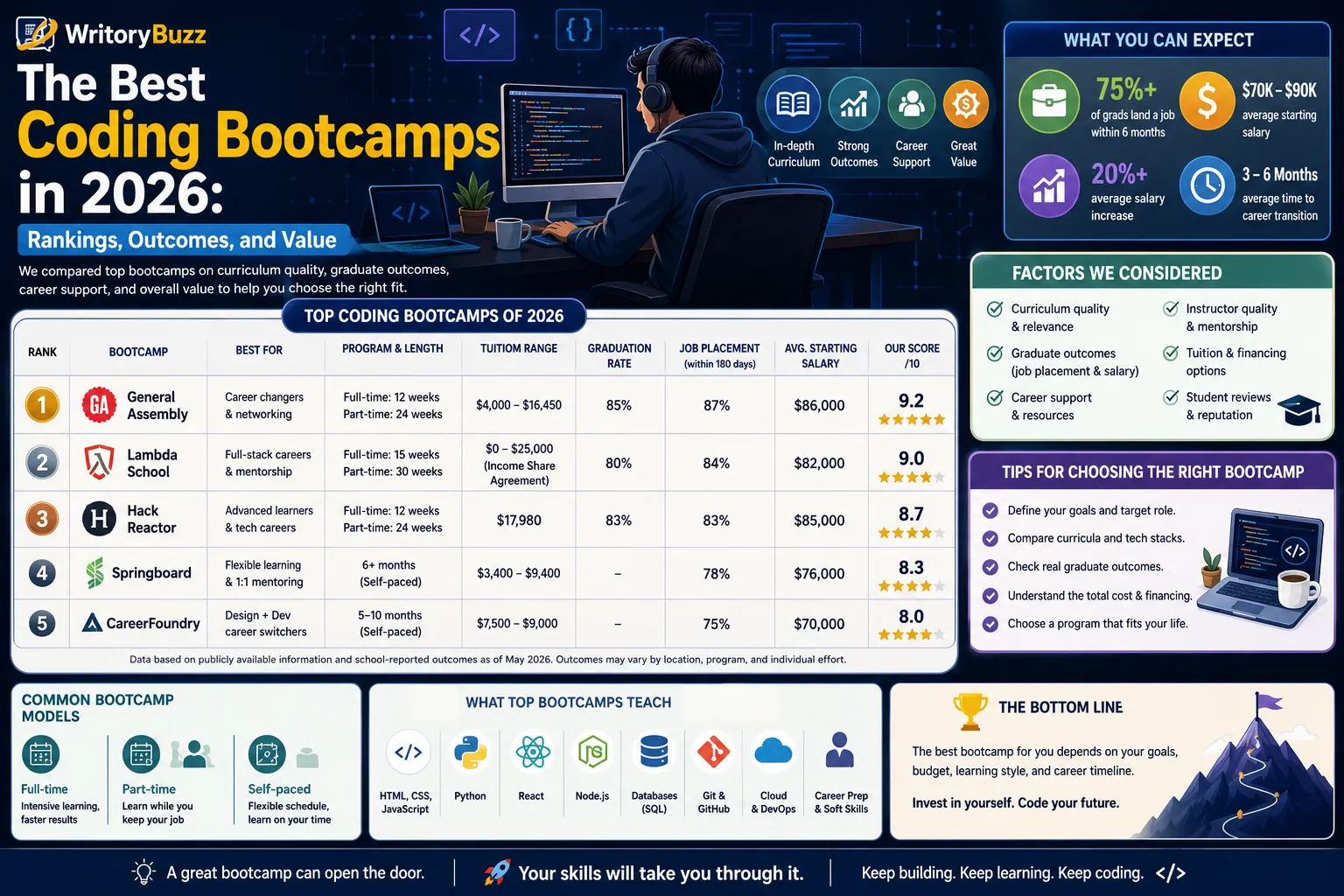
The bootcamp sector generated $826 million in tuition revenue in 2024, a 10 percent year-on-year increase. The average coding bootcamp cost $13,584 in 2026. Top-tier bootcamps report placement rates of 80 to 96 percent. Increased CIRR auditing means outcomes are harder to fake than they were in 2020. These rankings use verified or auditable placement data.
A coding bootcamp is a 12 to 24-week intensive programme covering software engineering, data science, UX design, or cybersecurity. Graduates report average first salaries of $70,698 according to Course Report 2026, against a median software developer salary of $146,869 (BLS). The ROI calculation depends significantly on which bootcamp you attend and how committed you are to the job search.
The Rankings: Top Programmes by Verified Outcomes
App Academy — Best Overall
App Academy consistently tops independent bootcamp rankings. 85 percent-plus placement rate. Income Share Agreement option: pay after you get a job (17.5 percent of first-year salary). Rigorous admissions: not everyone is accepted. 16-week full-time programme covering full-stack JavaScript and Ruby on Rails. CIRR-audited outcomes (App Academy stopped CIRR reporting after 2023 but independent tracking maintains the record). Software Engineering focus with a strong cohort experience.
Best for: Career-changers who can commit to 16 weeks full-time, can pass selective admissions, and want the ISA option to reduce financial risk.
Hack Reactor — Best Cohort Experience
12-week immersive full-stack JavaScript programme with daily stand-ups, pair programming, and real team sprint simulation from day one. The programme mimics a real development team environment more closely than most competitors. Strong alumni network across Silicon Valley and major tech hubs. Tuition approximately $17,980. Part-time option available at 36 weeks.
Best for: Those who want maximum immersion and a cohort experience, can clear their schedule for 12 intense weeks, and want a brand that recruiters recognise.
Springboard — Best for Self-Paced Learners with Job Guarantee
86 to 91.5 percent placement rate within 12 months with a full tuition refund job guarantee if you complete all requirements and do not land a qualifying role within 6 months. Self-paced with weekly 1-on-1 mentor calls from industry professionals. Covers software engineering, data science, UX design, and cybersecurity. 9 months part-time. Cost approximately $9,900 to $16,000 depending on track.
Best for: Working professionals who cannot leave their jobs, self-motivated learners who need accountability without daily class attendance, and those who want a job guarantee.
General Assembly — Best Brand Recognition and Global Network
GA reports approximately 96 percent placement rates for immersive graduates, though the definition and timeline are worth querying directly. 110,000-plus alumni network globally. In-person options in multiple US and international cities. 12-week Software Engineering Immersive. Tuition $16,450 (GI Bill eligible for veterans). Part of the Adecco Group with direct hiring relationships.
Best for: Those who want established brand recognition, a global alumni network, or in-person cohort options. GA’s career services network is among the strongest.
Flatiron School — Best for Computer Science Depth
Flatiron combines computer science fundamentals with hands-on project work. Placement rate approximately 90 percent within 6 months. Multiple track options: software engineering, data science, cybersecurity, and product design. Flexible formats (full-time, part-time, self-paced). Tuition approximately $16,900. Strong career services with real support rather than DIY job searching.
Per Scholas — Best Free Option
Per Scholas offers grant-funded IT and cybersecurity training at zero cost to students. No ISA, no deferred payment, genuinely free. Admission is competitive and prioritises underrepresented communities in 20-plus US cities. For eligible candidates, Per Scholas produces comparable outcomes to paid programmes with zero financial risk.
The ISA vs Upfront Payment Decision
Income Share Agreements require no upfront payment but take a percentage of future salary (typically 10 to 17 percent) for 2 years after a salary threshold is reached. The maths: an ISA at 17.5 percent for 2 years on a $70,000 first salary costs $24,500 total versus $17,000 upfront. ISAs cost more if you get a good job. They cost less if you do not. They transfer financial risk from student to bootcamp, which aligns the bootcamp’s incentives with your success.
Warning: Placement Rate Scepticism
Independent reviews consistently note that headline placement rates require scrutiny: ask each bootcamp the timeframe, the definition of a qualifying job, whether non-completers are excluded from the denominator, and whether the rate is CIRR-audited by an independent third party. A 96 percent placement rate counting any employment-related outcome within 12 months is a different number from a CIRR-audited rate counting jobs above a minimum salary within 6 months of graduation.
What is the best coding bootcamp in 2026?
App Academy and Hack Reactor consistently lead independent rankings on verified outcomes. Springboard leads for self-paced formats with the strongest job guarantee. General Assembly leads for brand recognition and global network. Per Scholas is the top free option for eligible candidates. Best depends on format preference, financial situation, and location.
How much do coding bootcamps cost in 2026?
Average cost is $13,584 (Course Report 2026). Range from free (Per Scholas, grant-funded) to $24,000 (some premium programmes). Mid-range options $9,000 to $17,000 cover most top programmes. Income Share Agreements allow deferred payment as a percentage of post-graduation salary.
What is the job placement rate for coding bootcamps?
Top programmes report 80 to 96 percent placement rates. Increased CIRR auditing has made outcomes harder to misrepresent than in earlier years. When evaluating placement claims, ask: what timeframe, what counts as a qualifying job, are non-completers excluded, and is the data third-party audited. Average first salary for bootcamp graduates is $70,698 (Course Report 2026).
What is an Income Share Agreement for a coding bootcamp?
An ISA defers tuition payment until after graduation and employment. Students pay a percentage of salary (typically 10 to 17.5 percent) for a defined period (typically 2 years) once earning above a threshold. ISAs cost more in total if you get a well-paid job. They transfer financial risk from student to the bootcamp, aligning the bootcamp’s incentives with your employment success.
Can you really get a software developer job from a coding bootcamp?
Yes, with caveats. Top bootcamp graduates entering the job market with strong portfolio projects, active networking, and effective interviewing practice do land software developer roles. The process takes active effort: average job search time after graduation is 3 to 6 months. Graduates from more selective programmes with stronger career services have measurably better outcomes.
How do you choose between full-time and part-time bootcamps?
Full-time (12 to 16 weeks) is faster to completion and more immersive. Requires ability to stop working for the duration. Part-time (6 to 9 months) is compatible with employment but requires strong self-discipline over a longer period. Self-paced (Springboard, Scrimba) requires highest self-motivation but maximum scheduling flexibility.
Verify the Outcomes Before the Tuition
The bootcamp you choose should have verifiable outcomes data you can scrutinise, a career services programme you can evaluate concretely, and an ISA or job guarantee that demonstrates confidence in their own placements. Programmes unwilling to provide specific, auditable placement data are telling you something about what that data looks like.
The right coding bootcamp can accelerate your tech career and open new opportunities. Follow WritoryBuzz for expert insights on coding, software development, career growth, online learning, and the latest technology trends to help you make informed decisions.