
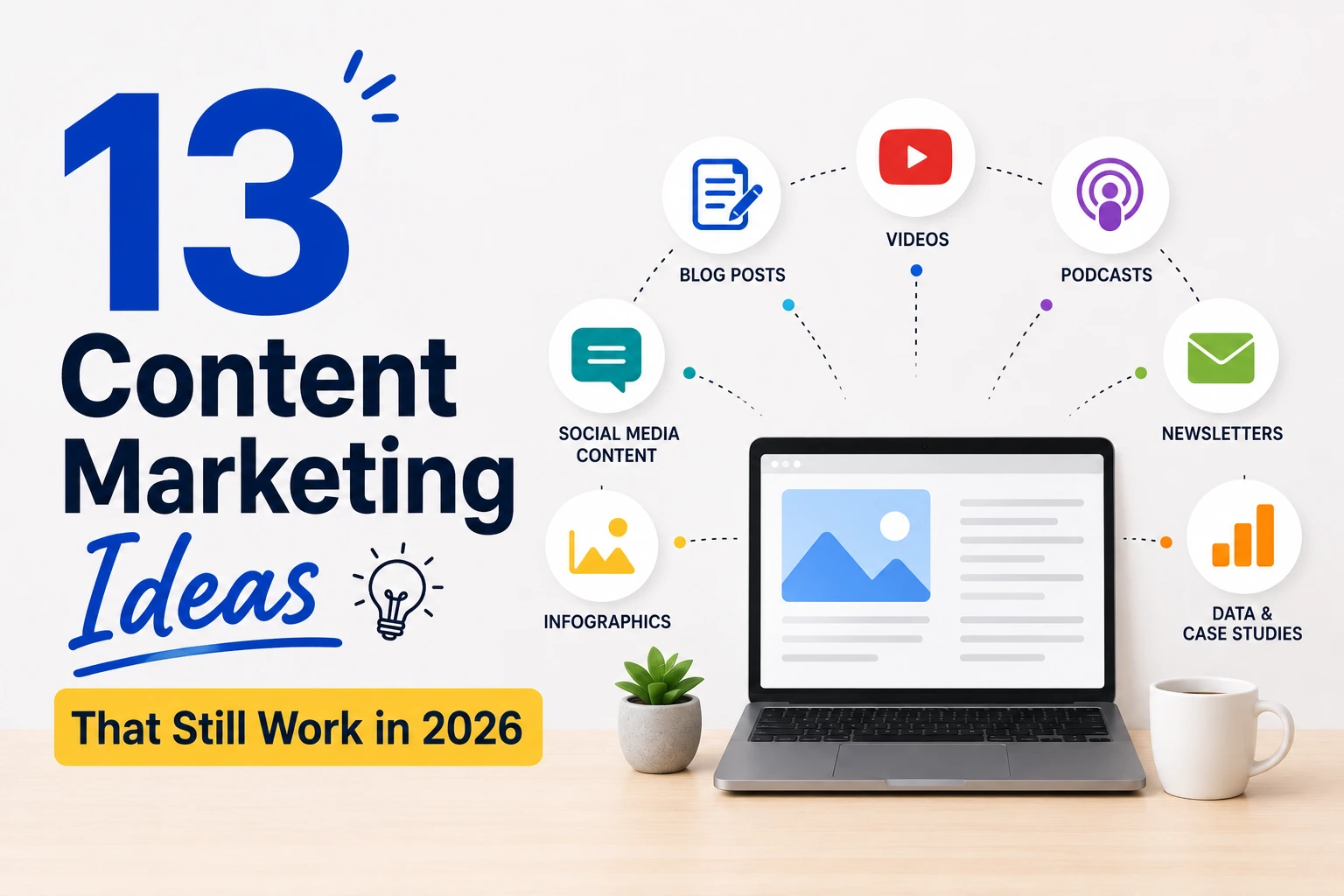
Live video generates 24 times more engagement than standard posted content, according to data cited in Averi’s 2026 content marketing trend research. HubSpot’s 2025 marketing survey found blog posts were the third most used content format among marketers at 38 percent adoption, and also ranked among the top five highest-ROI formats. Seventy-two percent of global marketers report they have completely rebuilt their strategies around privacy-first data models as third-party cookies have effectively disappeared. The content playbook that worked 18 months ago is measurably obsolete, and the ideas that replaced it are backed by data, not guesswork.
Millions of people now get ideas, education, and product recommendations directly from ChatGPT, Perplexity, and Google’s AI Overviews, which places a generative engine between a brand and its audience for the first time. That shift, often called zero-click content, is reshaping which formats and structures actually earn attention in 2026. The 13 ideas below reflect what is working right now: some are new tactics born from AI-mediated search, others are old fundamentals that matter more than ever because AI has raised the cost of mediocre content. If you are building the technical foundation these ideas sit on, our guide to building a viral content strategy that compounds is a useful companion read.
The Shift Behind Every Idea on This List
Two forces are reshaping content marketing in 2026, and understanding them explains why the tactics below work. The first is zero-visit visibility. A large and growing share of content is consumed without a click, summarised or cited inside an AI answer rather than read on the original page. WordStream’s 2026 trend research argues this is the single most influential shift of the year, because it forces marketers to rethink channel priority, on-page structure, and what “success” even means for a piece of content.
The second force is the collapse of third-party tracking. With third-party cookies effectively gone, 62 percent of brand marketers say first-party data will become more important over the next two years, according to the same 2026 industry research. For resource-constrained teams, this is not purely bad news. Startups and small publishers were never dependent on the legacy tracking infrastructure the way large advertisers were, which means they can build first-party relationships, email lists, community, direct product usage data, correctly from day one rather than migrating away from something broken.
1. Build Content for Zero-Click Citation, Not Just Clicks
The single biggest structural shift in 2026 is designing content to be cited inside AI answers, not only to be clicked from a search results page. This means writing self-contained, directly-answered passages, using clear question-and-answer structure, and naming specific facts and sources that an AI system can safely extract and attribute. A paragraph that requires the reader to scroll up for context is a paragraph an AI Overview will skip.
This does not replace traditional SEO. It sits alongside it. A page that ranks well and gets cited by AI systems captures both the visitor who clicks and the visitor who reads the citation and remembers the brand name. Structure a portion of every long-form piece, FAQ sections, definition paragraphs, key statistics, specifically for extraction, and measure brand mentions inside AI answers as a metric alongside traditional traffic.
2. Treat E-E-A-T as a Structural Requirement, Not a Guideline
In 2026, good writing is table stakes. What separates content that ranks and gets cited from content that does not is visible proof behind it: real authorship, demonstrated experience, and third-party confirmation. Industry analysis from Digital Elevator’s 2026 trend research calls E-E-A-T the most important ranking factor trend of the year, and recommends adding proof blocks to key pages that state who wrote the content, why they are qualified, and how the piece was reviewed.
The practical version of this idea is simple to execute and rarely done well: attach a named, credentialed author to every substantial piece of content, cite real sources rather than vague “studies show” phrasing, and where possible, back claims with original data your brand collected. Google’s raters and AI extraction systems both reward the same signal, verifiable expertise, which makes this one idea that pays off across every channel at once.
3. Publish Original, Citable Assets
Original benchmark data, teardown studies, templates, checklists, and simple calculators earn something generic blog content cannot: citations from other publishers and mentions inside AI-generated answers. Digital Elevator’s 2026 guidance specifically recommends this as a way to earn third-party mentions through digital PR, podcasts, and partnerships, because journalists and other content creators need something concrete to point to, and a proprietary statistic or tool gives them exactly that.
This idea requires more upfront effort than a standard article, which is precisely why it works. A small survey of your own customers, an analysis of your own product usage data, or a free calculator addressing a specific pain point becomes a durable asset that keeps earning links and citations long after a standard post has faded from relevance. One well-executed original asset can outperform a dozen ordinary posts in long-term authority.
4. Go Live: The Highest-Engagement Format Nobody Is Using Enough
Live video generates roughly 24 times more engagement than typical posted content, and formats like live Q&As, product demos, and behind-the-scenes sessions require zero post-production, which makes them unusually efficient for resource-constrained teams. The insight behind this format’s strength in 2026 is behavioural: audiences increasingly reward content that feels like a real person made it for other people, not a polished corporate production.
For a small team, this is an advantage disguised as extra work. A weekly live session, answering customer questions, demoing a new feature, discussing an industry event, costs almost nothing to produce and consistently outperforms scripted alternatives on engagement. Startups in particular are advised to stop trying to look like a big company and instead look like founders who know their subject, which live formats convey more convincingly than any edited video can.
5. Build First-Party Data Assets Deliberately
With third-party cookies effectively gone and 72 percent of marketers rebuilding strategy around privacy-first data, the brands winning in 2026 are treating email lists, community membership, and product usage data as owned assets, not afterthoughts. Unlike a legacy company migrating off broken third-party infrastructure, a growing brand can build first-party relationships correctly from the outset, which is a genuine structural advantage.
The content implication is direct: every piece of content should have a clear path to an owned relationship, a newsletter signup, a community invite, a free tool that requires an email. Content that only optimises for pageviews leaves this value on the table. Content that consistently converts a portion of its audience into an owned list compounds in value long after the traffic that originally found it has moved on to something else.
6. Repurpose Deliberately Into a Connected Content Ecosystem
One strong long-form post can become a LinkedIn thread, a short video, a webinar outline, and a downloadable checklist, and treating this repurposing as deliberate strategy, rather than an afterthought, is one of the highest-leverage ideas available to a small content team. Industry guidance in 2026 describes this as building a connected content ecosystem: a core idea that branches across formats and platforms rather than a series of disconnected posts.
The efficiency case is straightforward. Producing five distinct pieces of content from one well-researched core idea costs far less than producing five unrelated pieces from scratch, and each format reaches a segment of the audience that prefers it. Treat every cornerstone piece as a hub: plan its repurposed formats before you publish the original, not as an afterthought once it is already live.
7. Use AI as a Collaborator, Not a Strategy Substitute
Ninety-five percent of B2B marketers report their organisations now use AI-powered applications, but the meaningful 2026 shift is deploying AI for execution while keeping strategy, insight, and perspective firmly in human hands. Audiences can increasingly identify content that lacks specificity and a distinct point of view, which is exactly what happens when AI generates a piece end to end without a human directing its argument.
The winning pattern in 2026 is AI embedded across the workflow, ideation support, drafting speed, image variation, editing, rather than AI replacing the strategic decisions about what to say and why it matters. Teams that let AI move faster on production while a human retains the point of view are outperforming both the teams ignoring AI entirely and the teams who let it write unsupervised. The differentiator is no longer whether you use AI. It is what you keep for yourself.
8. Deploy Specialised AI Agents for Repetitive Workflows
Beyond using AI as a writing assistant, 2026 marks the shift toward AI agents that execute complete workflows autonomously: generating audience-specific ad variations from a single parent creative, adapting one visual across multiple platform formats, or managing a content calendar’s publishing cadence without manual handoffs. Marketing teams report deploying these agents specifically to offload repetitive production tasks, freeing human time for the creative decisions that still require judgment.
This idea matters most for lean teams without a large production staff. An agent that automatically resizes and adapts a hero visual for six ad formats, or that routes a drafted post through review and scheduling, removes hours of manual busywork per week. The teams gaining the most ground in 2026 are not the ones with the biggest headcount. They are the ones who offloaded the mechanical work to agents and kept the strategic work for themselves.
9. Build Hero Content Around Genuine Expertise, Not Trend-Chasing
Rather than producing high volumes of thin content chasing every algorithm shift, the brands standing out in 2026 are building fewer, deeper hero pieces anchored in genuine expertise, then supporting them with a network of related content. This approach, sometimes called expertise-driven content, treats each major piece as a long-term asset worth significant research investment rather than a disposable post competing for a week of attention.
The behavioural logic supports this: 2025 proved that more content did not mean better results, and audiences have grown more discerning about which sources they trust. A single deeply researched hero piece, built around real data or firsthand experience, tends to outperform ten shallow posts on the same topic, both in search performance and in the trust it builds with readers who remember where they learned something.
10. Structure Content for Multimedia From the Start
Text-only pages are increasingly limiting in 2026, and the recommended approach is treating each key piece of content as a hub: a written summary, supporting visuals, a short video clip, and internal links to deeper related pages, all built together rather than a video added as an afterthought to a finished article. HubSpot’s research also notes marketers are increasing investment in video-heavy formats and user-generated content alongside blog posts, not instead of them.
For a small team, this does not mean producing a full video for every post. It means planning the multimedia components at the same time as the written piece, so a short explainer clip, a chart, or an embedded demo becomes part of the content’s original structure rather than a separate project scheduled for later that never actually happens. Multimedia hubs perform better because they serve more ways of consuming the same information.
11. Build Direct Relationships That Competitors Cannot Buy
Email lists, community membership, and product usage data are described in 2026 startup guidance as assets your competitors literally cannot purchase, unlike ad inventory or influencer placements. As third-party targeting weakens across the industry, the durability of a direct, owned relationship with an audience becomes proportionally more valuable, because it does not depend on a platform’s algorithm or a data broker’s cookie.
The content idea here is to treat every channel as a funnel toward a direct relationship rather than an end in itself. A social post that earns a follow is good. A social post that earns a newsletter signup or a community join is better, because it survives a platform algorithm change or a policy shift that a follower count cannot. Prioritise content formats and calls to action that convert attention into an owned, direct connection.
12. Prepare for AI-Mediated Purchasing
Consumers are beginning to buy directly through AI interfaces like ChatGPT, skipping brand websites entirely, and Content Marketing Institute’s 2026 research flags this as a shift that will force marketers to rethink how they control messaging inside a purchase journey they no longer fully own. The early recommendation is for content teams to start building brand agents and structured product information that can deliver a consistent, accurate brand experience even when the interaction happens inside someone else’s AI interface.
This idea is still emerging, which is exactly why acting early on it is valuable. Ensuring your product data, pricing, and differentiators are structured, accurate, and machine-readable, through schema, a clean API, or a well-maintained knowledge base, positions a brand to be represented correctly when an AI system answers a purchase question on its behalf, rather than being misrepresented or omitted entirely.
13. Measure Outcomes Beyond Traffic
As zero-click consumption grows, traffic and click-through rate alone increasingly understate a piece of content’s real impact, since a meaningful share of value now comes from readers who never click through from an AI answer. Digital Elevator’s 2026 guidance recommends measuring outcomes beyond raw traffic: brand mention frequency inside AI answers, direct traffic growth as a proxy for brand recall, newsletter conversion rate, and qualitative signals like inbound mentions and citations from other publishers.
This is less a single tactic than a mindset shift that should inform every idea above. A content team still reporting success purely through pageviews is measuring an increasingly incomplete picture of its own performance. Building a small dashboard that tracks citation mentions, first-party signups, and repeat engagement alongside traditional traffic gives a far more honest read on whether the ideas above are actually working.
The 13 Ideas at a Glance
| Idea | Core Action | Primary Payoff |
|---|---|---|
| Zero-click citation | Write self-contained, directly-answered passages | Citations inside AI Overviews and chat search |
| E-E-A-T as structure | Add named authors and real sources | Higher trust from Google and AI extraction |
| Original citable assets | Publish proprietary data, tools, templates | Backlinks and third-party mentions |
| Live video | Run weekly live Q&As and demos | Up to 24x engagement, zero post-production |
| First-party data assets | Build email and community deliberately | Owned reach independent of platforms |
| Deliberate repurposing | Plan multi-format output from one hub piece | More reach per hour of production |
| AI as collaborator | Keep strategy human, offload execution | Speed without losing distinct perspective |
| AI agents for workflows | Automate repetitive production tasks | Hours reclaimed weekly for lean teams |
| Expertise-driven hero content | Fewer, deeper pieces over high volume | Stronger trust and search performance |
| Multimedia by design | Plan video, visuals, text together | Serves more ways of consuming content |
| Direct relationships | Convert attention into owned connections | Durability against platform algorithm shifts |
| AI-mediated purchase readiness | Structure product data for AI agents | Accurate brand representation in AI answers |
| Measure beyond traffic | Track citations, signups, direct traffic | Honest picture of zero-click value |
Content Marketing in 2026 Rewards Intent, Not Volume
The brands standing out in 2026 are not the ones chasing every new feature or publishing at the highest possible volume. They are the ones moving with intent: fewer, better pieces, built for both a human reader and an AI system that might cite them, anchored in real expertise, and designed from the start to convert attention into an owned relationship. Algorithms decide what gets shown. Increasingly, an AI system decides what gets summarised. But humans still decide what to trust, and that has not changed even as every mechanism around it has.
Pick three ideas from this list that match a gap in your current content operation, most teams are missing either the zero-click structure, the first-party data strategy, or the deliberate repurposing, and build them into your next content calendar. The playbook will keep shifting. The teams that treat these shifts as clarifying rather than terrifying are the ones pulling ahead.
AEO FAQ: Content Marketing Ideas Questions
What content marketing ideas actually work in 2026?
The content marketing ideas working in 2026 include building content structured for zero-click AI citation, treating E-E-A-T signals as a structural requirement rather than a guideline, publishing original citable data and tools, using live video for its outsized engagement, and building first-party data assets like email lists and communities as third-party cookies disappear. The common thread is depth and structure over volume, since audiences and AI systems both reward specificity and verified expertise in 2026.
What is zero-click content and why does it matter?
Zero-click content is content consumed and understood without the reader clicking through to the original page, typically because an AI system like Google’s AI Overviews, ChatGPT, or Perplexity summarised or cited it directly. It matters because a growing share of content consumption now happens this way, which means traditional click-through and pageview metrics understate real impact. Marketers respond by structuring content for citation, writing self-contained passages, and tracking brand mentions inside AI answers as a success metric.
Why is live video so effective for content marketing in 2026?
Live video is effective in 2026 because it generates roughly 24 times more engagement than typical posted content while requiring zero post-production, according to 2026 industry trend data. The behavioural reason is that audiences increasingly reward content that feels authentically made by a real person rather than a polished corporate production. Formats like live Q&As, product demos, and behind-the-scenes sessions let resource-constrained teams, especially startups, compete on authenticity rather than production budget.
How should marketers use AI in their content strategy in 2026?
Marketers should use AI as a collaborator embedded across the content workflow, ideation, drafting speed, image variation, and repetitive production tasks, while keeping strategy, insight, and a distinct point of view firmly in human hands. Ninety-five percent of B2B marketers report using AI-powered tools, but audiences can identify content that lacks specificity when AI generates it end to end without human direction. The winning pattern pairs AI-driven speed with human-driven perspective rather than substituting one for the other.
Why does first-party data matter more in content marketing now?
First-party data matters more because third-party cookies are effectively gone, and 72 percent of marketers report rebuilding their strategies around privacy-first data models as a result. Email lists, community membership, and direct product usage data are owned assets that do not depend on a platform’s algorithm or a data broker, which makes them durable in a way rented reach is not. Content should be designed with a clear path to converting attention into one of these owned, first-party relationships.
How is E-E-A-T different from general content quality in 2026?
E-E-A-T, which stands for experience, expertise, authoritativeness, and trustworthiness, is different from general quality because it requires visible proof rather than just well-written text. In 2026, this means attaching named, credentialed authors to content, citing real named sources instead of vague references, and adding proof blocks that show who wrote a piece, why they are qualified, and how it was reviewed. Digital marketing analysts increasingly call E-E-A-T the most important ranking factor trend of the year, ahead of writing quality alone.
Move With Intent, Not With the Algorithm
The content marketing playbook has been rewritten twice in two years, and it will likely shift again before 2026 ends. What has not changed is the underlying test: content earns attention and trust when it demonstrates real expertise, respects the reader’s time, and gives them a genuine reason to come back directly rather than through a platform’s feed. Build your next quarter of content around the ideas that pass that test, and treat the algorithm shifts as noise around a signal that has stayed remarkably constant.