
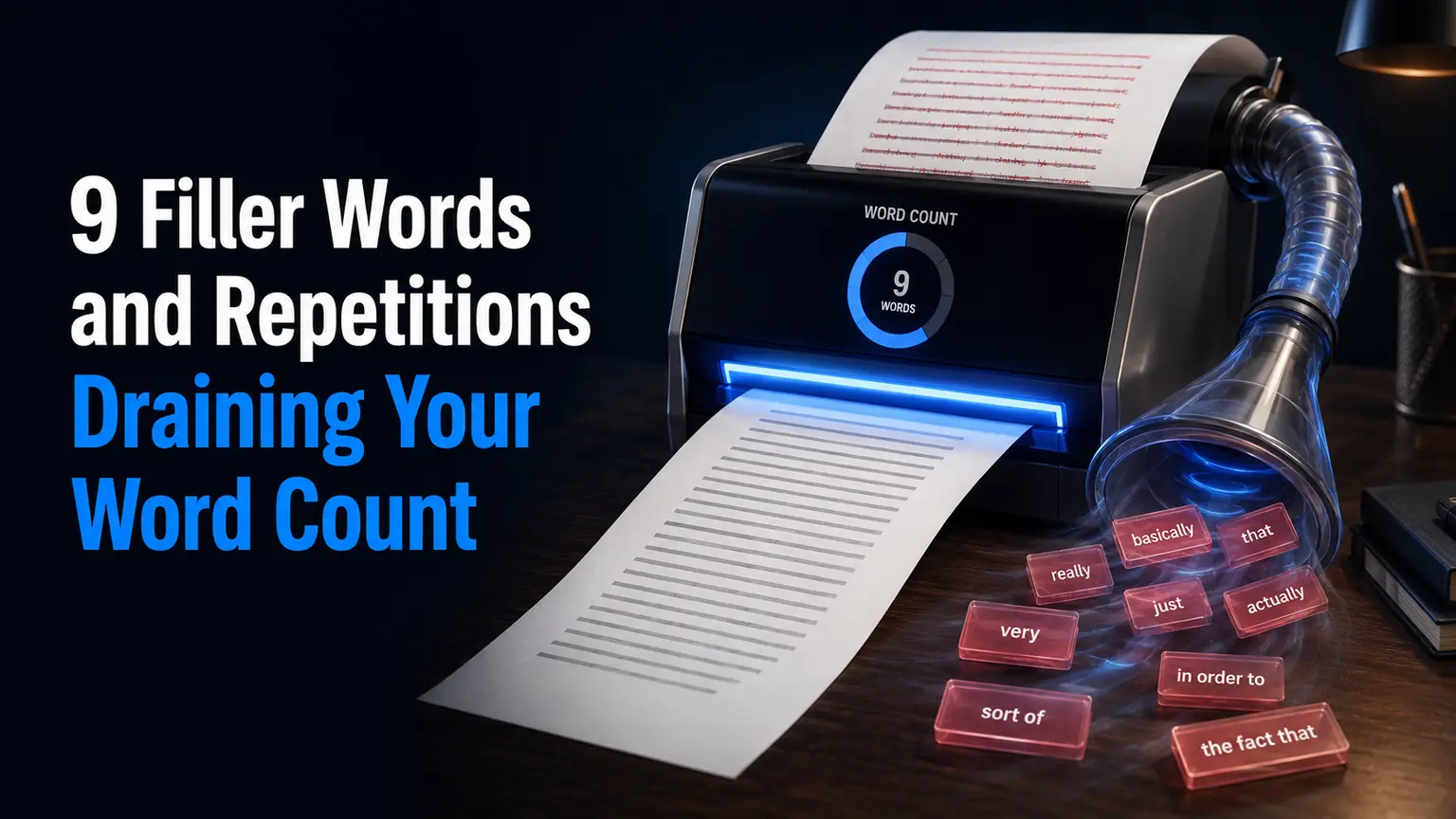
A surprising share of most first drafts is not actual content, it is filler, words and phrases that add length without adding meaning. Below are nine of the most common specific culprits, drawn from repeated patterns across thousands of edited drafts, along with how to catch each one quickly using a free remove duplicate words tool rather than hunting for them manually line by line.
1. The Accidental Double Word
“The the,” “is is,” and “and and” are the single most common accidental repetition, typically created during editing when a sentence gets rewritten and an old word gets left behind. These are genuinely easy to miss on a manual read-through because the eye tends to skip over short, familiar function words rather than actually reading each one individually, which is exactly the kind of pattern a free remove duplicate words scan catches instantly.
2. Repeated Transition Phrases
“In order to,” “due to the fact that,” and “at this point in time” are wordier versions of “to,” “because,” and “now.” Writers under deadline pressure frequently default to the same handful of transition phrases throughout an entire piece, which both inflates word count without adding meaning and makes the writing feel mechanically repetitive to a reader.
3. The Same Adjective, Reused Repeatedly
“Very,” “really,” “actually,” and “basically” tend to cluster densely within a single draft once a writer falls into the habit of reaching for them, and because none of these words carry much specific meaning on their own, cutting them almost always tightens a sentence without losing anything genuinely important.
4. Redundant Word Pairs
“Each and every,” “first and foremost,” and “final outcome” say the same thing twice using two different words. These pairings often slip through because each individual word is genuinely correct in isolation, it is only the combination that creates unnecessary repetition.
| Filler Pattern | Example | Typical Fix |
| Accidental double word | “the the report” | Delete the extra word |
| Wordy transition | “due to the fact that” | Replace with “because” |
| Repeated intensifier | “very, really, actually” | Delete or replace with a stronger verb |
| Redundant pair | “each and every” | Keep one word only |
5. The Restated Sentence
A specific sentence-level pattern where a writer states a point, then immediately restates the same point in slightly different words, often without realizing it, since this typically happens during a stream-of-consciousness first draft where the writer is thinking through an idea in real time rather than editing as they go.
6. Repeated Section Openers
Starting multiple paragraphs in a row with the same word or phrase, “additionally,” “furthermore,” “moreover,” specifically, creates a genuinely noticeable repetitive rhythm across a longer piece that a reader picks up on even if they cannot immediately articulate why the writing feels monotonous.
7. The Recycled Example
Using the same specific example or analogy more than once within a single piece, sometimes with slightly different wording each time, frequently happens in longer articles where a writer forgets they already made a particular point earlier and reaches for the same illustrative example again later without realizing the repetition.
8. Unnecessary Qualifier Stacking
“Kind of sort of,” “a little bit,” and “in a sense” stack multiple hedging qualifiers together where a single, more direct qualifier or no qualifier at all would communicate the same point with considerably less word count.
9. The Repeated Keyword, Overused
Distinct from the accidental repetition covered above, this pattern involves a target keyword genuinely appearing so frequently that it starts to read as unnatural rather than merely well-optimized, a balance worth checking with a keyword density checker rather than guessing at an appropriate frequency by feel alone.
How to Catch All Nine Patterns Quickly
Reading a draft slowly enough to manually spot every one of these nine patterns is realistic for a short piece, but becomes genuinely impractical for anything longer than a few hundred words. Pasting a full draft into a free remove duplicate words tool surfaces the accidental repetitions, patterns one, five, six, and seven specifically, automatically, leaving a writer free to focus their own manual review time on the more subjective filler patterns, two, three, four, and eight, that require genuine editorial judgment rather than pure pattern detection.
Once the repetition is cleared out, running the tightened draft through a word counter confirms exactly how much length the cleanup actually recovered, which is often a genuinely useful data point for writers working against a strict word count minimum or maximum.
Why This Matters Beyond Just Length
Cutting these nine patterns does not just shorten a piece, it genuinely improves how it reads, since filler words and unintentional repetition are precisely what makes writing feel padded or mechanical to an actual reader, even when that reader cannot immediately name what specifically feels off about the prose. A tighter draft reads faster, holds attention better, and, for content specifically written for search visibility, tends to perform better precisely because it more efficiently delivers on what a reader actually came to the page looking for.
For a broader library of writing and optimization utilities beyond just repetition cleanup, WritoryBuzz’s free content and SEO tools cover everything from word counting to keyword density to AI search readiness.