

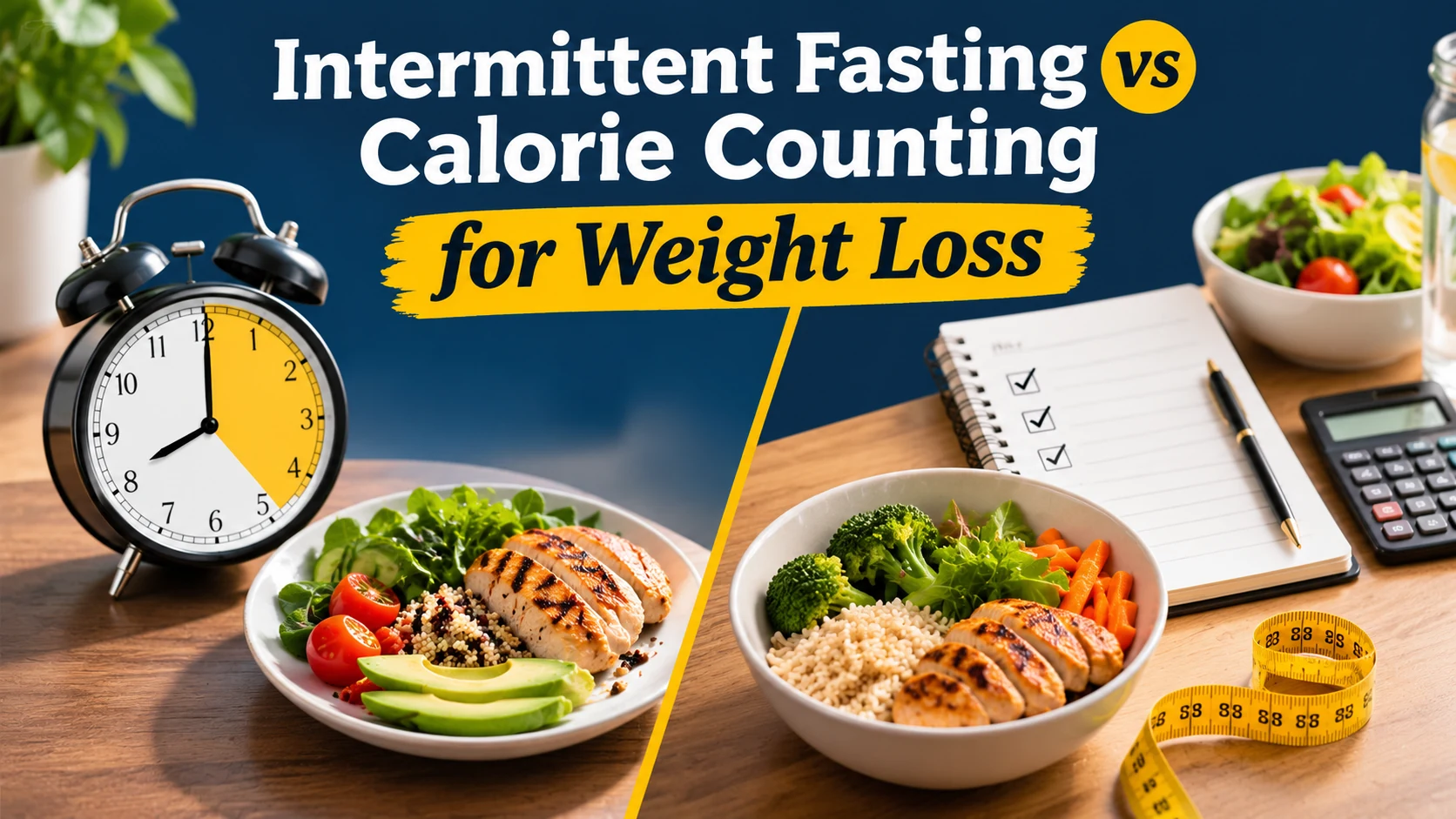
Neither is better. A 2026 Cochrane review of 22 randomised trials and 1,995 people found that intermittent fasting led to a weight difference of just 0.33 percentage points compared with conventional diets, which the authors described as statistically indistinguishable from zero. Both methods work for the same reason: they help you eat fewer calories than you burn.
So the practical question is which method you can follow safely and consistently for months. This guide compares intermittent fasting vs calorie counting on evidence, effort, safety and fit with Indian life, then gives you a 4 week test to find your answer. Read it with our guides on intermittent fasting benefits, what a calorie deficit is and the best weight loss diets backed by research. This is general information, not medical advice.
What Does the Research Say About Intermittent Fasting vs Calorie Counting?
The best recent evidence is a Cochrane systematic review reported by Rutgers in February 2026. It pooled 22 randomised controlled trials with 1,995 participants, covering time-restricted eating (meals within an 8 or 10 hour window), alternate-day fasting and the 5:2 approach.
Here is what it found:
| Comparison | Studies | Result |
|---|---|---|
| Intermittent fasting vs standard dietary advice | 21 studies, 1,430 people | 0.33 percentage point difference in body weight, statistically indistinguishable from zero |
| Intermittent fasting vs no intervention | 6 studies | About 3.4% weight loss |
| Rate reaching 5% weight loss | 4 studies | Virtually identical in both groups |
| Quality of life | Reviewed | Nearly identical |
| Adverse events | Reviewed | Nearly identical, no significant safety concern found |
The authors also flagged limits that matter. No study lasted more than one year. Adherence was self-reported in 10 of 22 studies. None assessed how satisfied people were with their diet, none reported diabetes outcomes, and 19 studies were done in high-income countries, mostly among white participants, which limits how well the results apply to India. They rated the evidence as low certainty for guideline use. In plain words: fasting works about as well as ordinary dieting in the short run, and we do not know much about the long run.
How Does Intermittent Fasting Work?
Intermittent fasting is an eating pattern that limits when you eat, not necessarily what you eat. The three main versions in the Cochrane review were:
1. Time-restricted eating. All meals within a window of 8 to 10 hours, such as 10 am to 6 pm. This is what many people call 16:8 or 14:10 fasting.
2. Alternate-day fasting. A very low calorie day alternating with a normal day. It is the hardest to keep up.
3. 5:2. Normal eating on five days and a sharply reduced intake on two days.
Most of the weight loss happens because fewer eating hours or fewer eating days lead to fewer total calories. The studies did not show a special metabolic advantage over regular dieting. Some people also like the simplicity: you follow a clock, not a calorie target.
How Does Calorie Counting Work?
Calorie counting means estimating your daily energy needs, setting a target below them and logging what you eat. NIDDK recommends tracking food, drink, sleep and activity daily and weighing yourself at least weekly, which is the core of a counting approach.
Here is a worked example using the Mifflin-St Jeor method. A 35 year old woman weighing 70 kg and 160 cm tall has a BMR of about 1,364 calories. At light activity (factor 1.375), her maintenance is about 1,876 calories. Aiming for roughly 1,500 calories gives a deficit of about 376 calories a day, within the 300 to 500 range often used for steady loss. Our diet plan for weight loss shows how this looks on a thali.
Two cautions. First, the old “3,500 calories equals one pound” rule is inaccurate. A NutritionFacts summary of the NIH Body Weight Planner research explains that a constant 500 calorie daily deficit gives about 25 pounds, roughly 11 kg, in the first year and then levels off, because a lighter body burns less. Second, portion control alone raises appetite: the same summary estimates about 45 more calories of hunger per pound lost. So expect the numbers to need adjusting every few weeks.
Intermittent Fasting vs Calorie Counting: Which Is Easier?
It depends on your personality and routine. Use the table as a quick comparison.
| Factor | Intermittent fasting | Calorie counting |
|---|---|---|
| Effort | Low once the clock becomes habit | Higher: logging, weighing, estimating |
| Skill it builds | Meal timing, less grazing | Portion and food awareness |
| Accuracy | Not needed | Imperfect for home-cooked Indian food |
| Social fit | Hard with family dinners or office lunches | Flexible; you can eat any time |
| Risk of overeating in the eating window | Common, especially after long fasts | Lower, since each meal is planned |
| Risk of obsessive behaviour | Rigid fasting rules | Number obsession |
| Best evidence | Short term, 3 to 12 months | Standard approach in most programmes |
| Cost | Free | Free or app cost |
The pattern is that fasting reduces decisions while counting increases awareness. Many people use both: a simple eating window to cut late night snacking, plus a rough portion plate.
Which Is Better for Indian Eating Habits?
Indian life has its own rhythms, and a method must fit them. Late dinners, family meals, office lunches, chai breaks, festival food and religious fasts all affect what is practical.
Time-restricted eating can suit you if you tend to snack after 9 pm, since closing the kitchen earlier removes calories that you did not even enjoy. It is harder if your family eats together at 9 or 10 pm, if you work shifts or if you travel often.
Calorie counting suits you if you cook at home, like numbers and want to learn what a katori of rice or a tablespoon of oil really adds. It is harder with shared dishes, restaurant meals and festival sweets, because the calorie values for Indian dishes vary widely by recipe. Treat any app entry for an Indian dish as an estimate.
Religious fasting such as Navratri is different from a planned weight loss protocol, and it often involves fried, starchy foods. See our guide on Navratri fasting and weight loss for what works and what does not.
Who Should Avoid Intermittent Fasting?
Do not start fasting without medical advice if you:
- are pregnant, breastfeeding or trying to conceive
- are under 18 or over 65
- have diabetes, especially if you take insulin or tablets that can cause low blood sugar
- have a history of eating disorders, or notice bingeing or food guilt
- take regular medicines that must be taken with food
- have kidney, liver or heart disease, gallstones or reflux
- have frequent headaches, dizziness or low blood pressure
The Cochrane review reported no significant safety concerns, but none of the included studies reported diabetes outcomes, so it cannot tell people with diabetes what is safe. If you feel faint, shaky, confused, have palpitations or notice that you are thinking about food all the time, stop and see a doctor.
Calorie counting is not risk-free either. If counting makes you anxious, leads to skipping meals, or becomes a rule you cannot break, speak to a doctor or dietitian and switch to a plate-based approach.
What Should You Eat Within Your Eating Window?
Fasting does not give you permission to eat anything. Most mistakes happen when the first meal turns into a feast. Use the same balanced plate: half vegetables, about a quarter protein and about a quarter cereals or millets, as in the ICMR-NIN 2024 guidelines, which advise keeping sugar below 5% of energy and limiting ultra-processed foods.
A simple 10 hour window might look like this:
| Time | Meal | Example |
|---|---|---|
| 9:30 am | Break fast | Vegetable poha or besan chilla with curd |
| 1:00 pm | Main meal | 2 rotis, dal, sabzi, salad |
| 4:30 pm | Snack | Fruit, roasted chana or buttermilk |
| 7:00 pm | Last meal | Khichdi with curd or paneer or egg with vegetables |
Drink water, plain tea or coffee outside the window, and avoid sugar-laden drinks. Our list of weight loss drinks covers what fits. For meal prep, use our guide on how to meal plan for a week.
How Do You Count Calories Without Burning Out?
Counting works best as a short learning phase, not a life sentence.
1. Weeks 1 to 2: log everything. Weigh or measure portions of rice, dal, oil and snacks. You will learn which foods are calorie dense.
2. Weeks 3 to 4: log main meals only. Use the plate method for the rest.
3. After week 4: spot check. Log for three days every month or whenever weight stalls.
Use an app that lets you enter home recipes, and compare two or three entries for the same dish. If the numbers differ by a lot, take the middle value. A kitchen scale and a set of katori and spoon measures are cheaper than most subscriptions.
What Is a 4 Week Test to Decide Between Fasting and Counting?
If you cannot choose, test both honestly. Check with a doctor first if any of the health conditions above apply.
| Week | Approach | What to track |
|---|---|---|
| Baseline (3 to 7 days) | Eat normally and log food, sleep, steps and weight | Average intake, snacking times |
| Weeks 1 to 2 | Calorie counting with a target close to your Mifflin-St Jeor estimate minus 300 to 500 | Weight, hunger, energy, time spent logging |
| Weeks 3 to 4 | Time-restricted eating within a 10 hour window with a balanced plate and no counting | Weight, hunger, energy, sleep, social fit |
| Review | Compare | Which felt easier? Which gave steady weight and waist change? Which could you keep for a year? |
Choose the one that you could keep for a year. If both feel miserable, try a hybrid: a 12 hour overnight break (for example 8 pm to 8 am), a plate-based dinner and rough portion control. Build the habit with our guides on building a fitness habit that sticks and why habits do not stick.
What Are the Most Common Mistakes With Each Method?
Most people who say “fasting did not work for me” or “counting did not work for me” have fallen into one of a few predictable traps. Spotting them early saves weeks of effort.
| Method | Common mistake | Simple fix |
|---|---|---|
| Intermittent fasting | Making up for the fast with a very large first meal | Break the fast with a normal plate and eat slowly |
| Intermittent fasting | Skipping protein, so hunger returns by evening | Add dal, curd, egg, paneer or sprouts to each meal |
| Intermittent fasting | Sweet tea or snacks sneaking into the “fasting” hours | Keep to water, plain tea or black coffee outside the window |
| Intermittent fasting | Sleeping late and shifting the window every day | Fix the same window for at least two weeks |
| Calorie counting | Forgetting oil, ghee, chai sugar and bites of other people’s food | Measure cooking oil and log drinks and tastings |
| Calorie counting | Using one app entry for very different recipes | Compare two entries and use the middle value |
| Calorie counting | Setting the target too low and quitting by week three | Start 300 to 500 calories below maintenance, not 1,000 |
| Both | Weighing daily and reacting to normal swings | Weigh weekly and judge a four week trend |
Both methods also fail when sleep and stress are poor. Short sleep raises appetite, and a stressful week makes late snacking more likely, so treat rest as part of the plan rather than an extra. It also helps to keep moving: aim to build towards the WHO’s 150 minutes of moderate activity a week, which supports weight maintenance and health whichever eating pattern you choose.
What If Neither Method Works?
Check the basics before switching. Portions often creep up, weekends and festivals add hidden calories, sleep and stress affect appetite, and a lighter body needs fewer calories. In a 2022 trial, adults with overweight who slept about 1.2 hours longer ate roughly 270 fewer calories a day. Work through the weight loss plateau checklist and, if needed, speak to a doctor about thyroid, hormonal or medicine-related causes.
Our guide on choosing weight loss programs and apps can help you find qualified support.