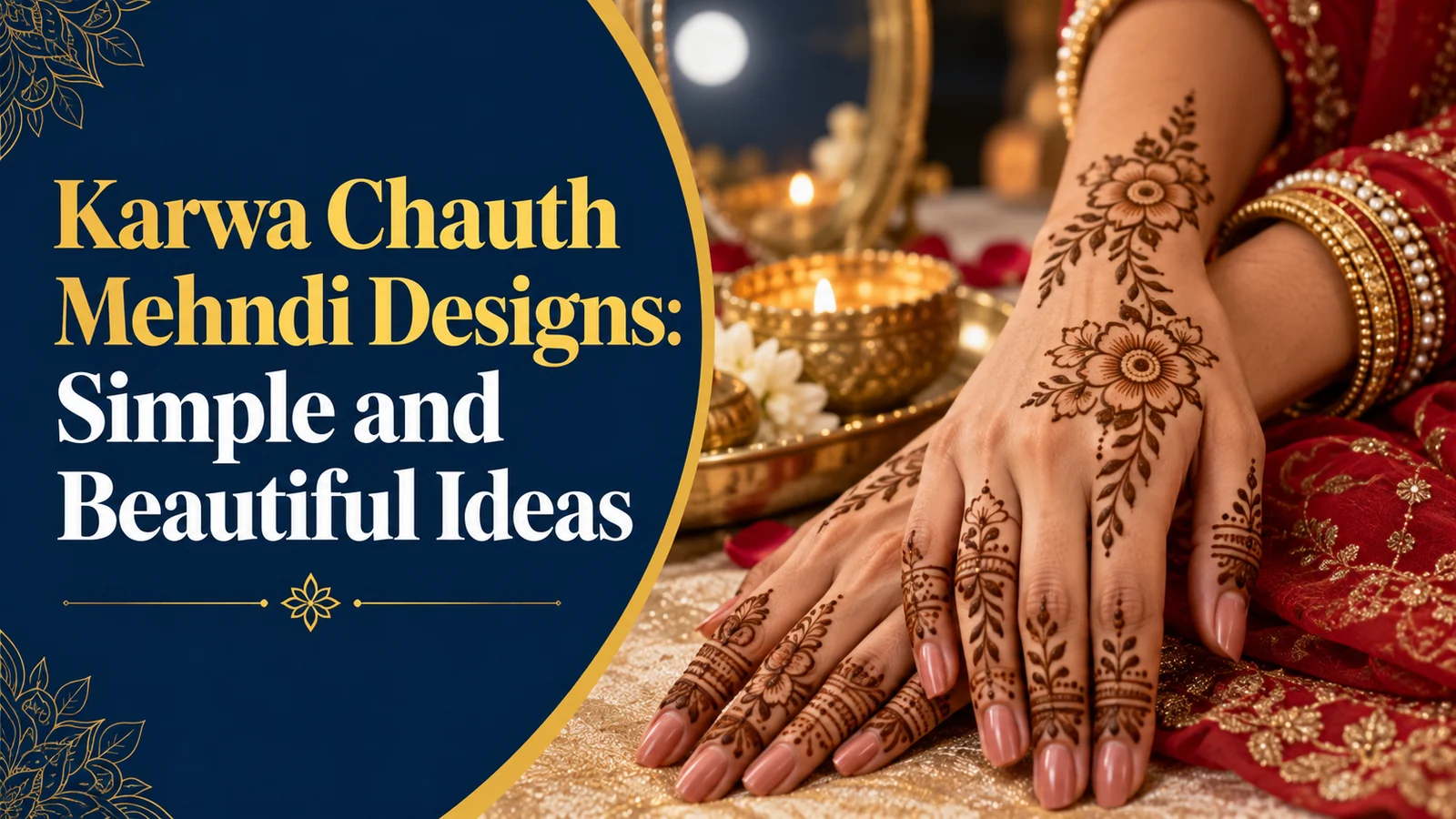
Wikipedia’s page on Karva Chauth notes that in the days before the festival women buy jewellery, mehndi and puja items and wear festive clothes, which makes henna one of the oldest parts of the preparation. With Karwa Chauth on Thursday, 29 October 2026, the mehndi question is practical: which design, who applies it, and when.
This guide covers simple and beautiful Karwa Chauth mehndi design ideas for the front and back of the hand, a timing plan based on how henna stains, and the safety point that matters most: avoiding black henna. It draws on WebMD, an NPR report on the FDA’s warning and Wikipedia.
Simple Karwa Chauth Mehndi Design Ideas
A good Karwa Chauth design does not need to cover the whole arm. Because the day involves a long fast, a puja and a moon sighting, many women prefer a design that is quick to apply and comfortable to wear. The ideas below mix traditional symbols with clean, modern layouts.
| Design idea | Where it sits | Best for |
|---|---|---|
| Moon and sieve motif | Centre of the palm | A design that reflects the ritual itself |
| Karwa pot with floral border | Palm or wrist | Traditional look with a recognisable symbol |
| Finger only trail | Fingers and a small palm patch | Very short appointment time |
| Back hand floral vine | Back of the hand to the wrist | Clean, everyday look that photographs well |
| Arabic style stripes | Fingers to forearm | Bold look with less filling |
| Couple or bridal inspired motif | Palm | First Karwa Chauth after marriage |
Pick one focal point, such as the moon or a pot, and keep the rest of the pattern lighter. That keeps the design balanced and avoids a crowded look.
Karwa Chauth Mehndi Design Easy Front Hand Ideas
The palm is the traditional canvas, and it suits symbolic motifs. A circle for the moon with a small sieve beside it, or a karwa pot in the centre with leaves and dots around it, reads clearly even in a simple outline.
Palm Centre Motifs
A single large motif in the centre with fine lines radiating outward is easy for an artist to complete quickly. It also leaves the fingers free, which is useful if you will handle the puja thali and the sieve.
Finger and Wrist Details
Add a narrow band at the wrist or a short vine up each finger. These details frame the central motif and make a minimal design look complete.
Back Hand Mehndi Design for Karwa Chauth
The back of the hand shows in photographs and while you hold the sieve, so it is worth some attention. A floral vine that begins at the knuckles and curls toward the wrist is a classic, and a row of small paisleys or dots gives a lighter version.
If you want a modern look, try a single bold flower on the back of the hand with a few thin lines running to the fingertips. Negative space, meaning areas left unfilled, makes simple designs look intentional and not unfinished.
When to Apply Mehndi and How to Get a Darker Stain
WebMD says natural henna paste is greenish-gray and turns orange when moistened, and that leaving the paste on for 2 to 6 hours makes the stain darker. It also reports that the stain keeps darkening for 2 to 4 days after the paste is washed off, and that a henna stain usually lasts a few days to a few weeks depending on sun and water exposure.
| Fact | What WebMD reports | What it means for you |
|---|---|---|
| Paste contact time | Leaving paste on for 2 to 6 hours makes the stain darker | Plan an appointment when you can sit still afterwards |
| Colour development | The stain keeps darkening for 2 to 4 days after washing off | Apply one to two days before Karwa Chauth for a deeper colour |
| How long it lasts | A few days to a few weeks, up to about 6 weeks depending on sun and water | Expect fading to begin after the festival |
| Fading | Sun and water speed it up | Limit scrubbing and long soaks |
If you apply mehndi two days before the fast, the colour will be well developed by 29 October. Applying on the morning of the fast leaves little time for the stain to deepen and may take hours out of your day.
Black Henna Warning: Keep Your Mehndi Safe
WebMD reports that black henna often contains p-phenylenediamine, known as PPD, and that nearly all henna allergic reactions trace back to PPD and not to natural henna. WebMD states that natural henna is generally safe, and says about 1 in 40 people who get black henna tattoos have a severe allergic reaction to PPD.
An NPR report on the FDA’s warning says black henna is often not plant based, can contain a harsh chemical that causes allergic reactions, and that PPD is not meant for use on skin. NPR describes natural henna as taking 2 to 12 hours to stain, while black henna stains within about an hour, citing Israeli dermatologists writing in Dermatology Online Journal. The report was published in 2013, but the guidance on PPD remains consistent with WebMD’s more recent medically reviewed page.
| Sign | Natural henna | Black henna |
|---|---|---|
| Colour of fresh paste | Greenish-gray, turns orange when moistened (WebMD) | Often very dark |
| Stain speed | 2 to 12 hours (NPR) | Within about an hour (NPR) |
| Main risk | Generally safe (WebMD) | PPD allergic reactions (WebMD) |
Speed and darkness alone do not prove what a product contains, so ask your artist what is in the paste, avoid anything marketed as instant, and stop if you notice burning or itching. If a rash appears, see a doctor.
Booking and Prep Tips Before Karwa Chauth
Wikipedia notes that women prepare for the festival by buying mehndi and puja items, so artists are in high demand. Book early, share a picture of the design you want and agree a time that suits your fasting day.
Keep your outfit in mind while choosing the design. A heavily worked sleeve or bangle set pairs well with a lighter hand design, while a plain sleeve gives you room for a fuller pattern. If you are still planning your look, our guide to fall fashion trends for 2026 has colour ideas that pair well with warm henna tones.