
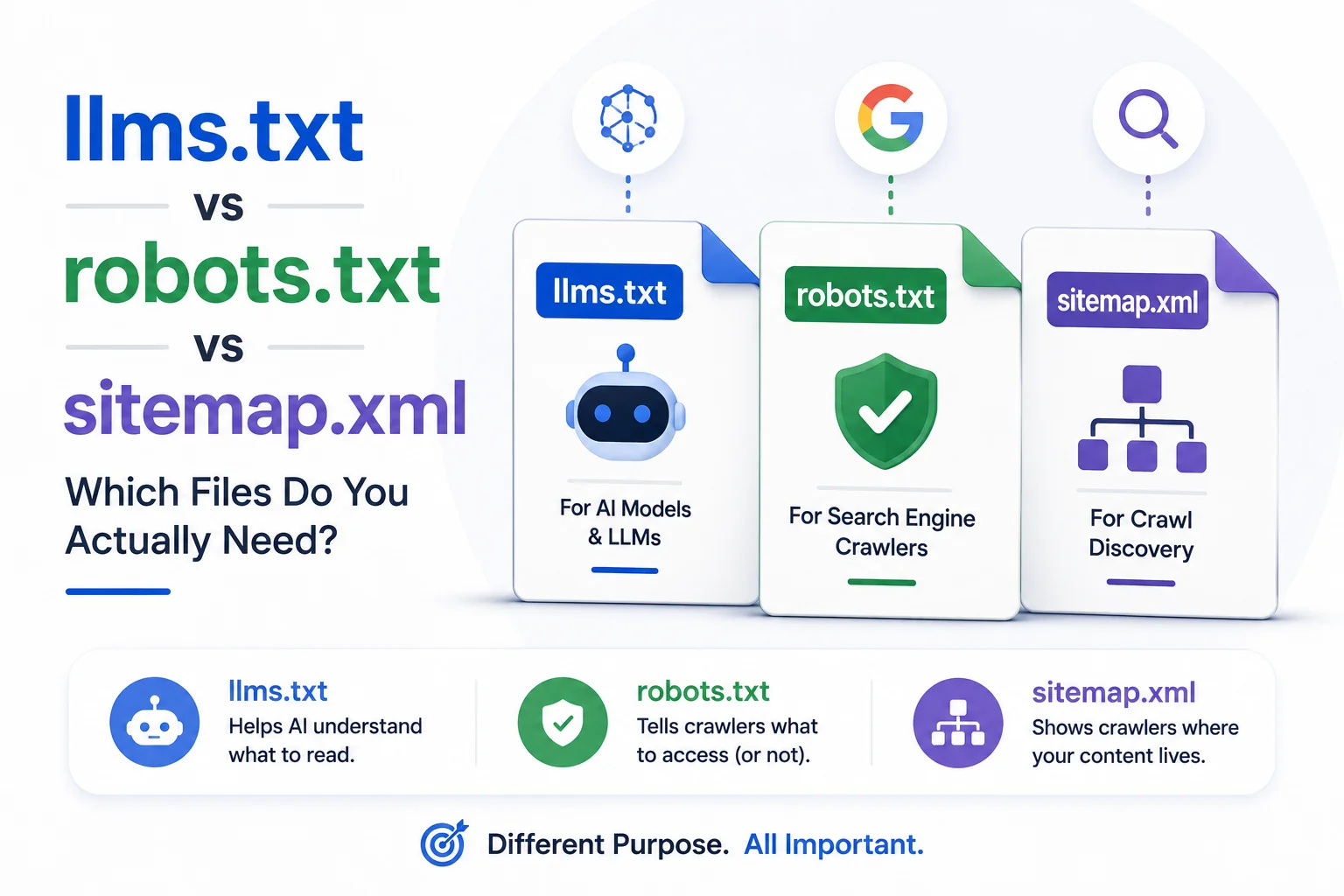
robots.txt has governed crawler access since developer Martijn Koster proposed the Robots Exclusion Protocol in 1994. sitemap.xml became a working search engine standard after Google adopted it in 2005, later joined by Bing and Yahoo under the shared sitemaps.org protocol. llms.txt is the newest of the three, proposed by Jeremy Howard and the Answer.ai team in September 2024, and it remains the only one of the three with no confirmed role in any major search or AI ranking system.
All three files can sit in the same root directory, which leads to a common assumption that they are redundant or interchangeable. They are not. Each solves a distinct problem for a distinct audience, and a site can need all three, two, or in rare cases none, depending on its size and its priorities around AI visibility. This comparison breaks down exactly what each file controls, where they overlap, and which ones actually matter for a given site in 2026.
What Each File Actually Controls
robots.txt is a permission file. It tells crawlers, both traditional search crawlers and newer AI crawlers such as GPTBot and ClaudeBot, which URLs they are allowed or disallowed from requesting. It says nothing about content quality or importance, only access.
sitemap.xml is an index file. It lists every URL a site wants search engines to consider for crawling and ranking, often including metadata like last-modified dates and change frequency. It says nothing about permission, only about which URLs exist and are worth checking.
llms.txt is a curation file. It recommends a small, hand-picked subset of pages for language models to read, formatted in plain markdown rather than XML or rule syntax. Unlike the other two, it makes no claim about completeness and is not meant to include every page on a site.
Side-by-Side Comparison
| Attribute | robots.txt | sitemap.xml | llms.txt |
| Introduced | 1994 | 2005 | 2024 |
| Primary audience | All crawlers | Search engines | Language models |
| Format | Plain text rules | XML | Markdown |
| Function | Access control | Full URL index | Curated content index |
| Confirmed ranking role | Indirect (blocks indexing) | Yes, for crawling | Not confirmed |
| Typical size | Under 50 lines | Can exceed 50,000 URLs | Under 100 lines |
Where the Three Files Overlap
The overlap is smaller than it looks. robots.txt can reference the location of a sitemap.xml file with a Sitemap directive, which is the one place the two standards formally intersect. Neither format has any formal relationship with llms.txt as of 2026, since the proposal defines it as an independent file with no required cross-reference to the other two. Building all three correctly still benefits from checking them together, which a robots.txt generator with a built-in sitemap directive field handles in one pass.
Does Every Site Need All Three?
A sitemap.xml is close to mandatory for any site with more than a handful of pages, since search engines rely on it heavily for efficient crawling and it carries measurable ranking benefit through faster, more complete indexing. robots.txt is functionally mandatory too, if only to explicitly allow crawling by default or block specific sections like admin panels and staging environments.
llms.txt is the only genuinely optional file of the three. Its value depends on whether a site’s traffic mix includes meaningful referral volume from AI answer engines and chat assistants, a factor that varies enormously by industry. A free llms.txt generator makes testing the format low-cost enough that the optional status is not much of a barrier.
The Order to Implement Them In
For a site with none of the three files in place, the practical order is sitemap.xml first, since it carries the clearest, most established SEO benefit. robots.txt comes second, primarily to confirm no important sections are being accidentally blocked, and to add explicit rules for newer AI crawlers if a site wants to control their access specifically.
llms.txt comes last, both because its benefit is less proven and because drafting a genuinely curated file well benefits from the page-prioritisation thinking already required to build a clean sitemap. WritoryBuzz’s XML sitemap generator and llms.txt generator share the same underlying page list, which makes building them back to back faster than treating them as unrelated tasks.
How Search Engines and AI Crawlers Read Them Differently
A traditional search engine crawler processes sitemap.xml as a queue: it fetches the listed URLs in some priority order, indexes the content, and periodically revisits based on the changefreq and lastmod hints in the file. This is a batch process running on the search engine’s own schedule, not triggered by any single user query.
An AI system consulting llms.txt during a live query behaves differently. If a retrieval-augmented system checks the file at query time, it is deciding in real time which of a handful of linked pages to fetch based on the current question, closer to a targeted lookup than a batch crawl. This distinction is why llms.txt files stay short: a batch crawler can handle 50,000 URLs over days, but a live query cannot afford to evaluate that many options before responding.
A Common Misconception Worth Correcting
Blocking a crawler in robots.txt does not mean a language model cannot learn about a page from llms.txt, and the reverse holds too: listing a page in llms.txt does not override a disallow rule in robots.txt for any crawler that respects both files. Some site owners assume publishing llms.txt is a way to selectively surface content while keeping it out of search rankings, which is incorrect. A fuller list of misunderstandings like this one is covered in 7 llms.txt Mistakes That Stop ChatGPT and Claude From Citing You.
Three Files, Three Jobs, No Real Redundancy
Treating these three files as interchangeable or redundant misses what each one is actually for. robots.txt answers a permission question, sitemap.xml answers a completeness question, and llms.txt answers a curation question, and a site can reasonably need answers to all three at once.
For background on llms.txt specifically before deciding whether it is worth adding, see What Is llms.txt? The New Standard for AI Crawler Visibility.
For the upload mechanics once the decision is made, see How to Create and Upload an llms.txt File.
Explore the rest of WritoryBuzz’s free AI search and technical SEO toolkit to check the other two files at the same time.
Frequently Asked Questions: llms.txt vs robots.txt vs sitemap.xml
What is the main difference between llms.txt and robots.txt?
robots.txt controls which pages crawlers are permitted to request, using access rules established in 1994. llms.txt recommends which pages a language model should prioritise reading, in a curated markdown format unrelated to access permissions.
Does sitemap.xml help with AI search visibility?
sitemap.xml is built for traditional search engine crawling and indexing, with no confirmed role in AI answer engine citation as of 2026. llms.txt is the format specifically designed to address AI model comprehension rather than search indexing.
Can a website have llms.txt without a sitemap.xml?
Yes, technically the two files are independent, though sitemap.xml carries far more established SEO value and is close to mandatory for sites with more than a few pages. Most sites should prioritise sitemap.xml before considering llms.txt.
Does blocking a crawler in robots.txt affect llms.txt?
Listing a page in llms.txt does not override a disallow rule in robots.txt for any crawler that respects both files. The two files operate independently, and a page blocked in robots.txt should generally not appear in llms.txt either.
Which file should a new website set up first?
sitemap.xml first, since it has the clearest established SEO benefit, followed by robots.txt to confirm crawler access rules, with llms.txt added last once the site’s key pages are already clearly prioritised from the sitemap process.
Is llms.txt a replacement for sitemap.xml?
No. llms.txt is a small, curated subset of pages for language models, while sitemap.xml is intended to be a complete index of every indexable URL for search engines. The two serve different audiences and neither substitutes for the other.