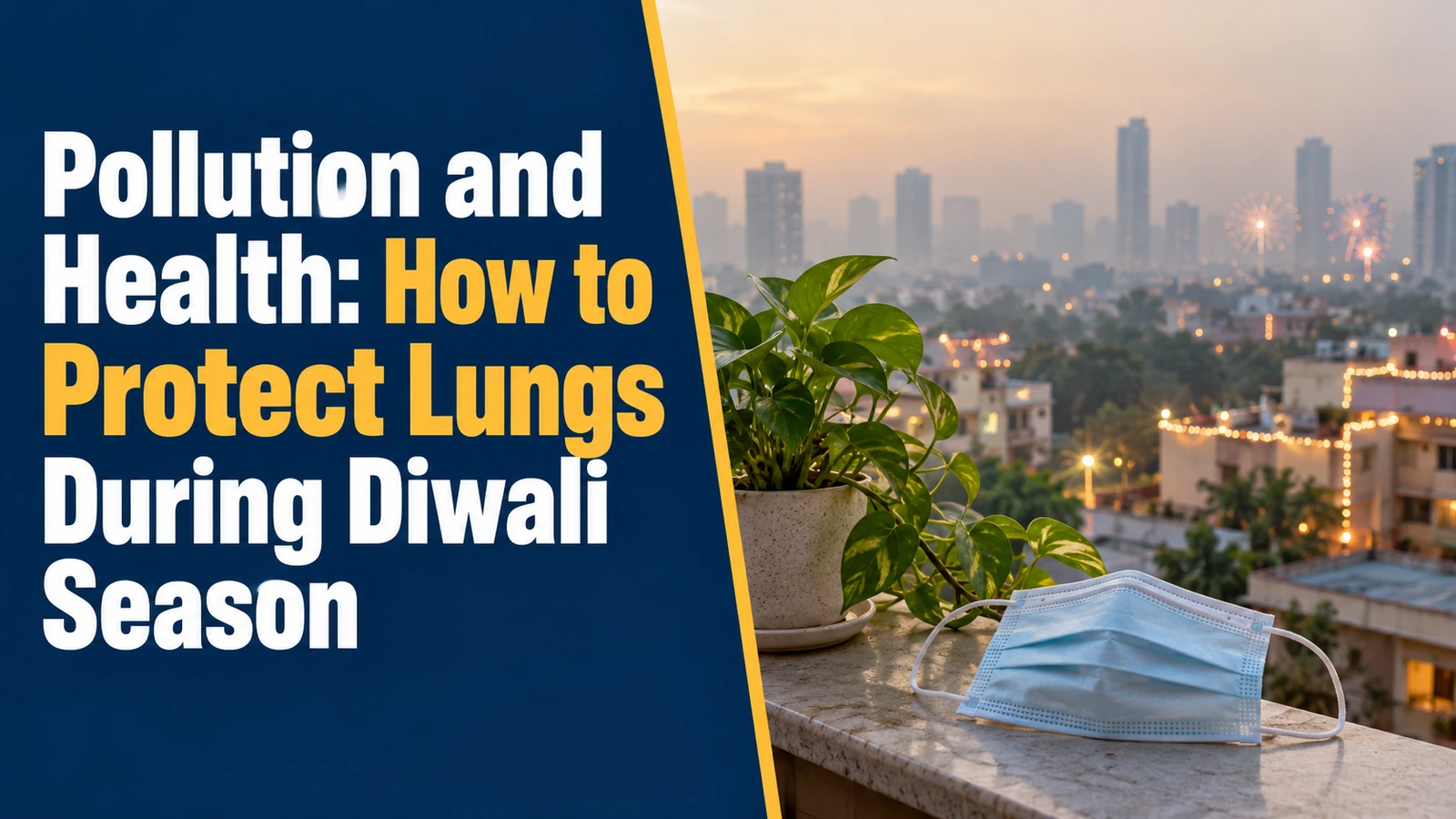
Wikipedia’s entry on Diwali notes that fireworks raise dust and pollutant levels and that smoke can cause smog lasting days, and records that on one night in 2023 New Delhi briefly reached an air quality index of 680. For anyone with asthma, a heart condition, a young child or an elderly parent at home, that is not an abstract statistic but a reason to plan the festival around the air.
This guide explains Diwali pollution and health in plain language: how to read the AQI, when to stay indoors, how to use an N95 mask, how to keep indoor air cleaner, how to exercise safely, how to protect children and older family members, and how to celebrate with light instead of smoke. It is general information, not medical advice, and anyone with a lung or heart condition should follow their own doctor’s guidance. Diwali falls on Sunday, November 8, 2026.
Why Diwali Pollution Matters for Your Lungs
Air pollution in the weeks around Diwali often combines several sources: seasonal weather that traps air near the ground, traffic, construction dust, crop burning in some regions and fireworks. Wikipedia notes that fireworks raise dust and pollutant levels and that smoke can cause smog lasting days.
The Business Standard report of AIIMS New Delhi’s advisory says current air quality poses significant risks, especially for children, the elderly and those with heart or lung conditions. That is why the practical steps below focus on reducing exposure rather than on cures.
How to Read the Air Quality Index (AQI)
The AQI is a number that summarises air pollution. In its report on the AIIMS advisory, Business Standard cites the CPCB categories, where 201 to 300 is poor and 301 to 400 is very poor. AIIMS advises checking the AQI daily on credible apps such as SAMEER, the app from the Ministry of Environment, Forest and Climate Change, to decide whether it is safe to go out.
| AQI range (CPCB) | Category | What to do |
|---|---|---|
| 201 to 300 | Poor | Limit long outdoor activity; vulnerable people take extra care |
| 301 to 400 | Very poor | Avoid outdoor exercise; wear a mask when out; keep windows closed at peak hours |
Check your local authority for official advice on days when the index is higher still. Use the app each morning during the festival week and plan your outdoor tasks around it.
Masks: What AIIMS Recommends
The AIIMS advisory reported by Business Standard recommends wearing an N95 mask outdoors, noting that these masks limit inhalation of dangerous particulate matter. A mask only works if it fits well, so choose one that seals around the nose and cheeks, and replace it when it becomes damp or damaged.
| Mask tip | Why it matters |
|---|---|
| Choose N95 or equivalent | Filters fine particles better than cloth masks |
| Check the seal | Gaps let polluted air bypass the filter |
| Do not reuse a soiled mask | A damp or damaged mask filters less well |
| Keep a spare in your bag | Makes it easy to protect yourself on short errands |
| Ask your doctor before using one with a lung condition | Masks can make breathing harder for some people |
Timing: When to Stay Indoors and When to Go Out
Business Standard reports that AIIMS advises staying indoors during peak hours, which the report says run until about 8:30 to 9:00 am, when pollution is highest. Plan school runs, walks and shopping for later in the day when the AQI is lower, and always check the app first.
| Activity | Better time | Why |
|---|---|---|
| Morning walk | Later in the day, after the AQI drops | Early hours are often the most polluted |
| Shopping | Late morning or afternoon | Avoids peak hours and crowds |
| Opening windows | When the AQI app shows improvement | Prevents outdoor smoke from entering |
| Evening celebrations | Indoors or in a courtyard with good air flow | Reduces exposure to fireworks smoke |
Keeping Indoor Air Cleaner
AIIMS suggests using air purifiers if you can afford them, according to the Business Standard report. The same report quotes doctors who say indoor air can carry a large share of outdoor PM2.5 unless windows are sealed and purifiers are used. If you cannot buy a purifier, you can still reduce the load.
| Step | How to do it |
|---|---|
| Close windows at peak hours | Seal gaps with draught strips or a rolled towel |
| Use a purifier in one room | Pick the bedroom or the room where elders spend time |
| Avoid indoor smoke | Skip incense and mosquito coils during the worst days |
| Wet-mop instead of dry-sweeping | Stops dust rising back into the air |
| Limit candles and diyas in closed rooms | Place them near open doors or in ventilated areas |
| Wash hands and face after coming in | Removes particles from skin |
Exercise and Outdoor Activity
AIIMS advises avoiding running, jogging or cycling outdoors in polluted air, as reported by Business Standard, and choosing indoor exercise instead. On bad days, swap your run for a brisk walk indoors, a stretching session, yoga or a short home workout.
| If the AQI is | Exercise plan |
|---|---|
| Poor or worse | Move indoors; keep it gentle if you have a lung condition |
| Very poor | Skip outdoor exercise completely; use stairs or a home routine |
| Improving | Short outdoor walk at low intensity, with a mask if needed |
Protecting Children, Elders and People with Lung Conditions
The AIIMS advisory singles out children, the elderly and those with heart or lung conditions as the most vulnerable. Keep their inhalers, medicines and doctor’s contact number ready before the festival, and keep indoor spaces as clean as possible. Reduce the time children play outdoors on high-AQI days.
Contact your doctor promptly if you or a family member notices worsening cough, wheezing or breathlessness, and seek emergency care for severe difficulty breathing. This article cannot replace a doctor’s advice for your own situation.
Celebrate With Light, Not Smoke
Wikipedia describes Diwali as a festival where earthen lamps, candles and lanterns light homes and temples. Those lights, along with rangoli, sweets and family time, are the heart of the festival. You can reduce your own contribution to smog by choosing a light-only celebration, skipping fireworks or attending a community display instead of lighting your own.
If you are hosting guests, tell them early that you are keeping the celebration smoke-free, and offer family games or music instead. Children usually remember the diyas and sweets more than the noise.