Home
Categories
Free Tools
Write For UsAbout UsContact

What Are AI Tools? Types, Uses and Examples Explained

What are AI tools? A plain explanation of the main types, what each is used for, real examples, the limits to know and how to pick your first one safely.

November 12, 2026 Updated November 11, 2026 7 min read
What Are AI Tools? Types, Uses and Examples Explained

AI tools are software products that use machine learning models to do tasks that once needed a person, such as writing a draft, summarising a document, generating an image or suggesting code. About half of U.S. adults, 49 percent, said they now use AI chatbots in a Pew Research Center survey fielded on 17 to 23 February 2026, up from 33 percent in 2024.

That growth explains the confusion. Dozens of products now call themselves AI tools, and they are not the same thing. This guide sorts them into seven types, shows what each is good for, and flags the limits. It is the first post in a series, so when you finish, move on to AI tools for beginners and our guide to the best AI tools in 2026 by use case.

What Types of AI Tools Exist?

TypeWhat it doesTypical taskExamples (not tested by us)
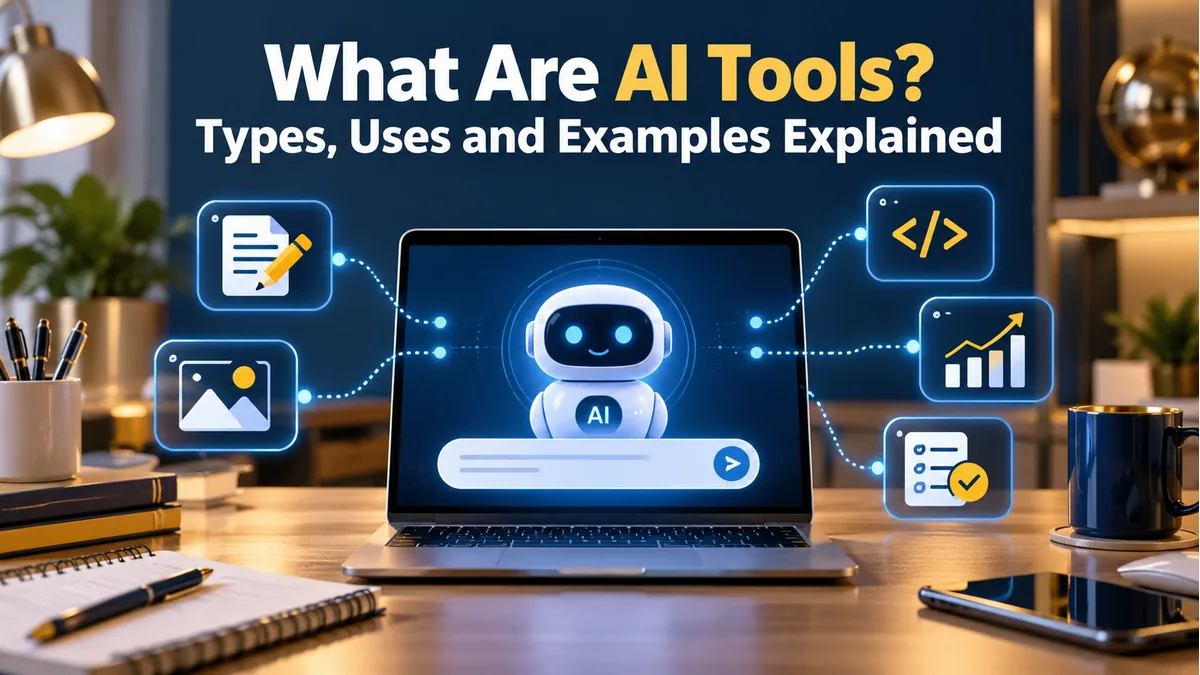
Chat assistantsAnswer questions and draft text from a promptExplain, brainstorm, rewriteChatGPT, Gemini, Claude
Writing toolsEdit grammar, tone and structurePolish an email or articleGrammarly, QuillBot
Image and video toolsCreate or edit visuals from textSocial posts, bannersMidjourney, Adobe Firefly, Runway
Coding toolsSuggest and explain codeDraft a function, fix a bugGitHub Copilot, Cursor
Meeting and note toolsRecord, transcribe and summariseMeeting minutesOtter, Fireflies
Research toolsSearch and summarise sourcesLiterature scanPerplexity, Elicit, NotebookLM
Automation toolsConnect apps and run stepsSend a report each weekZapier, Make, n8n

The classification is ours, built for this series. The example names are only well-known products in each group; we have not tested them, and you should check each vendor’s current features and pricing before use. Our live guides cover several groups in depth, including AI tools for blog writing, AI coding tools and AI note-taking apps.

How Do AI Tools Work in Simple Terms?

Most chat and writing tools are built on large language models, which predict likely next words from patterns learned in training data. That is why they sound fluent, and also why they can state a wrong fact confidently. Our explainer on AI hallucinations covers the problem, and how to use AI for research without hallucinated facts gives a checking routine.

Who Is Using AI Tools, and for What?

Use is broad. The Stanford AI Index 2026, as summarised by Lumenova AI, reports that generative AI reached 53 percent population adoption within three years, and that over 80 percent of U.S. high school and college students use AI for schoolwork while only about half of schools have AI policies. McKinsey’s survey found generative AI use in organisations rose from 33 percent in 2023 to 71 percent in 2024 and 79 percent in 2025.

Those are adoption figures, not quality ratings. They show how common the tools are, not how well they work for a given job.

What Are the Limits of AI Tools?

LimitWhat it meansSource or note
ErrorsOutput may be wrong or inventedStanford researchers describe a ‘jagged frontier’ of strong and weak areas
Data privacyChats may be reviewed or used for training depending on settingsGoogle says a subset of Gemini chats are reviewed by humans
Not scaledMost organisations are still earlyMcKinsey: 7 percent fully scaled
CostFree tiers have limits; heavy use is paidSee our pricing guide
JudgementThe tool does not know your goal or audienceOurs

Read the privacy row twice. Our AI tool safety checklist shows what to check before you paste anything sensitive.

How Do You Pick Your First AI Tool?

Start with one problem, not one product. Write the task you repeat most, then test a free tier on it for a week. Our guide on how to choose the right AI tool for your workflow gives a scoring method, and building a daily workflow around free AI tools shows how to start at no cost. For the money side, see AI tools pricing compared, and for the large assistants, read ChatGPT vs Gemini vs Claude.

A longer catalogue is in our list of 50 AI tools, and the direction of travel is in new AI tools trends for next year.

How Do AI Tools Relate to AI Agents and Automation?

A chat tool answers when you ask. An agent can take steps for you, such as searching, filling a form or running a task on a schedule. Vendors now list agent features on paid plans, and our guides to agentic AI for business and 8 practical agentic AI use cases explain the difference.

For most beginners, a plain chat assistant is enough. Add agent features only after you trust the tool with simple tasks.


Related readBest AI Tools in 2026: Picks by Use CaseRead →

Free tools for Artificial Intelligence

FAQs

What are AI tools in simple words?

AI tools are apps that use machine learning to do part of a task for you, such as drafting text, summarising a meeting, making an image or suggesting code. You give an instruction, called a prompt, and the tool returns a result you can accept, edit or reject. They save time but still need human checking. Think of the tool as a fast assistant that still needs your direction, your judgement and a final check before anything leaves your hands.

What are some examples of AI tools?

Common examples include chat assistants like ChatGPT, Gemini and Claude, grammar tools like Grammarly, image tools like Midjourney and Adobe Firefly, coding tools like GitHub Copilot and research tools like Perplexity. We have not tested these products ourselves, so check each vendor’s page for current features, limits and prices. Check the vendor’s current page for the latest details, because features and plans change quickly and a list written today can age within weeks.

Are AI tools free?

Many have a free tier with limits. Claude’s pricing page, for example, lists a free plan with limited usage every five hours and every week, and paid plans from 20 dollars a month. Free tiers can change, and some services show ads or use chats for training, so read the plan details and privacy settings. Look at the plan terms too, since some free services show ads, limit messages or use conversations in ways you may want to change.

Are AI tools safe to use at work?

They can be, if you follow your employer’s policy and avoid pasting confidential data. Samsung banned staff use of generative AI in 2023 after reported leaks of internal code, according to The Register. Business plans often have stronger data controls, but always check the vendor’s current terms before sharing anything sensitive. Ask your employer first, use approved tools where they exist and keep a short note of what you shared, so any problem can be handled quickly.

Can AI tools replace human workers?

The sources we reviewed do not support a simple answer. McKinsey found most organisations still use AI in early phases, with only 7 percent fully scaled, and Stanford researchers describe uneven capability. AI tools are better treated as assistants for specific tasks, with people responsible for judgement, accuracy and final decisions. In practice, people stay responsible for accuracy, privacy and final decisions, and the tools mainly speed up first drafts and repetitive steps.

How do I start using AI tools as a beginner?

Pick one repeated task, such as summarising notes or drafting emails, and try a free tool on it for a week. Keep a short log of what saved time and what needed fixing. Avoid sharing private data, and verify any facts. Our beginner guide in this series walks through the first steps. Keep the experiment small and low risk at first, and repeat it a few times before you decide whether the tool deserves a regular place.

Was this guide helpful?
Jinal Mistry
Written by

Jinal Mistry

Jinal Mistry is the Founder of WritoryBuzz and an SEO & Digital Growth Specialist with 5+ years of experience in Technical SEO, AI SEO, International SEO, and organic growth strategy. She helps businesses improve search visibility through data-driven SEO, content optimization, search experience enhancement, and AI-focused search strategies.Having worked with clients across multiple industries and international markets, Jinal specializes in building sustainable organic growth through technical excellence, user-focused optimization, and future-ready digital marketing practices. Through WritoryBuzz, she shares insights on SEO, AI search, content strategy, digital marketing, and emerging search trends to help businesses and marketers stay ahead in the evolving digital landscape.

More from this author

More in Artificial Intelligence

View all in Artificial Intelligence →

Keep exploring

Have expertise to share? Write for WritoryBuzz.Read the guidelines and send us your pitch.
Become a contributor
Free tools

63 free tools for writers, SEOs and developers

Open one in your browser and start. Nothing to install, and your text stays on your device.

PrivateInstant resultsNo sign up
Write for us

Have expertise to share?

  • Original, well researched guides
  • Reviewed by our editors
  • 29 categories to publish in
Submit a guest post
© 2026 WritoryBuzz. All rights reserved.Back to top