
Home
Categories
Free Tools
Write For UsAbout UsContact

New AI Tools Trends Shaping Work Next Year

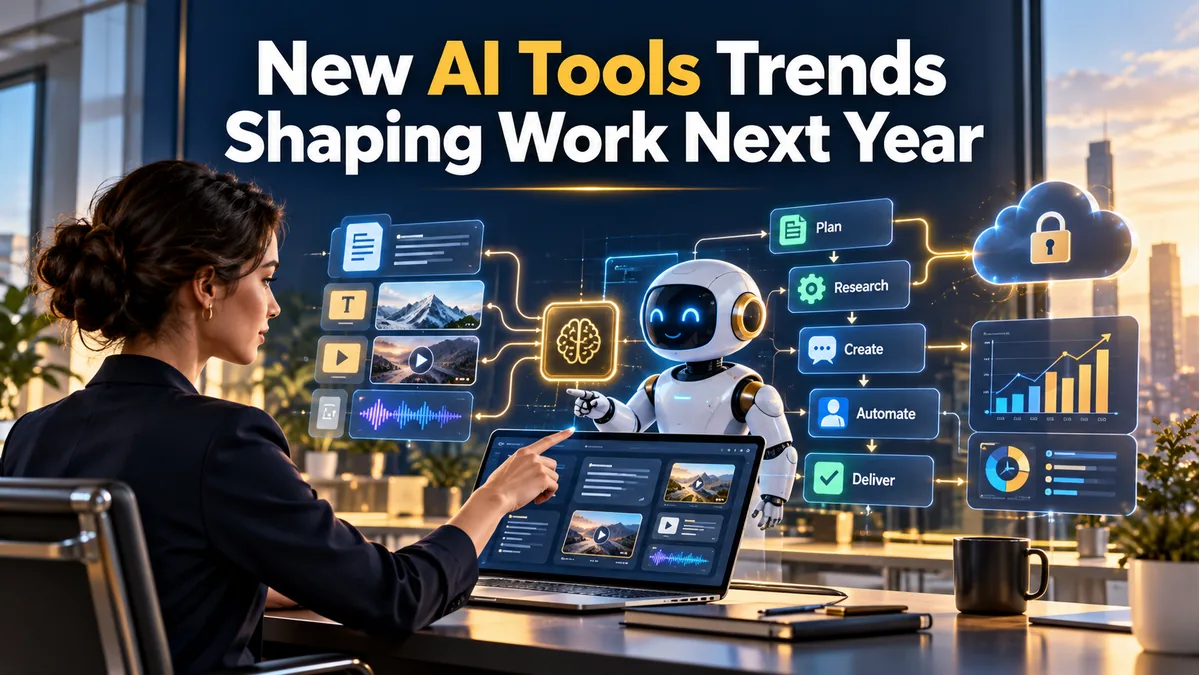
Five AI tools trends for work next year, from agents and tiered pricing to ads and data choices, with 2026 evidence, three myths and what to do about each.

November 12, 2026 Updated November 11, 2026 7 min read
New AI Tools Trends Shaping Work Next Year

The strongest evidence about where new AI tools are heading is not a prediction, it is a pattern: use is spreading fast, but real change at work is slow. McKinsey’s 2025 survey found 88 percent of respondents said their organisations use AI, yet only 7 percent said it was fully scaled, and the Stanford AI Index 2026 recorded 362 documented AI incidents in 2025, up from 233 in 2024.

This post turns that pattern into five trends to watch and three myths to drop, using only evidence we could check on 31 October 2026. Anything that looks forward is marked as our view. If you are new to the topic, start with what AI tools are, and for the products themselves see the best AI tools in 2026 by use case.

Trend 1: Are Agents Replacing Chat Windows?

Vendors are adding agent features that act for you. OpenAI’s pricing page lists agent mode for Plus, and Anthropic’s lists task handoff and scheduling on Pro. We cover how agents work, and where they fail, in our guides to agentic AI workflows and AI browser agents. Our view is that the safest first agent task is a low-stakes, easily reversed one.

Trend 2: Why Are Pricing Plans Multiplying?

VendorWhat changedSource
GoogleTop AI Ultra tier cut from 250 to 100 dollars a month; a 200 dollar option adds Project Genie accessEngadget, 19 May 2026
OpenAIPro now lists 100, 200 and 500 dollar tiers, per one third-party reportGEO Toolbox, modified 28 October 2026
AnthropicPro 20 dollars, Max 100 dollars, Ultra 200 dollars, plus Team seatsClaude pricing page

Plans increasingly sell usage limits, not just features. The OpenAI tier details come from a third-party blog that says it could not check OpenAI’s own page, so verify them before you rely on them. Our full comparison is in AI tools pricing compared.

Trend 3: Will Free AI Come With Ads and Data Trade-offs?

Possibly. In January 2026 OpenAI said it planned to begin testing ads in its free tier and ChatGPT Go in the US, and our explainer on ChatGPT ads covers what that means. Separately, Anthropic’s August 2025 consumer terms update let Free, Pro and Max users choose whether chats train its models, with five-year retention for those who opt in. Our view is that more tools will offer a cheap tier paid for by attention or data.

Trend 4: Is the Real Work Redesigning Workflows?

McKinsey says that broader AI use may require redesigning workflows and building platforms that can operate at scale, and calls most companies still early in their journey. For a small team, that means writing down the steps of a task before handing any step to a tool. Start with how to choose the right AI tool for your workflow.

Trend 5: Are Rules and School Policies Catching Up?

Not yet, on the Stanford evidence. Lumenova’s summary says over 80 percent of U.S. high school and college students use AI for schoolwork while only about half of schools have AI policies, and that safety and governance have not kept pace with technology. For the policy side, see our posts on AI governance frameworks and AI regulation before 2027.

Which Three AI Myths Should You Drop?

MythWhat the evidence saysSource
‘Everyone already uses AI at scale’88 percent use AI somewhere; 7 percent have fully scaled itMcKinsey
‘AI is always getting more reliable in every area’Researchers describe a jagged frontier with surprising errorsStanford AI Index via Lumenova
‘Free means no cost’Free tiers can carry limits, ads or training choicesOpenAI, Anthropic

The wording of each myth is ours; the evidence column is sourced. Also remember that Pew’s 2026 and 2024 questions were worded differently, so the rise from 33 to 49 percent is a guide, not an exact like-for-like trend.

How Should You Plan for These Trends?

TrendSmall action (ours)Review when
AgentsTrial one low-risk taskVendor adds new agent features
Pricing tiersTrack the plan you use each quarterA vendor changes limits
Ads and data choicesCheck settings every three monthsTerms are updated
Workflow redesignWrite down the steps of one taskYou add a second tool
Policy catch-upWrite a one-page team ruleYour company sets a policy

None of these actions needs a budget. They need a calendar reminder, a note and a habit. For another angle, read why AI predictions go wrong before trusting any forecast, including ours.


Related readThe Rise of Agentic AI Workflows: When AI Acts Without Being ToldRead →

Free tools for Artificial Intelligence

FAQs

What are the biggest AI tools trends for next year?

The evidence we found points to agent features, more pricing tiers, ads and data trade-offs on cheap plans, workflow redesign inside companies and slow policy catch-up. The forecasting is ours. The supporting facts come from McKinsey, the Stanford AI Index summary, vendor pricing pages and news reports. Remember that vendors can change plans and features quickly, so check each page again before making any decision that involves real money.

Will AI agents become common at work?

Vendors already sell agent features, such as agent mode on ChatGPT Plus and task scheduling on Claude Pro. Whether most workers will rely on them next year is our open question, not a sourced fact. A sensible start is a low-risk, reversible task, with a person reviewing the result. Start with a small trial, keep a person in the loop and record the time saved, so you can judge the feature on evidence rather than excitement.

Are AI tools getting more expensive?

Prices are splitting, not simply rising. Google halved its top Ultra tier to 100 dollars a month in May 2026, while OpenAI added higher Pro tiers, according to a third-party report. Plus is reported at 20 dollars a month, unchanged since February 2023 by one third-party source, and Claude Pro is listed at 20 dollars. Compare current prices on each vendor’s own page before deciding, because plans, tiers and regional prices move more often than most articles can keep up.

Will free AI tools disappear?

We found no evidence of that. Free tiers still exist on ChatGPT and Claude. But OpenAI said it planned to test ads in its free tier and Go, and Anthropic gave consumer users a training-data choice, so free access may involve trade-offs. Read the current terms. Keep a free option as a backup, read the terms when they change and look for settings that give you control over your own data.

How many companies use AI?

McKinsey’s survey, fielded 25 June to 29 July 2025 with 1,993 participants, found 88 percent of respondents said their organisations use AI in at least one function. Only 7 percent said AI was fully scaled across the organisation. These are survey answers, not audited counts. Survey results describe what respondents said they do, not an audit of what organisations actually run, so use them as a guide rather than a count.

What should small teams do about these trends?

Pick one workflow, document its steps, test one tool on a small part of it and measure time saved. Set a data rule for what may be pasted. Review plans each quarter, because pricing and policies change often. These steps are our suggestions, informed by McKinsey’s finding that workflow redesign matters. Review the plan list each quarter, update your data rules when vendors change terms and share the results with your team in a short note.

Was this guide helpful?
Jinal Mistry
Written by

Jinal Mistry

Jinal Mistry is the Founder of WritoryBuzz and an SEO & Digital Growth Specialist with 5+ years of experience in Technical SEO, AI SEO, International SEO, and organic growth strategy. She helps businesses improve search visibility through data-driven SEO, content optimization, search experience enhancement, and AI-focused search strategies.Having worked with clients across multiple industries and international markets, Jinal specializes in building sustainable organic growth through technical excellence, user-focused optimization, and future-ready digital marketing practices. Through WritoryBuzz, she shares insights on SEO, AI search, content strategy, digital marketing, and emerging search trends to help businesses and marketers stay ahead in the evolving digital landscape.

More from this author

More in Artificial Intelligence

View all in Artificial Intelligence →

Keep exploring

Have expertise to share? Write for WritoryBuzz.Read the guidelines and send us your pitch.
Become a contributor
Free tools

63 free tools for writers, SEOs and developers

Open one in your browser and start. Nothing to install, and your text stays on your device.

PrivateInstant resultsNo sign up
Write for us

Have expertise to share?

  • Original, well researched guides
  • Reviewed by our editors
  • 29 categories to publish in
Submit a guest post
© 2026 WritoryBuzz. All rights reserved.Back to top