OpenAI announced on October 21, 2026 that ChatGPT Ads is expanding by 26 countries to reach 89 markets, and said more than 100,000 advertisers have run campaigns since ads launched about eight months earlier, according to Unite.ai. ChatGPT is also reported to have over 1.2 billion weekly users, which makes the ad programme one of the fastest new ad channels in search-adjacent media.
This guide explains what ChatGPT ads are, who sees them, how they are labelled, what OpenAI says about privacy and sensitive topics, what advertisers can buy and what publishers and site owners should do. Details are changing quickly, so the facts here are as reported by the sources named, as of October 24, 2026.
What Are ChatGPT Ads?
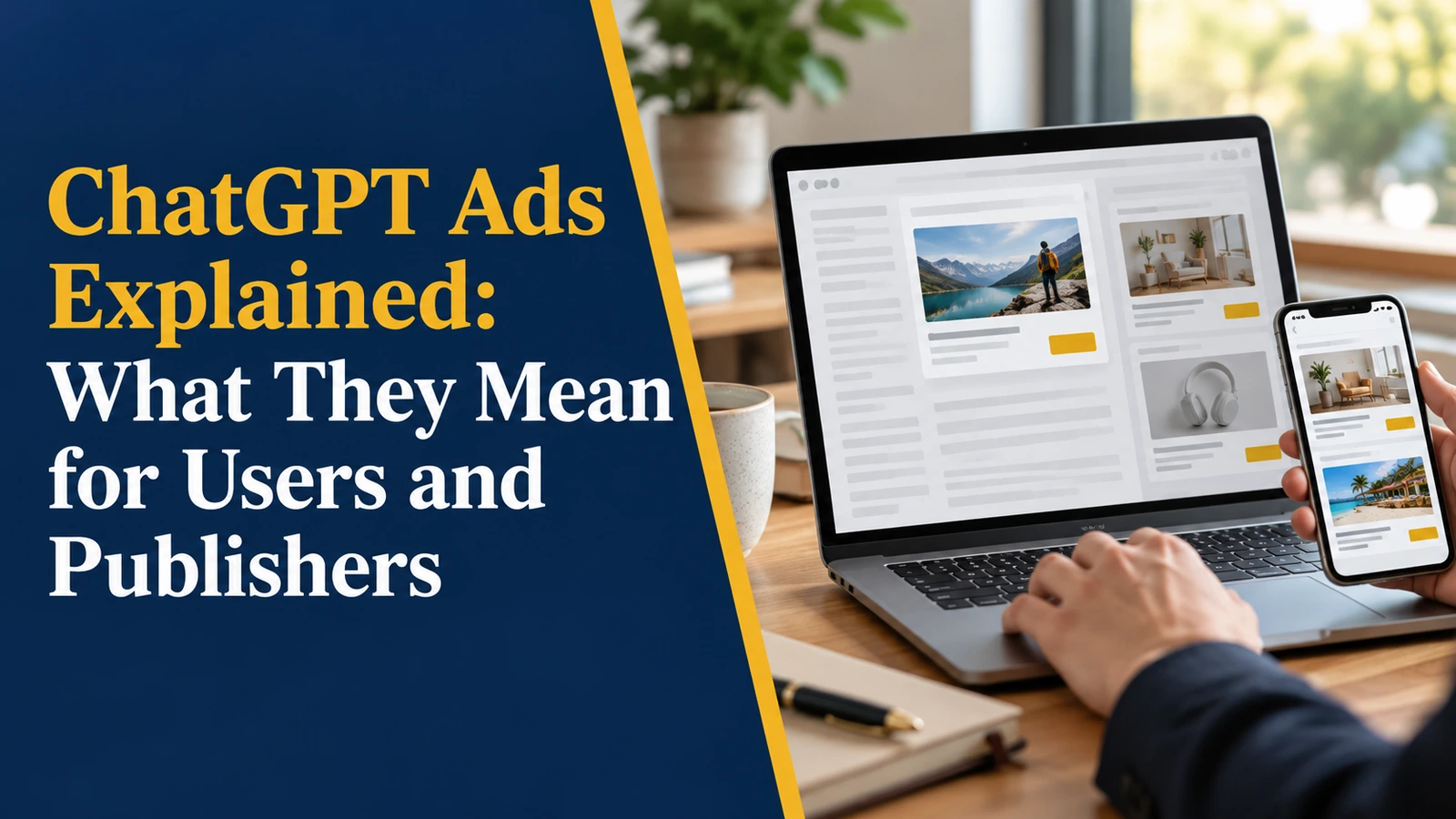
ChatGPT ads are sponsored placements shown inside the ChatGPT product to some users. Search Engine Journal reported on February 9, 2026 that OpenAI had begun testing ads for logged-in adult users in the United States on the Free and Go plans, with ads shown at the bottom of responses, visually separated from the answer and labelled as sponsored.
How the Rollout Has Progressed
| Date | Milestone | Source |
|---|---|---|
| January 16, 2026 | ChatGPT Go launched in the United States at 8 dollars a month | Search Engine Journal |
| February 9, 2026 | Ads test reported for Free and Go users in the United States | Search Engine Journal |
| October 21, 2026 | Expansion by 26 countries to 89, with self-serve in Ads Manager | Unite.ai |
Who Sees ChatGPT Ads and Who Does Not
| Plan | Ads shown? |
|---|---|
| Free | Yes |
| Go | Yes |
| Plus | No |
| Pro | No |
| Business | No |
| Enterprise | No |
| Education | No |
Search Engine Journal reported that OpenAI said it would not show ads in conversations about health, mental health or politics, and would not serve ads to accounts identified as under 18. Free users can opt out of ads in exchange for fewer daily free messages, and Go users can avoid ads by upgrading to Plus or Pro.
ChatGPT Ads and Privacy: What OpenAI Says
According to Search Engine Journal’s report of OpenAI’s statement, ads are matched to the conversation’s topic, past chats and past interactions with ads, and advertisers do not see conversations or personal details, only aggregate data such as views and clicks. Users can dismiss an ad, see why it appeared, turn off personalisation or clear all ad-related data.
Questions Users Should Still Ask
Matching ads to the conversation topic means your questions influence what you see, even if advertisers do not see the text. If that bothers you, turn off personalisation, clear ad data or move to a paid plan. Also be careful with fake sponsored messages and scams that imitate AI products, as our guide to AI-driven phishing attacks explains.
What ChatGPT Ads Mean for Advertisers
Unite.ai reports that advertisers in the new countries can buy through technology partners or self-serve in Ads Manager, and that OpenAI says the next phase will bring new formats, objectives, buying options and measurement capabilities. Early reports in February described a 200,000 dollar minimum commitment (reported by Adweek) and prices of about 60 dollars per 1,000 views (reported by Digiday), but those figures were for the initial test and may have changed.
| What is known | What is not yet clear |
|---|---|
| Ads are labelled and shown below answers | Full ad formats beyond today’s placements |
| Self-serve Ads Manager is available in new markets | Current pricing and bidding rules |
| Advertisers receive aggregate data only | Depth of measurement and attribution |
| More than 100,000 advertisers have run campaigns | Performance benchmarks by industry |
If you run paid media, compare it with the channels you already know. Our explainer on programmatic advertising and real-time bidding shows how auction-based buying works, which helps when judging any new platform.
What ChatGPT Ads Mean for Publishers
Unite.ai describes ads served inside ChatGPT for advertisers and does not discuss third-party sites, so publishers should not expect ChatGPT ads to place ads on their pages. The more important question is how paid placement changes the way people reach publisher content.
Referral Traffic Is Still Small
Similarweb data reported by TechCrunch in July 2025 showed ChatGPT referrals to news sites rising from just under 1 million in January to May 2024 to more than 25 million in 2025, while news-site organic traffic fell from over 2.3 billion visits at its mid-2024 peak to under 1.7 billion. The article concluded that ChatGPT referral growth was not enough to offset the decline in search clicks.
Ads and Answers Are Meant to Stay Separate
Search Engine Journal reports that ads sit below responses and do not affect what ChatGPT recommends, and that OpenAI’s published principles include answer independence. Publishers should keep earning citations through quality and structure instead of assuming spending buys placement in the answer. Our guide on how to rank in ChatGPT and AI Overviews covers this. If your pages are not being cited at all, read about why sites become invisible to AI search.
What to Do Now
| If you are | Do this |
|---|---|
| A user on Free or Go | Review ad settings, turn off personalisation if you prefer, and keep sensitive questions out of the chat |
| An advertiser | Test small, track incremental results and ask about measurement before scaling |
| A publisher | Keep content crawlable, answer questions clearly and track referrals from AI sources |
| A marketer | Plan for paid and organic visibility in AI answers separately |