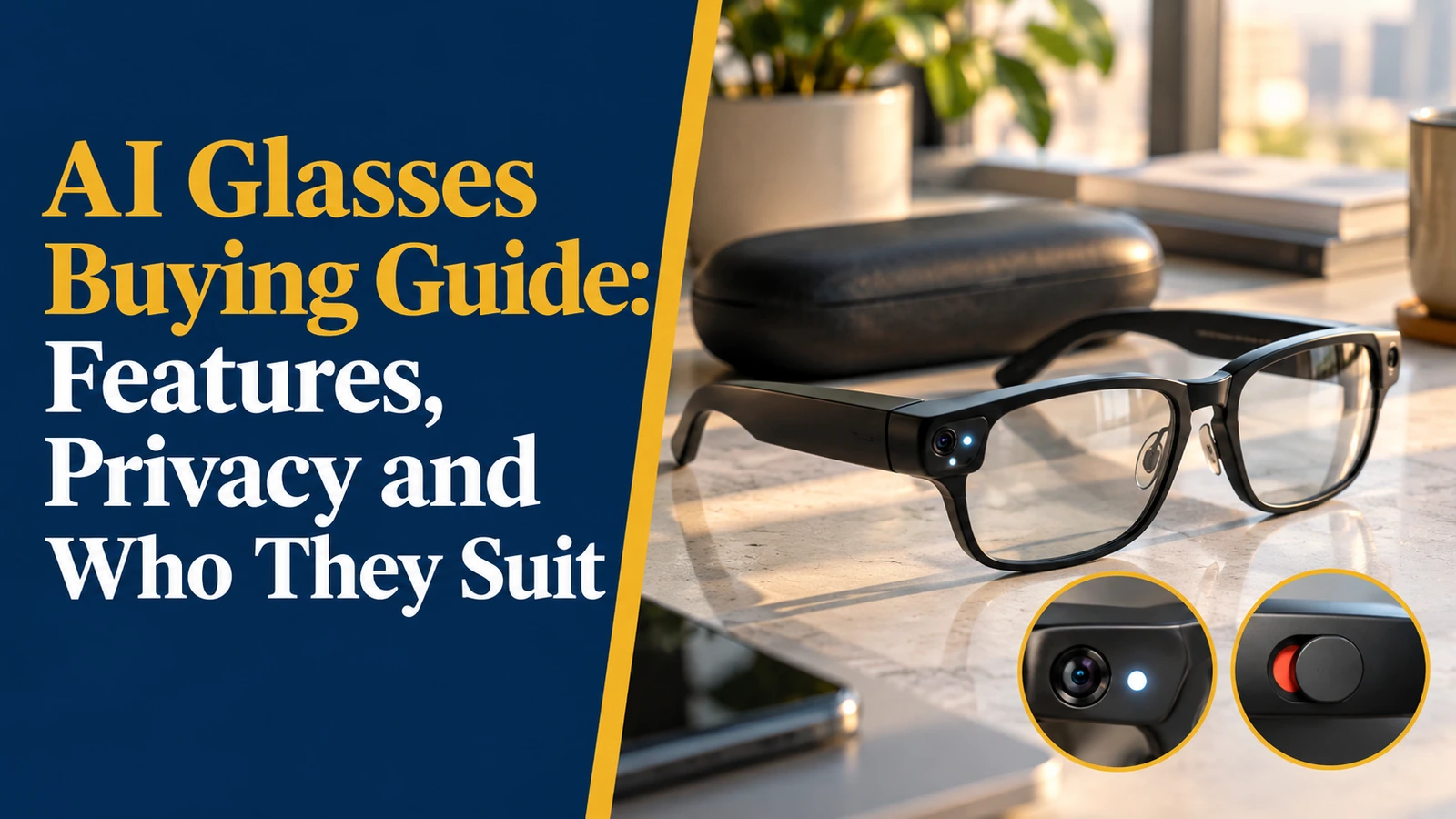
Meta’s Ray-Ban glasses were reported to be recording audio on their own in October 2026, with users saying the assistant started voice recordings without the wake word, and Meta told Android Authority the issue was resolved, according to 9to5Google on October 15. The episode is a useful reminder that AI glasses are cameras and microphones you wear on your face, and that buying one means choosing a privacy posture as much as a feature list.
This guide explains what AI glasses actually do, how current models compare on price, camera, display and battery, what the privacy and bystander issues are, and who each type suits. Specifications and release dates change fast, so check the latest details before buying.
What AI Glasses Do
AI glasses look like ordinary eyewear but add a camera, microphones, open-ear speakers and a voice assistant. You can take photos and short videos, make calls, listen to music and ask questions, and some models add a small display for navigation or message previews.
| Feature | What it does | Typical limit |
|---|---|---|
| Camera | Photos and short video, often hands-free | Small recording indicator light |
| Microphones and speakers | Calls, music, assistant questions | Quality drops in noise |
| Voice assistant | Answers, translations, descriptions of what you see | Needs an internet connection and app |
| Display (some models) | Shows directions or message previews in the lens | Heavier and costlier |
| Companion app | Settings, storage, firmware | Often required for setup |
Our roundup of the best AI gadgets for 2026 places smart glasses alongside other wearables if you are comparing categories.
AI Glasses Compared: Price, Camera, Display and Battery
MemeBurn compared the main options in a May 28, 2026 article. The figures below are as of that date, and prices for Google and Apple were estimates.
| Model | Status in May 2026 | Price | Camera | Display | Battery |
|---|---|---|---|---|---|
| Meta Ray-Ban Gen 2 | Available | 299 to 379 dollars | 12 megapixel | None | About 4 hours mixed use |
| Meta Ray-Ban Display | Available | About 500 dollars or more | 12 megapixel with 3x zoom | Monocular 600 by 600 pixels in right lens | About 4 hours estimated |
| Google (Warby Parker, Gentle Monster) | Expected fall 2026 | 299 to 499 dollars estimated | Yes, specs to be confirmed | None at launch | To be confirmed |
| Apple (rumoured) | Expected 2027 | 299 to 499 dollars estimated | Two cameras rumoured | None in first generation | To be confirmed |
Since this table is from May, check whether the Google glasses have launched, and treat the Apple details as rumours until the company announces them.
AI Glasses Privacy: What You and Bystanders Should Know
The Electronic Frontier Foundation advises caution. In a March 2026 article it noted that photos and videos are typically stored online at some point, that the glasses’ AI features cannot run locally and so send footage to Meta, that some footage is used for AI training and that audio from conversations with the assistant is saved by default. It also said the recording indicator light is small and that bystanders have limited recourse.
| Risk | What the sources say |
|---|---|
| Cloud processing | EFF says AI features send footage to Meta |
| Voice data | Help Net Security reports voice recordings triggered by the wake word are stored in the cloud by default |
| Bystander recording | Glasses look like ordinary eyewear, so people may not notice recording |
| Recording light | EFF calls it small; Help Net Security reports some wearers pay to disable it |
| Facial recognition | Researchers showed footage could be linked to external recognition systems; Meta has left it out so far, but reports suggest it may revisit that |
| Software bugs | Meta said a bug that caused unprompted voice recordings was resolved, per 9to5Google |
How to Use AI Glasses More Responsibly
EFF’s advice to owners includes turning off cloud media and additional data sharing in the app’s privacy settings, limiting use to a specific purpose instead of constant recording, respecting business signage and private spaces, and blurring strangers’ faces before uploading footage. Our explainer on biometric technology and privacy covers how face and voice data are treated more broadly.
Who AI Glasses Suit, and Who Should Wait
| Buyer | Best fit | Why |
|---|---|---|
| Social media users and creators | Meta Ray-Ban Gen 2 | Lowest current price and hands-free capture, per MemeBurn |
| Early adopters who want visual information | Meta Ray-Ban Display | Display in the lens, but needs a separate wristband and is heavier |
| Google ecosystem users and iPhone owners | Google glasses when available | Gemini and Google apps, though pricing and specs were unconfirmed in May |
| Apple ecosystem users | Wait for Apple | Rumoured for 2027, timing could slip |
| People who handle sensitive information | Probably skip for now | Cloud processing and recording risks |
If you work in a place where recording is restricted, such as a clinic, school or secure office, check the rules first. Our look at augmented reality at work in 2026 shows where wearables help and where policy gets in the way.
Buying Checklist for AI Glasses
| Check | What to look for |
|---|---|
| Prescription support | Confirm lens options before you buy |
| Battery and case | Ask for realistic hours and charging case capacity |
| Privacy settings | Look for cloud media off, voice log deletion and clear indicator |
| Return policy | Test them for a week before the window ends |
| Software updates | Check how often firmware is updated and how bugs are handled |
| Comfort | Try weight and fit; heavy frames tire quickly |