
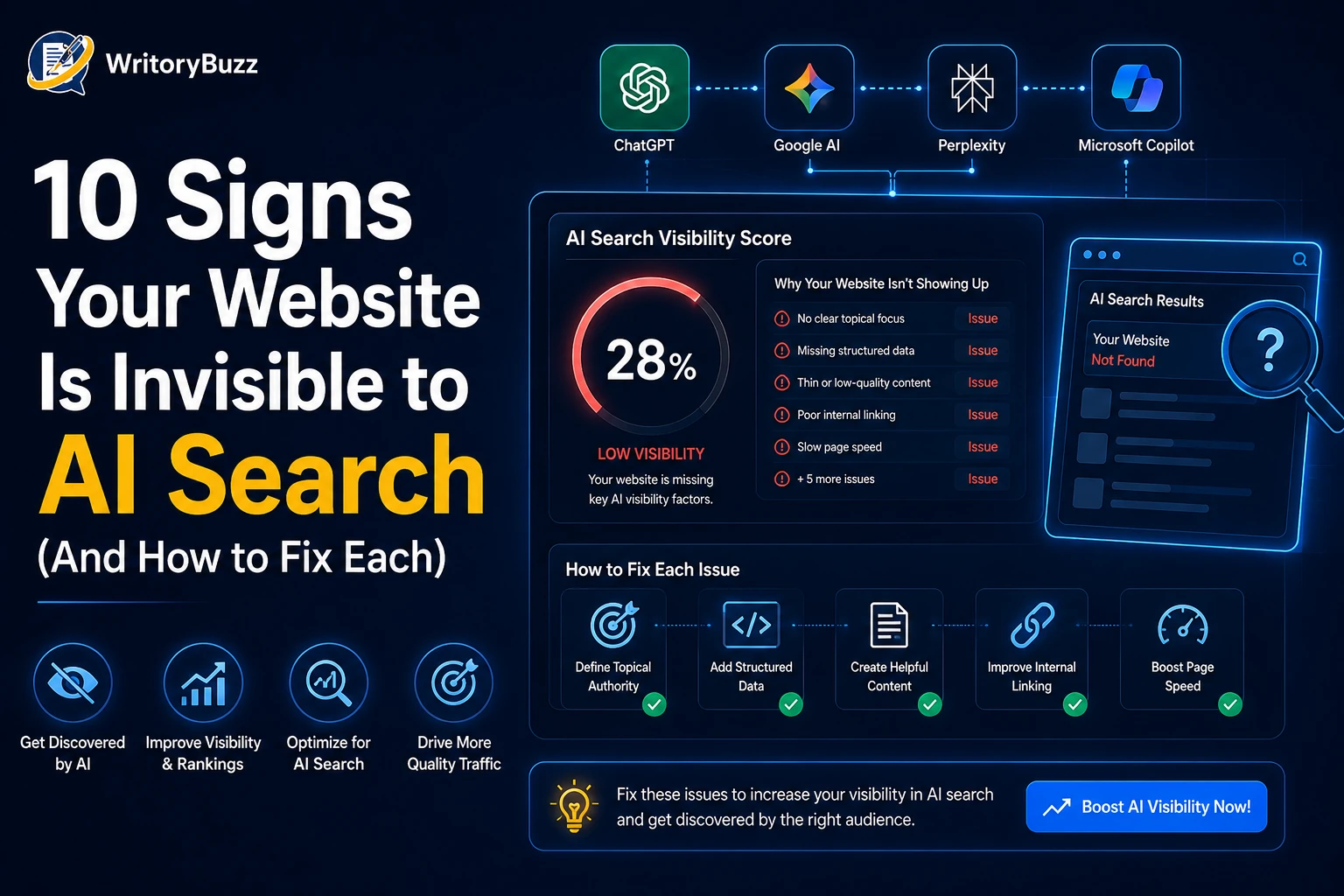
A site can rank reasonably well in traditional search while remaining almost entirely invisible to AI answer engines, since the two systems evaluate content differently. Below are ten specific, checkable signs a site is currently being skipped by AI systems, each paired with a concrete fix rather than a vague general recommendation.
1. Your Answers Are Buried, Not Stated Upfront
If a page’s core answer to its own title question does not appear within the first paragraph or two, an AI system scanning that page for a quotable answer frequently moves on to a competing page that states its answer more directly. Fix this by rewriting the opening section to lead with the direct answer itself.
2. Your Headings Read Like Marketing Copy, Not Questions
Headings like “Our Approach” or “Why It Matters” give an AI system nothing specific to match against an actual user question. Fix this by rewriting headings as the literal questions a reader would type.
3. You Have Never Actually Checked Your AEO Readiness
Many site owners simply do not know where they currently stand, since AEO readiness was not a metric anyone tracked until quite recently. Fix this immediately by running your top pages through a free aeo checker to establish a genuine baseline before making any other changes.
4. You Have No llms.txt File
Without an llms.txt file, AI crawlers have no explicit signal about which parts of your site represent your most authoritative, citation-ready content. Fix this by generating one through a llms.txt generator and publishing it at your site’s root.
5. Your Content Lacks Specific, Checkable Detail
Vague, general statements without specific numbers, sources, or examples give an AI system little confidence to cite you over a more specific competing source. Fix this by adding concrete data points and named sources throughout your highest-priority pages.
| Sign | Root Cause | Primary Fix |
| Answer buried mid-page | Content structured for narrative, not extraction | Move the direct answer to the opening paragraph |
| No llms.txt file | AI crawlers lack explicit guidance | Publish an llms.txt file site-wide |
| Weak author attribution | No demonstrated expertise signal | Add detailed author bios and credentials |
| Outdated statistics | Content has not been refreshed | Update key facts and figures regularly |
6. Your Author Bios Are Thin or Missing
AI systems increasingly weigh demonstrated expertise before citing a source, similar to how search quality guidelines evaluate expertise. Fix this by adding genuine, detailed author bios establishing relevant credentials and experience, then confirm the improvement with an eeat checker.
7. Your Statistics and Examples Are Years Out of Date
AI systems weigh content freshness when selecting a citation source for a time-sensitive question, and stale statistics signal a page has not been actively maintained. Fix this by auditing and refreshing key data points on a regular schedule.
8. Your Robots.txt Is Accidentally Blocking AI Crawlers
Some sites unintentionally restrict AI crawler access through an overly broad robots.txt rule originally written for a different purpose. Fix this by reviewing your robots.txt configuration specifically for AI crawler access, not just traditional search crawler access.
9. Your Content Reads as a Wall of Text
Dense, unbroken paragraphs are considerably harder for an AI system to parse into a clean, extractable answer than clearly segmented content. Fix this by breaking long paragraphs into shorter, more self-contained sections.
10. You Have Never Retested After Making Changes
Fixing these signs once and never verifying the actual improvement leaves you guessing whether the changes genuinely worked. Fix this by running a free aeo checker scan again after implementing changes, and repeating that same verification on a regular, ongoing cadence rather than treating AEO as a single, one-time project.
Putting It All Together
Most sites showing several of these ten signs simultaneously are not failing due to one single catastrophic issue, they are accumulating small, individually modest gaps that compound into genuine AI invisibility once combined. Working through this list systematically, starting with a free aeo checker baseline scan, addresses these gaps in a genuinely prioritized, evidence-based order rather than guessing at which fix matters most.
Access every tool referenced in this list, plus additional SEO and content utilities, through WritoryBuzz’s free tools hub.