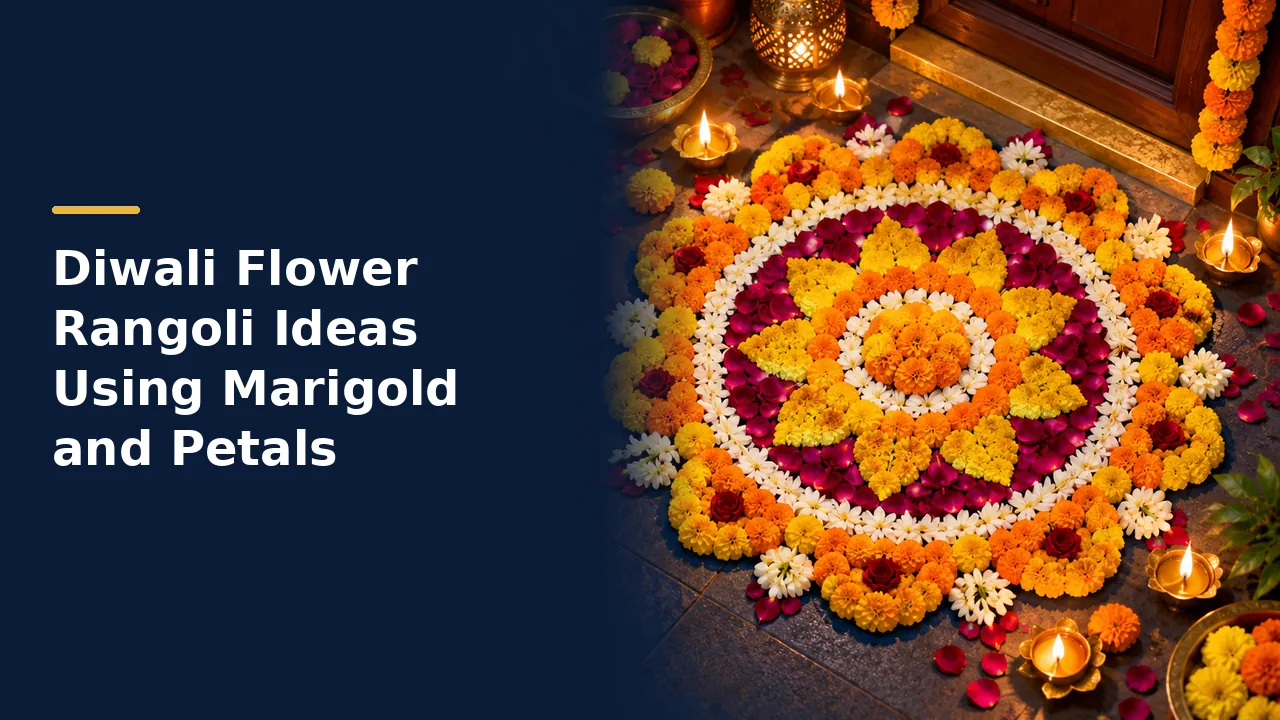
Wikipedia’s entry on rangoli records that during Onam in Kerala, flowers are laid out on each of the ten days, with the design growing more complex every day. That habit of building a floral pattern from fresh petals is the same idea behind a Diwali flower rangoli, and it is why marigold, rose and jasmine remain the favourite materials for the festival entrance.
This guide gives you Diwali flower rangoli ideas using marigold and petals, including 15 designs, colour combinations, how to prepare the flowers, a step-by-step method, where to place diyas, and how to clean up in an eco-friendly way. Diwali falls on Sunday, November 8, 2026, according to Dekho Panchang.
Diwali Flower Rangoli Ideas: Why Petals Work
A flower rangoli is bright, fragrant and quick to make. You do not need to colour anything, because the petals carry the colour, and you can build the design in layers. Wikipedia lists flower petals alongside rice flour, coloured sand and powdered limestone as traditional rangoli materials, and notes that rangoli designs may use flower and petal forms.
Flower designs also suit homes where powder is difficult to clean. Petals can be swept up and composted, and they can be combined with a thin rangoli outline in flour if you want crisp edges.
Best Flowers for Diwali Rangoli
Choose flowers by colour and petal size. Marigold is the classic Diwali flower because of its warm orange and yellow tones, and its petals are easy to separate. Roses give red and pink, jasmine gives white, and green leaves provide a contrasting outline.
| Flower or leaf | Colour | Best used for |
|---|---|---|
| Marigold (genda) | Orange, yellow | Rings, borders, fill |
| Rose petals | Red, pink | Centre motifs, hearts |
| Jasmine or mogra | White | Outlines, small accents |
| Chrysanthemum | Yellow, white, purple | Layered fans |
| Hibiscus | Red | Large centre petals |
| Green leaves (mango, curry or banana) | Green | Borders and stems |
| Dried petals or seeds | Mixed | Backup, texture |
Buy a little more than you need, because petals vary in size and some will tear while you work.
15 Diwali Flower Rangoli Designs
These designs use petals as the main material. Pick one based on your time and the size of your entrance.
| # | Design | Petals used | Level |
|---|---|---|---|
| 1 | Marigold ring | Orange and yellow in two concentric circles | Easy |
| 2 | Rose heart | Red petals with a diya at the centre | Easy |
| 3 | Sunburst | Radiating orange and yellow petals | Medium |
| 4 | Rainbow wedges | Six petal colours in pie sections | Medium |
| 5 | Lotus in petals | Pink and white petals in tiers | Medium |
| 6 | Peacock fan | Blue, green and yellow petals | Hard |
| 7 | Star with leaves | Marigold star with green leaf tips | Medium |
| 8 | Petal swirl | Spiral from the centre outward | Medium |
| 9 | Leaf and flower wreath | Ring of flowers and green leaves | Easy |
| 10 | Floating bowl | Water bowl with petals and a floating diya | Easy |
| 11 | Welcome footprints | Footprint shape filled with white petals | Easy |
| 12 | Border garland | Line of petals along the edge of the doorway | Easy |
| 13 | Diya in petals | Lamp shape in orange with a yellow flame | Medium |
| 14 | Mandala in petals | Multiple rings of different colours | Hard |
| 15 | Elephant pair in petals | Two elephants with a central lotus | Hard |
Colour Combinations for Flower Rangoli
A limited palette looks more polished than many colours. Choose two main colours and one accent, and repeat them across the rings.
| Combination | Flowers | Mood |
|---|---|---|
| Warm festive | Orange marigold, yellow chrysanthemum, red rose | Classic Diwali |
| Pink and white | Rose, jasmine, white chrysanthemum | Soft and elegant |
| Gold and green | Yellow marigold, green leaves | Fresh |
| Red and white | Red rose, jasmine | Bold and simple |
| Rainbow | Six colours in sections | Playful |
How to Prepare Petals for Rangoli
Pluck petals the evening before and store them in a cool place, loosely covered with a damp cloth, so they stay fresh until the morning. Sort by colour into shallow bowls. Wash and dry any leaves you plan to use. Do not wet the petals on the floor, because water can stain or make them slide.
If you need to lay the design in advance, mark the outline with chalk and keep petals in bowls close by. Place them only on the day, shortly before guests arrive.
Step-by-Step: A Marigold Rangoli
This simple design uses three colours and takes about 30 minutes.
| Step | What to do |
|---|---|
| 1 | Clean and dry the floor and mark a circle with chalk |
| 2 | Divide the circle into rings with a lid or string |
| 3 | Lay a ring of orange marigold petals on the outer edge |
| 4 | Add a ring of yellow petals inside it |
| 5 | Lay red rose petals in the centre in a flower shape |
| 6 | Add green leaves around the edge and place a diya at the centre |
Press each petal gently into place with your fingertip, overlapping slightly so there are no gaps.
Combining Petals With Powder and Diyas
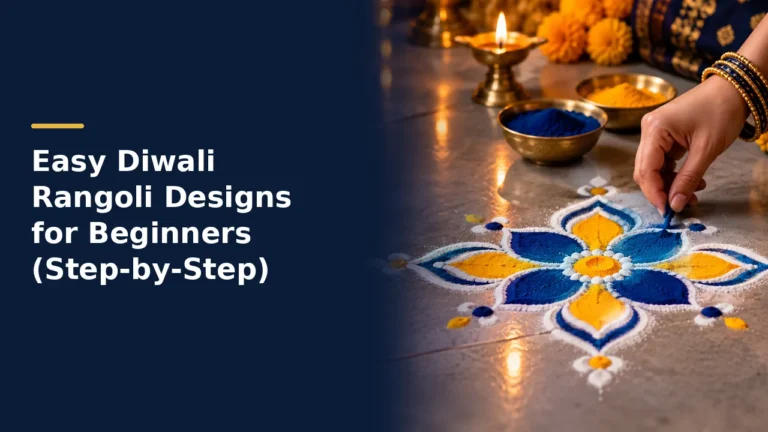
A common approach is to draw a thin outline in white rice flour, fill the large areas with petals and use coloured powder only for fine detail. Wikipedia notes that rangoli uses a combination of materials including rice flour, powders, grains and petals, so mixing them is entirely traditional.
South Yorkshire Fire and Rescue advises placing diyas, tea lights and candles on heat-resistant surfaces well away from curtains and decorations, and supervising children and pets at all times near flames. Keep dry petals and any loose fabric at a safe distance from lit lamps, and light the diyas only when you are present.
Eco-Friendly Clean-Up
Flower rangoli is easy to clear. Sweep the petals into a bag after the festival, compost them with garden waste and wash the floor with a damp cloth. Avoid sweeping dry petals into drains. If you used powder, collect it separately and dispose of it with household waste.
| Material | After Diwali |
|---|---|
| Fresh petals | Compost |
| Leaves | Compost |
| Rice flour | Sweep up; can be left for birds and ants outdoors |
| Coloured powder | Sweep and bag |
| Diyas | Wash, dry and store for next year |
The idea of leaving rice flour for ants and birds comes from tradition: Wikipedia notes that cereal powders are believed to feed insects, which is considered a form of seva.