Wikipedia’s entry on kolam states that millions of households in Tamil Nadu, Telangana and Andhra Pradesh draw kolam daily, usually at dawn at the house entrance, using white rice flour. For Diwali, that everyday practice is simply made a little grander, with more dots, more colour and a lamp at the centre.
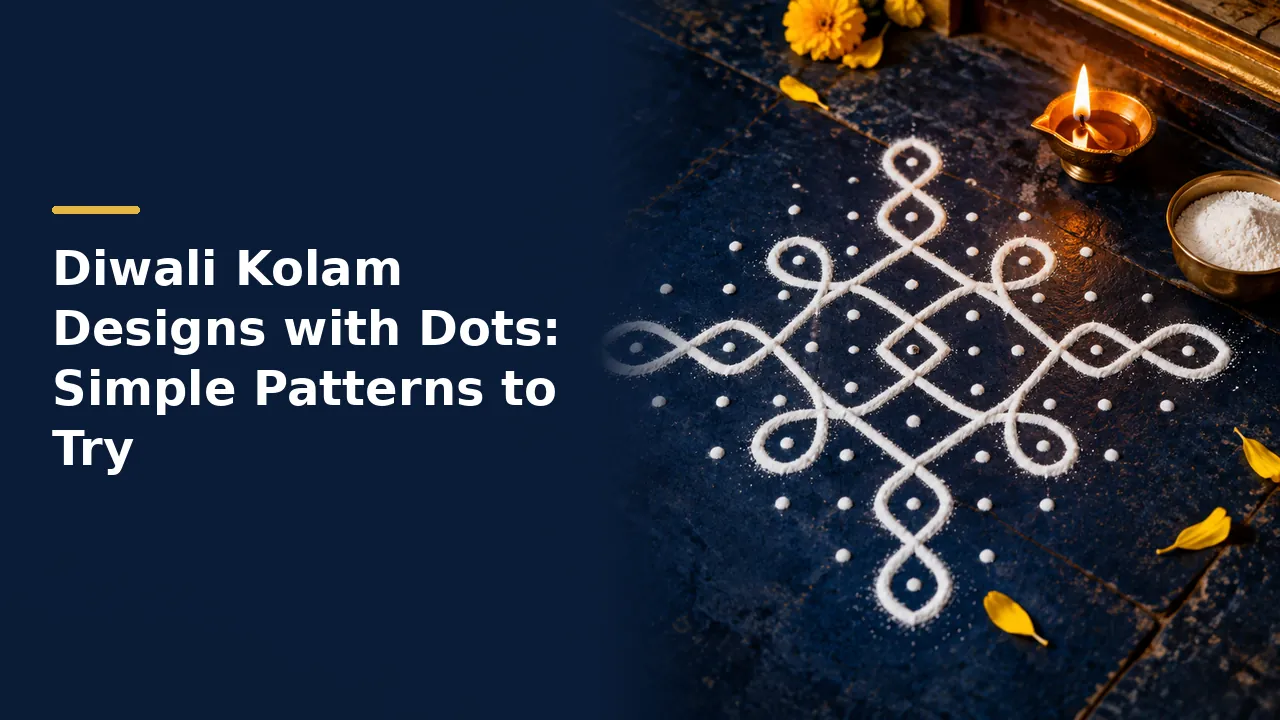
This guide gives you Diwali kolam designs with dots: simple pulli patterns, dot grids from 3 by 3 to 9 by 9, step-by-step methods, deepam kolam ideas, tips for neat lines and notes on materials and safety. Diwali falls on Sunday, November 8, 2026, according to Dekho Panchang.
Diwali Kolam Designs: What Kolam Is
Kolam, also called muggu in Andhra Pradesh and Telangana, is described by Wikipedia as a form of traditional decorative art drawn with rice flour. It is a geometric line drawing of straight lines, curves and loops around a grid of dots, and is found across South India and among the diaspora in countries such as Sri Lanka, Singapore and Malaysia.
Kolam is usually monochrome or lightly coloured and symmetrical. Rangoli, by contrast, is a broader and more colourful tradition made for festivals. For Diwali, many households add colour to a classic dot kolam, which gives the best of both traditions.
Materials for Kolam Designs with Dots
Traditional kolam uses white rice flour, often the dry coarse type called kolapodi. Other options include white stone powder, chalk powder and dilute rice paste, with colour powders for festival designs. Wikipedia notes that old kolams were drawn with coarse rice flour so ants would not have to travel far for a meal, and the powder also feeds birds and other small creatures.
| Material | Use | Note |
|---|---|---|
| Dry rice flour | Dots and lines | Traditional and biodegradable |
| Chalk powder | Lines on stone floors | Easier on smooth tiles |
| Rice paste | Wet outlines | Dries white and holds well |
| Coloured powders | Festival fills | Use sparingly |
| Flowers | Accents | Add last |
| Diya | Light | Place at the centre or corners |
How to Draw a Pulli Kolam Step by Step
Pulli means dot in Tamil. In a pulli kolam, Wikipedia describes a stroke that runs once around each dot and returns to its starting point, forming a mostly geometric figure. Before drawing, sweep the entrance and sprinkle it with water so that the surface is damp. The kolam is drawn while the surface is still damp, because the design holds better.
| Step | What to do |
|---|---|
| 1 | Sweep the entrance and sprinkle with water |
| 2 | Place the dots with a pinch of rice flour, in equal rows |
| 3 | Start at one dot and draw a line looping around it |
| 4 | Continue around the next dots, keeping the line smooth |
| 5 | Return to your starting point to close the design |
| 6 | Add a border and, if you like, colour between the lines |
Practise with a finger and a plate of flour, or draw on paper with a pencil, until the loops feel natural.
Simple Diwali Kolam Patterns with Dots
Start with small grids and increase the size as you gain confidence. The table below shows a ladder of designs, from the simplest to the most elaborate.
| # | Dot grid | Pattern | Level |
|---|---|---|---|
| 1 | 3 by 3 | Four-petal flower | Easy |
| 2 | 3 by 3 | Square with curved corners | Easy |
| 3 | 5 by 5 | Eight-petal flower | Easy |
| 4 | 5 by 5 | Interlocking star | Easy |
| 5 | 5 by 5 | Diya outline | Medium |
| 6 | 7 by 7 | Lotus | Medium |
| 7 | 7 by 7 | Diamond lattice | Medium |
| 8 | 9 by 9 | Sixteen-petal flower | Hard |
| 9 | 9 by 9 | Peacock outline | Hard |
| 10 | Large grid | Border of connected lamps | Hard |
Deepam Kolam and Diwali Kolam Designs with Lamps
The deepam kolam places a lamp at the centre or at the corners of the pattern. Draw a simple dot kolam, then fill the centre with a lamp shape. Place a real diya on the lamp when you light it. You can also draw a row of small lamps along the border, with each lamp shaped like a loop around a dot.
| Idea | How to draw it |
|---|---|
| Centre deepam | Draw a lamp shape in the middle of a 5 by 5 grid |
| Corner lamps | Place a lamp in each corner of a square kolam |
| Lamp garland | Draw a line of small loops with a lamp every third dot |
| Lotus and lamp | Lotus petals with a lamp at the centre |
Adding Colour to a Kolam for Diwali
Since kolam is usually monochrome or lightly coloured, a little colour goes a long way. Wikipedia notes that natural or synthetic colour powders are used, and that for special occasions, limestone and red brick powder are used for contrast. Choose two colours that complement the white lines, such as red and yellow, and fill alternate sections.
Fill colours after the white outline is complete, working from the centre outward. Use a small cone or your fingers, and tap the excess powder from the edge so it does not smear.
Tips for Neat Lines and Even Dots
Neat kolam depends on spacing. Use your finger width, a small cup or a ruler to space the dots evenly. Hold the powder between your thumb and forefinger and release it in a thin, steady stream, moving your hand at a constant speed. If your line wobbles, wipe it away with a damp cloth and redraw it.
| Problem | Cause | Fix |
|---|---|---|
| Uneven dots | No spacing guide | Use a ruler or a lid as a template |
| Thick lines | Too much powder | Pinch less and move faster |
| Broken loops | Lifting your hand | Practise drawing without stopping |
| Pattern off-centre | No centre mark | Mark the centre dot first |
| Powder blown away | Dry surface | Sprinkle the floor lightly with water |
Safety and Etiquette Around Kolam
South Yorkshire Fire and Rescue advises placing diyas, tea lights and candles on heat-resistant surfaces and well away from curtains and decorations, and supervising children and pets at all times near flames. Keep kolam powder and flowers at a safe distance from lit lamps.
Wikipedia notes that kolams are walked on, washed away by rain or blown by wind, and new ones are made the next day. That impermanence is part of the tradition, so do not worry if your Diwali kolam does not last long.