Dekho Panchang lists Diwali 2026 on Sunday, November 8, with the Lakshmi Puja muhurat from 5:48 PM to 7:14 PM IST in New Delhi, which gives families a clear deadline for finishing the rangoli at the entrance. Wikipedia notes that rangoli is made during many Hindu festivals, and most often during Diwali, where it is meant to welcome Lakshmi and represent happiness and prosperity.
This guide gives you 60 Diwali rangoli designs for 2026, grouped by style so you can choose by skill and time: classic motifs, diya designs, flower rangoli, dot-grid patterns, modern and creative ideas, and large entrance rangoli. It also covers materials, a simple method, colour ideas, safety around diyas and what to do after the festival.
Diwali Rangoli Designs: What Rangoli Means
Rangoli is a decorative art form from the Indian subcontinent in which patterns are made on a floor or tabletop. The name comes from the Sanskrit word for colour. Britannica calls it a folk art of floor drawings, regarded as creating an auspicious space, and notes that designs can be figurative, geometric or a combination of both.
Traditional materials include dry rice flour, powdered limestone, red ochre, coloured sand and flower petals, while modern versions use paints, chalk and coloured powders. Rangoli is placed at the entrance of the home, and its regional names include kolam in Tamil Nadu, muggu in Andhra Pradesh and Telangana, alpana in West Bengal and pookalam in Kerala.
Materials and Tools for Easy Rangoli Designs
You do not need much to make beautiful Diwali rangoli designs. A small set of materials covers almost every idea in this list.
| Material | Used for | Tip |
|---|---|---|
| Rice flour or chalk powder | Outlines and white base | Dry flour flows more smoothly through fingers |
| Coloured rangoli powder | Fills and shading | Keep colours in separate small bowls |
| Flower petals | Marigold, rose and jasmine accents | Use fresh petals on the day |
| Diyas and tea lights | Light and decoration | Place on heat-resistant bases |
| Stencils and cones | Neat lines and repeated shapes | Good for beginners |
| Chalk or pencil | Marking the grid | Draw lightly, then trace with flour |
| Soft brush or cloth | Clean-up of stray colour | Use a dry brush for powder |
Classic Rangoli Designs for Diwali (Ideas 1 to 10)
Classic motifs are the safest choice if you want a design that looks right for the festival. Wikipedia lists the lotus, mango, fish, birds such as parrots, swans and peacocks, foliage, the diya, Ganesha and Lakshmi among the common motifs.
| # | Design | What it looks like | Level |
|---|---|---|---|
| 1 | Lotus | Layered petals around a centre, in pink and white | Easy |
| 2 | Peacock | Fan tail with blue, green and gold feathers | Hard |
| 3 | Lakshmi footprints | Pair of small footprints entering the home | Easy |
| 4 | Kalash | Pot with mango leaves and a coconut | Medium |
| 5 | Mango motif | Paisley-shaped mango repeated in a ring | Medium |
| 6 | Parrot | Green bird on a branch | Medium |
| 7 | Swan pair | Two white swans facing each other | Medium |
| 8 | Ganesha outline | Simple outline of the deity in orange and red | Hard |
| 9 | Om symbol | Bold symbol at the centre with a border | Easy |
| 10 | Fish pair | Two curved fish forming a circle | Medium |
Diya Rangoli Designs (Ideas 11 to 20)
A diya in the design is the simplest way to tie the rangoli to Diwali. Draw the lamp shape in colour, then place a real diya on top when you light it.
| # | Design | What it looks like | Level |
|---|---|---|---|
| 11 | Single large diya | One big lamp shape with a flame in orange and yellow | Easy |
| 12 | Row of diyas | Five small lamps in a line | Easy |
| 13 | Diya ring | Eight diyas around a central flower | Medium |
| 14 | Diya on a lotus | Lamp sitting on an open lotus | Medium |
| 15 | Diya with rays | Flame with radiating lines | Easy |
| 16 | Diya in a square frame | Lamp inside a bold square border | Easy |
| 17 | Twin diyas | Two diyas facing each other | Easy |
| 18 | Diya and petals | Lamp surrounded by petal fans | Medium |
| 19 | Stacked diyas | Three lamps in a pyramid | Medium |
| 20 | Diya garland | Curved line of tiny lamps with leaves | Medium |
Flower Rangoli Designs (Ideas 21 to 30)
Flower rangoli designs use petals instead of powder, which makes them fast and fragrant. In Kerala’s Onam tradition, flowers are laid out for each day with the design growing more complex daily, an idea you can borrow for the five days of Diwali.
| # | Design | What it looks like | Level |
|---|---|---|---|
| 21 | Marigold circle | Concentric rings of orange and yellow petals | Easy |
| 22 | Rose petal heart | Red petals in a heart shape with a centre diya | Easy |
| 23 | Petal peacock | Fan made of coloured petals | Hard |
| 24 | Jasmine border | White flowers along the edge of a design | Easy |
| 25 | Rainbow petals | Wedge sections in several colours | Medium |
| 26 | Flower and leaf wreath | Ring of petals and green leaves | Easy |
| 27 | Petal star | Eight-point star with alternating colours | Medium |
| 28 | Floating flower bowl | Water bowl with petals and a diya | Easy |
| 29 | Petal swirl | Spiral of marigold petals from the centre | Medium |
| 30 | Layered lotus in petals | Three tiers of pink and white petals | Medium |
Dot-Grid and Geometric Rangoli Designs (Ideas 31 to 40)
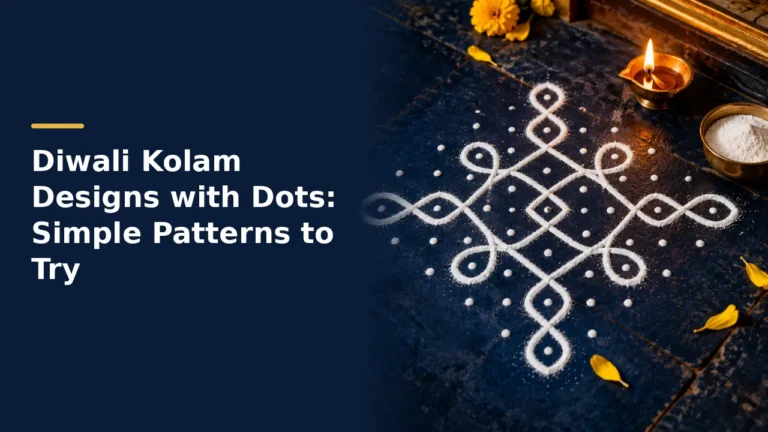
Dot patterns are the best way to get neat, symmetrical results. Wikipedia notes that a square grid is common in North India and a hexagonal grid in South India, and that the basic method is to mark a centre point and cardinal points, then build outward.
| # | Design | What it looks like | Level |
|---|---|---|---|
| 31 | 5 by 5 dot flower | Simple flower joined with curved lines | Easy |
| 32 | 7 by 7 star | Eight-point star in alternating colours | Medium |
| 33 | 9 by 9 diamond | Diamond lattice with a centre motif | Medium |
| 34 | Hexagonal dot design | Six-sided pattern with petals | Medium |
| 35 | Dot lotus | Lotus drawn around a grid | Medium |
| 36 | Interlocking squares | Two rotated squares making a star | Easy |
| 37 | Circle of dots | Ring of dots joined by loops | Easy |
| 38 | Dot peacock | Peacock drawn with curved lines through dots | Hard |
| 39 | Mirror pattern | Symmetrical design with four equal quarters | Medium |
| 40 | Dot diya | Lamp drawn by joining dots | Easy |
Modern and Creative Rangoli Designs (Ideas 41 to 50)
Modern rangoli designs use new materials and bold shapes. Wikipedia mentions crayons, acrylic paints and coloured powders as modern options. Use what is convenient for your space, particularly if you live in an apartment where flour and petals are hard to clean.
| # | Design | What it looks like | Level |
|---|---|---|---|
| 41 | Acrylic floor mandala | Painted circular pattern on a mat or board | Medium |
| 42 | Chalk rangoli | Coloured chalk outlines with simple fills | Easy |
| 43 | Lights and powder | Colour powder with fairy lights around the border | Medium |
| 44 | Sticker rangoli | Reusable rangoli stickers arranged in a pattern | Easy |
| 45 | Stencil rangoli | Stencil pressed onto the floor and filled with powder | Easy |
| 46 | Rangoli on a wooden board | Portable design that can be moved indoors | Medium |
| 47 | Rangoli with beads | Beads and stones added for sparkle | Medium |
| 48 | Neon colours | Bright pink, green and blue on a dark base | Medium |
| 49 | Minimalist line design | One thin outline of a lotus or diya | Easy |
| 50 | Rangoli with rice and lentils | Coloured grains used for texture | Medium |
Big Rangoli Designs for Entrances (Ideas 51 to 60)
A large rangoli at the entrance is the first thing guests see. Choose a bold shape, plan the size on the floor with chalk and keep the colours consistent so the whole design reads from a distance.
| # | Design | What it looks like | Level |
|---|---|---|---|
| 51 | Giant lotus | Six-layer lotus filling the doorway | Hard |
| 52 | Welcome border | Rectangular border with a diya in each corner | Medium |
| 53 | Peacock pair | Two peacocks facing a central lamp | Hard |
| 54 | Sunburst | Radiating rays from a central circle | Medium |
| 55 | Kalash and mango leaves | Tall pot at the centre with leaves on both sides | Medium |
| 56 | Footprint path | Lakshmi footprints leading from the door | Easy |
| 57 | Mandala circle | Multi-ring circular pattern | Hard |
| 58 | Elephant motif | Pair of elephants flanking a lotus | Hard |
| 59 | Garland arch | Curved design of flowers and diyas | Medium |
| 60 | Rangoli carpet | Full rectangular design like a carpet | Hard |
How to Make a Diwali Rangoli Step by Step
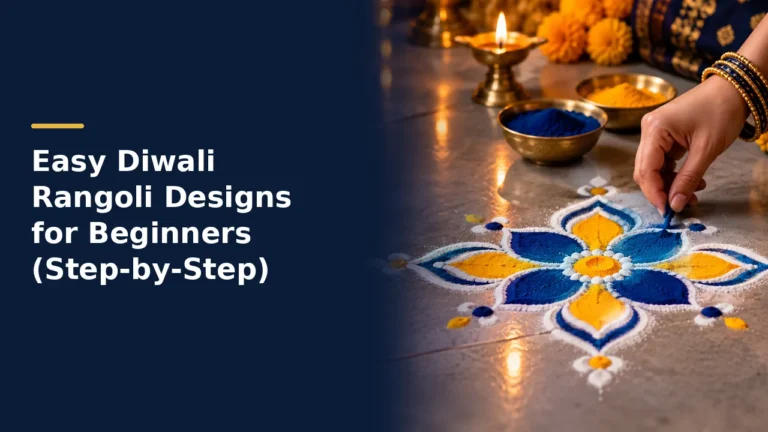
Clean and dry the floor, then follow a simple sequence. Mark the centre and the main points lightly with chalk, draw the outline with white flour or powder, and add the main motif. Fill the colours from the centre outward, finish with the border and place diyas last.
| Step | Action | Time |
|---|---|---|
| 1 | Sweep and dry the floor | 5 minutes |
| 2 | Mark the centre and outline in chalk | 5 to 10 minutes |
| 3 | Trace the outline with flour or powder | 10 to 20 minutes |
| 4 | Fill colours from the centre outward | 20 to 40 minutes |
| 5 | Add the border and place diyas | 10 minutes |
Colour Ideas and Safety Around Diyas
Traditional palettes use red, orange, yellow, green and white, with pink and blue for lotus and peacock designs. Choose two or three main colours and one accent for a cleaner look.
South Yorkshire Fire and Rescue advises placing diyas, tea lights and candles on heat-resistant surfaces and well away from curtains and decorations, and supervising children and pets at all times near flames. Keep flowers and loose powders at a safe distance from lit diyas, and keep a bucket of water nearby for emergencies.
After Diwali: Cleaning and Reusing
Rangoli is ephemeral art, as Britannica puts it. Sweep powder into a bag, compost the flower petals and wash the floor with a damp cloth. Save leftover colours in sealed containers for the next festival.