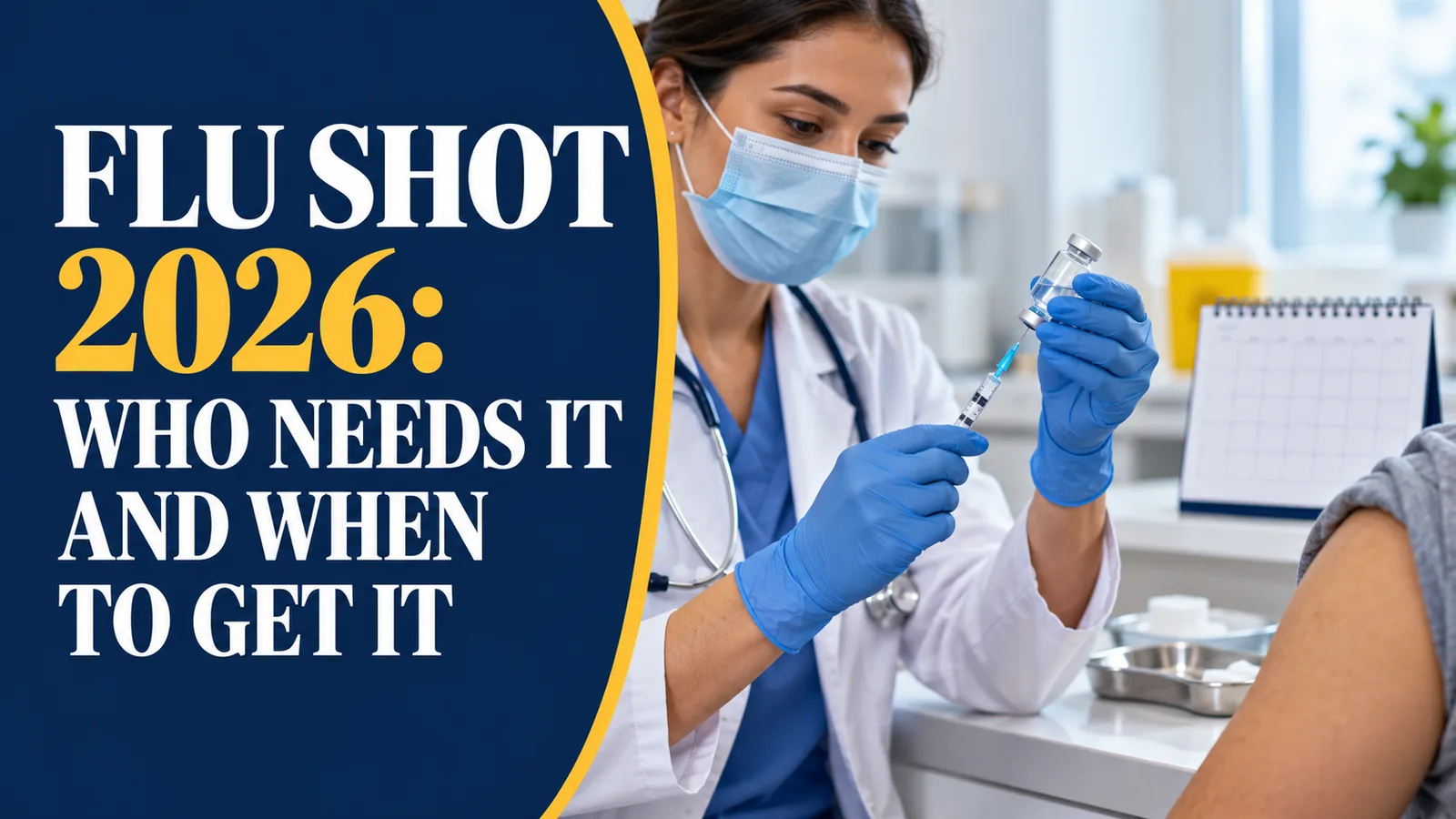
The US Centers for Disease Control and Prevention says everyone 6 months and older should get a flu vaccine every season with rare exceptions, and that when vaccine viruses match circulating flu viruses, vaccination reduces the risk of needing a doctor visit for flu by 40 percent to 60 percent. Yet each autumn the same questions return: who needs a flu shot, when is the best time, and which vaccine should you ask for?
This guide answers those questions for the 2026 to 2027 season. It covers who should be vaccinated, the best timing, vaccine types for children, adults and people over 65, whether you can get a flu shot with a COVID or RSV vaccine, what to expect afterwards and how to find a clinic. It is general information, so follow the advice of your own clinician.
Who Needs a Flu Shot in 2026?
The CDC’s advice is simple: everyone 6 months and older should get a flu vaccine every season with rare exceptions, and vaccination is especially important for people at higher risk of serious complications. Johns Hopkins Medicine summarises the 2026 to 2027 recommendations in the same way: most people 6 months and older should get an annual, age-appropriate flu vaccine.
People with an egg allergy can receive any appropriate vaccine, egg-based or non-egg-based, according to the CDC. If you have had a severe reaction to a flu vaccine in the past or have a condition that makes you unsure, ask your clinician before you book. For household planning, our guide to meal planning for a week helps keep sick days from derailing the family routine.
When to Get Your Flu Shot
Johns Hopkins Medicine says vaccination before the end of October is ideal, but later vaccination still offers protection. Flu season typically peaks from December through February and can last through May, and protection takes about two weeks to develop, so you can get vaccinated at any time during the season. If you are reading this in October, you are in the ideal window.
| When | What it means |
|---|---|
| September to October | Ideal window, so protection is in place before the winter peak |
| November to December | Still worthwhile; protection builds in about two weeks |
| January onward | Flu season can last through May, so vaccination can still help |
| Children 6 months to 8 years who need two doses | Start early; doses must be at least four weeks apart |
If you have never been vaccinated, or your child has an unknown or off-schedule history, check with a clinician about two doses. According to Johns Hopkins Medicine, children 6 months to 8 years need one or two doses, with two required if the child has never been vaccinated or has an unknown or off-schedule history, while children 9 and older need one.
Flu Vaccine Types: Which One Is Right for You?
Johns Hopkins Medicine lists the options for 2026 to 2027. Egg-based or cell-based flu shots are available for many age groups, and a cell-based vaccine such as Flucelvax is one example of the cell-based option. An mRNA flu vaccine is available for adults 50 and older. Adults 65 and older should receive a higher-dose inactivated or recombinant vaccine, or an adjuvanted inactivated vaccine. The nasal spray is for ages 2 to 49 who are not pregnant and have no underlying health conditions.
| Group | Options (per Johns Hopkins Medicine) |
|---|---|
| Children 6 months to 17 years | Age-appropriate flu shot; nasal spray for ages 2 to 49 if eligible |
| Adults 18 to 49 | Standard flu shot; nasal spray if not pregnant and no underlying conditions |
| Adults 50 to 64 | Standard flu shot, including the mRNA option for adults 50 and older |
| Adults 65 and older | Higher-dose inactivated or recombinant vaccine, or adjuvanted inactivated vaccine |
| People with egg allergy | Any appropriate vaccine, egg-based or not (CDC) |
The 2026 to 2027 vaccines cover three viruses: two influenza A and one influenza B/Victoria, according to Johns Hopkins Medicine. Brand names vary by pharmacy and clinic, and you do not need to request a particular one unless your clinician advises it for your age or health.
Can You Get a Flu Shot With a COVID-19 or RSV Vaccine?
Johns Hopkins Medicine says most people can get flu and COVID-19 vaccines at the same visit, often in different arms, and that side effects are generally similar to getting them separately. If you are eligible, the RSV vaccine can also be given at the same visit. There is no need to delay your flu shot to wait for another vaccine.
How Effective Is the Flu Shot and What Are the Side Effects?
The CDC says that when vaccine viruses match circulating flu viruses, vaccination reduces the risk of needing a doctor visit for flu by 40 percent to 60 percent. Effectiveness varies from season to season and by age and health, which is why the CDC emphasises annual vaccination. The vaccine does not guarantee you will not catch flu, but it improves your odds of a milder illness.
Common reactions include a sore arm, mild tiredness or a low fever for a day or two. Seek medical help for difficulty breathing, swelling of the face or throat, or other severe symptoms soon after the shot. Support your recovery with rest, fluids and simple food, and keep a few healthy comfort food makeovers in mind for recovery days.
Where to Get a Flu Shot
Flu shots are widely available at pharmacies, primary care clinics, workplaces, health departments and some community events. Searching flu shots near me brings up local options, and pharmacies commonly run walk-in or appointment clinics. If cost is a concern, check whether your insurance, employer or local health department offers vaccination at no charge, and ask the clinic before you book. Bring your insurance details and a list of any allergies. Outside the United States, follow your national health authority, since timing and available vaccines vary by country and hemisphere.
Beyond the Shot: Everyday Habits During Flu Season
Vaccination works best alongside basic habits. Wash your hands, stay home when ill, ventilate rooms, and keep up sleep and nutrition. Our guide to science-backed habits for better sleep explains why rest matters, and our piece on best supplements for energy discusses what supplements can and cannot do. Supplements do not replace vaccination.