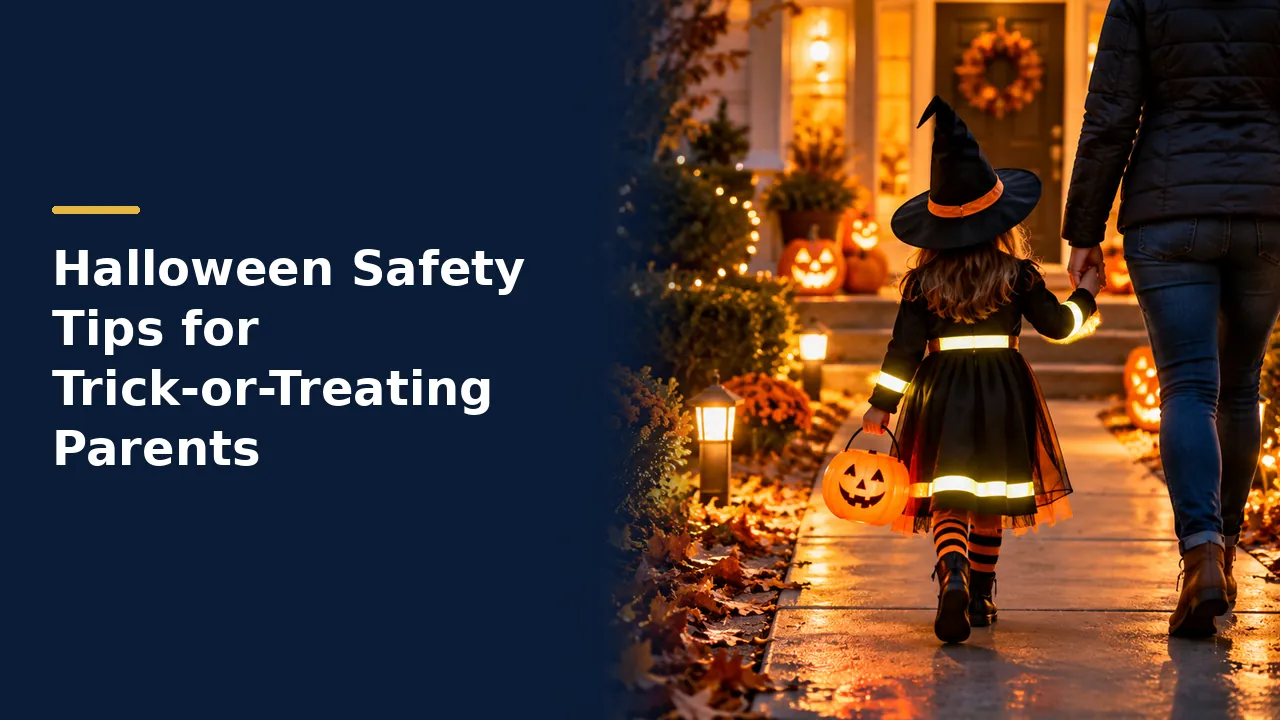
Safe Kids Worldwide, citing National Highway Traffic Safety Administration data for crash year 2006, reports that more than twice as many children are killed in pedestrian and vehicle incidents on Halloween between 4:00 pm and 10:00 pm as during the same hours on other days of the year. The figure is old, but the pattern it describes, excited children in dark costumes crossing busy streets at dusk, has not changed.
This guide gives you Halloween safety tips in the order you will need them: pedestrian rules for trick-or-treaters, Halloween costume safety, makeup and contact lens checks, Halloween candy safety tips, Halloween driving safety tips for drivers, and fire safety for jack-o-lanterns and decorations. Halloween falls on Saturday, October 31, 2026.
Halloween Safety Tips for Trick-or-Treaters on Foot
Most Halloween safety tips start with walking, because the main risk is traffic. Safe Kids Worldwide advises that children under 12 should be accompanied by an adult when trick-or-treating and when crossing streets. Older children should go in a group, follow a planned route and agree on a time to be home.
| Situation | Safe habit | Why it helps |
|---|---|---|
| Walking in the neighbourhood | Use sidewalks or paths; if none, walk on the left side facing traffic | Drivers see you coming |
| Crossing a street | Cross at corners and crosswalks and obey signals | Drivers expect people there |
| Before stepping off the curb | Look left, right and left again, and keep watching | Cars may turn or reverse |
| Moving between houses | Walk, do not run, and stay together | Running children are harder to predict |
| After dark | Carry a flashlight or glow stick | You are seen from farther away |
Talk through these habits before leaving the house, and repeat them every year. Safe Kids notes that glow stick liquid is hazardous, so tell children not to chew or break them.
Halloween Costume Safety: What to Check Before You Leave
A costume that looks good but trips a child, blocks their view or catches fire is not worth wearing. Guidance in a Morris County health department sheet, which attributes its tips to the FDA, CPSC and CDC, says to look for flame resistant labels, add reflective tape and keep props soft.
| Check | What to look for | Quick fix |
|---|---|---|
| Fabric | Flame resistant label | Choose another costume if there is no label |
| Length | Hems clear of the ground, nothing trailing | Pin or shorten the hem |
| Visibility | Light colours and reflective strips | Add reflective tape to the front and back |
| Props | Soft, flexible, short | Swap swords and sticks for foam versions |
| Masks | Eye holes wide enough to see | Use face paint instead if vision is limited |
| Footwear | Comfortable, closed, with grip | Skip oversized boots or heels |
Safe Kids also recommends choosing face paint or makeup over masks, which can block vision, and avoiding sharp objects such as swords. Walk around the house in the full costume before you go, because you will spot problems in minutes.
Halloween Makeup and Contact Lens Safety
Skin and eyes need extra care. The Morris County sheet says to test makeup 24 to 48 hours ahead, check the FDA colour additive list and be careful around the eyes. Use products made for skin, never craft paint, and stop at once if skin becomes red, itchy or sore.
The same sheet advises against decorative contact lenses that change how your eyes look unless they are properly fitted and are a trusted brand name. If your costume depends on special lenses, speak to an eye doctor first.
Halloween Candy Safety Tips: Inspect Treats at Home
Do the treat check at home, not on the street. Ohio State University’s Chow Line column advises looking closely at candy under a bright light for re-wrapping, torn paper, unusual smells, discolouration, pinholes or stains, and checking that treats are in original packaging. Children should wait until you have inspected the haul.
Safe Kids adds that candy with faded or torn wrappers, or anything unwrapped, should be thrown away. For children with food allergies, OSU says to always read the label to make sure the allergen is not present.
| Treat problem | What to do |
|---|---|
| Unwrapped candy | Throw it away |
| Torn or faded wrapper | Throw it away |
| Odd smell or colour | Throw it away |
| No ingredient label and an allergy in the family | Do not eat it |
| Small hard sweets for toddlers | Remove them, because they are a choking risk |
Halloween Driving Safety Tips for Drivers
Drivers share the responsibility. Safe Kids advises slowing down in residential neighbourhoods, where children may move unpredictably, and turning on headlights earlier in the day to spot them from farther away. Remember that costumes can limit a child’s visibility, and children may not see your vehicle.
Minimise in-car distractions, drive slowly when pulling out of driveways, and plan to park a block away on busy streets rather than looking for a space while trick-or-treaters are around.
Fire Safety for Jack-o-Lanterns and Decorations
NFPA advice, as published by the Connecticut State Fire Administrator, recommends using battery candles or flashlights in jack-o-lanterns, keeping exits clear and avoiding billowing fabric near flames. It also warns that dried flowers, cornstalks and crepe paper are highly flammable, so keep them away from heat sources.
If your child’s costume includes a cape or long skirt, keep them away from candles and lit pumpkins, and make sure all family members know where the exits are.
Pumpkin Carving Safety for Families
Ohio State University, citing Consumer Product Safety Commission data, reports that 44 percent of Halloween-related injuries were related to pumpkin carving. Use a carving kit, work on a dry, well-lit surface and let children aged 14 and under draw and scoop rather than cut.
A Halloween Night Checklist for Parents
Run through this short checklist before you leave the house.
| Before you go | Done? |
|---|---|
| Costume is flame resistant, short enough and easy to move in | Check |
| Reflective tape and a flashlight or glow stick are ready | Check |
| Face paint was tested 24 to 48 hours ago | Check |
| Route, group and return time are agreed | Check |
| Phone is charged, and a contact number is in each child’s pocket | Check |
| Allergies and medication are packed if needed | Check |