Home
Categories
Free Tools
Write For UsAbout UsContact

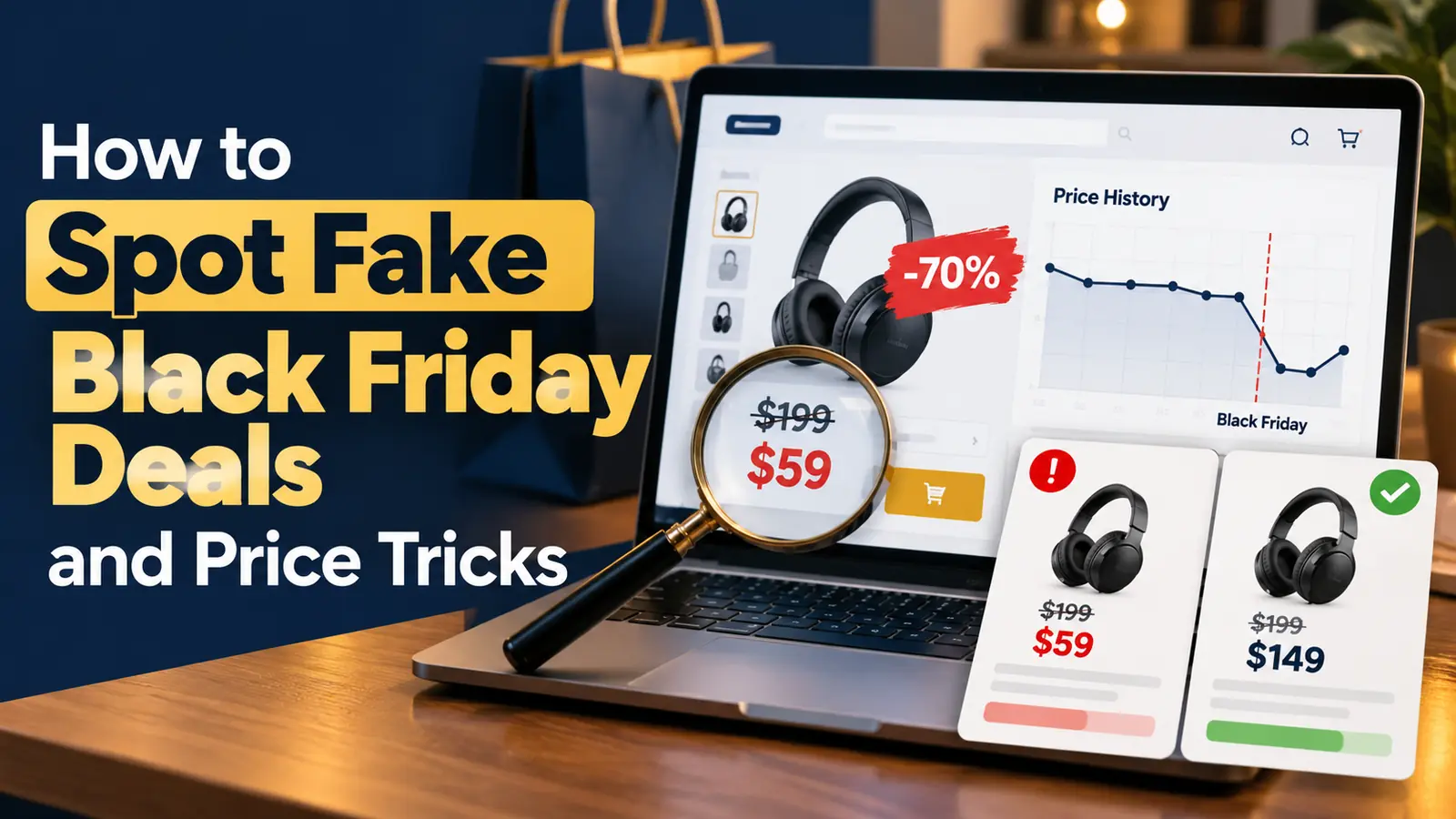
How to Spot Fake Black Friday Deals and Price Tricks

How to spot fake Black Friday deals: inflated 'was' prices, fake discounts and urgency tricks, with research from Which? and InvestigateTV and a checklist.

November 1, 2026 Updated October 30, 2026 6 min read
How to Spot Fake Black Friday Deals and Price Tricks

Key takeaways

  • Which? found 56 percent of 1,617 TVs had a price between the sale price and the 'was' price.
  • Which? tracked 175 products in 2024: 100 percent were cheaper or equal at some point in the six months either side of Black Friday.
  • InvestigateTV reported a shirt tagged 40 percent off 149 dollars that sold at 89 dollars, when 40 percent off its 109-dollar list price would be 65 dollars.
  • Check price history before you buy; do not trust 'was' prices or RRP alone.
  • If a price looks wrong, take a photo and report it; the FTC takes reports at ReportFraud.ftc.gov.

In a Which? review of 1,617 TVs at four major UK tech retailers from February 2024 to February 2025, 56 percent had at least one price between the sale price and the stated ‘was’ price, which suggests many ‘was’ prices were not what shoppers were paying just before the sale. A separate US investigation by InvestigateTV, published on 27 July 2026, found similar tactics in American stores.

This guide to fake Black Friday deals combines the Which? research (UK, in pounds), the InvestigateTV report (US) and NBC Select’s tips. The tactics are not illegal in every case, and I do not name any retailer as guilty beyond what the sources report. Black Friday 2026 is on Friday, 27 November.

The Main Price Tricks

The sources describe several patterns. The first is an inflated reference price, where the ‘was’ or original price is higher than shoppers recently paid. The second is a permanent sale, where discounts run continuously. The third is a misleading ‘sale’ sticker. The fourth is urgency, such as ‘limited time’ banners.

TrickWhat the sources found
Inflated ‘was’ priceWhich?: 56% of 1,617 TVs had a price between the sale and ‘was’ price
Wrong reference priceInvestigateTV: a Macy’s shirt tagged 40% off 149 dollars sold at 89 dollars; 40% off the 109-dollar price would be 65 dollars
Continuous discountsConsumers’ Checkbook tracked 25 major retailers for six months from February 2025 and found discounts at most were continuous
‘Sale’ stickersA former Dollar General employee told InvestigateTV corporate told her to put ‘sale’ stickers on items that weren’t discounted, and she estimated 40% of her stickers were misleading

What RRP and ‘Was’ Really Mean

Which? found confusion about RRP: only 62 percent of respondents knew what the term stands for, 18 percent wrongly thought it meant the retailer had sold the item at that price, and 31 percent assumed a ‘was’ price was offered immediately before the promotion. In one example, Amazon listed a Samsung tumble dryer at 629.99 pounds against an RRP of 789.99 pounds, but its highest price in the previous 12 months was 719 pounds.

TermWhat it meansWhat to check
RRPManufacturer’s recommended priceWhether anyone sold it at that price
Was priceRetailer’s earlier pricePrice history for the last 6 to 12 months
Original priceRetailer’s list priceThe same, plus other stores

How to Check a Deal in Five Steps

Which? recommends five checks, and NBC Select adds tools. Our wording below is a summary, not a quote.

StepHow
1. Compare retailersCheck at least three stores for the same product
2. Check price historyPricerunner, PriceSpy and CamelCamelCamel (Which?); Keepa and Honey (NBC Select)
3. Distrust ‘was’ pricesLook at what it actually sold for
4. Do not rely on RRPIt is not always what shops charged
5. Use independent reviewsWhich? recommends its own tested picks

Which? found that 83 percent of 175 products tracked in 2024 were cheaper or equal at least once in the year, so waiting is often a valid strategy.

What the US Rules Look Like

InvestigateTV reports that a former FTC official, Monica Vaca, said inflating original prices violates the FTC Act, while Consumers’ Checkbook’s Kevin Brasler said the FTC has not enforced its deceptive-pricing rules in over 40 years. Vaca also said the FTC lost authority in 2021 to recover money for consumers. California district attorneys settled with Walmart for more than 5 million dollars. Rules differ elsewhere, so this is a US picture only.

If you spot a wrong price, InvestigateTV advises taking a photo and reporting it to your state attorney general and at ReportFraud.ftc.gov.

Other Red Flags

Be skeptical of ‘limited-time’ urgency, off-brand products that may be made just for the sale, and deals that arrive through links you did not search for. Scripps News quotes Andrea Woroch warning about doorbuster deals on off-brand products. For scam links and fake storefronts, read our guide to AI phishing attacks.
Related readOnline Shopping Safety Checklist Before Black FridayRead →

Free tools for E-commerce

FAQs

How can I tell if a Black Friday deal is fake?

Check the item’s price history over the last 6 to 12 months and compare at other stores. Which? found 56 percent of 1,617 TVs had a price between the sale price and the ‘was’ price. If the ‘was’ price was rarely charged, the discount is probably inflated. Our own addition: take a screenshot of the product page with the date visible before you buy, which gives you evidence if the advertised price turns out to be misleading.

Are Black Friday prices really the lowest of the year?

Not always. Which? found that all 175 products it tracked from the 2024 sales were cheaper or the same price at some point in the six months either side. The data is from the UK, but it is a useful warning for shoppers everywhere. Because the data covers one year of UK products, treat it as evidence of a pattern rather than a rule, and always check the specific product you plan to buy.

What is a ‘was’ price?

A ‘was’ price is the retailer’s earlier price shown beside the sale price. Which? found 31 percent of survey respondents assumed it was offered immediately before the promotion. Retailers do not always do that, so check price history before you trust the saving. The simplest check is to open a price tracker, look at the last six to twelve months and see how often the item sold at that higher price.

What does RRP mean?

RRP stands for recommended retail price, set by the manufacturer. Which? found only 62 percent of respondents knew this, and 18 percent wrongly thought the retailer had sold at that price. It is not proof that the item was ever sold for that amount. Our own addition: when you see a high RRP next to a low price, ask what the shop itself charged in the weeks before, which is the number that actually matters.

Can I report a misleading price?

InvestigateTV advises taking a photo of the wrong price and reporting it to your state attorney general and at ReportFraud.ftc.gov in the US. In the UK, check the consumer authorities’ guidance. Keep screenshots of the product page, with the date, as evidence. Our own addition: keep order confirmations and receipts too, since they help with refunds and disputes, and check the retailer’s published return rules before you pay.

Which tools check price history?

Which? names Pricerunner, PriceSpy and CamelCamelCamel for Amazon in the UK. NBC Select names CamelCamelCamel, Honey and Keepa for US shoppers. Availability differs by country and store, so test the tool on an item you already know. Our own addition: test the tool on a product whose price you remember, which shows quickly whether its chart is accurate and covers the store you plan to use.

Make the Store Prove It

The strongest defence against fake deals is a habit: never accept the ‘was’ price at face value. Treat the sale price as a claim, and the price history as the evidence.

Before 27 November, pick three items, note their current prices and set tracker alerts. If the Black Friday price does not beat what you recorded, skip it and keep waiting.

Sources: Which?: How to avoid fake Black Friday deals; InvestigateTV via Hawaii News Now: How some retailers inflate original prices to create fake discounts; NBC Select: Black Friday and Cyber Monday deals won’t be good this year; Scripps News: How to score the best Black Friday tech deals

Was this guide helpful?
Jinal Mistry
Written by

Jinal Mistry

Jinal Mistry is the Founder of WritoryBuzz and an SEO & Digital Growth Specialist with 5+ years of experience in Technical SEO, AI SEO, International SEO, and organic growth strategy. She helps businesses improve search visibility through data-driven SEO, content optimization, search experience enhancement, and AI-focused search strategies.Having worked with clients across multiple industries and international markets, Jinal specializes in building sustainable organic growth through technical excellence, user-focused optimization, and future-ready digital marketing practices. Through WritoryBuzz, she shares insights on SEO, AI search, content strategy, digital marketing, and emerging search trends to help businesses and marketers stay ahead in the evolving digital landscape.

More from this author

More in E-commerce

View all in E-commerce →

Keep exploring

Have expertise to share? Write for WritoryBuzz.Read the guidelines and send us your pitch.
Become a contributor
Free tools

63 free tools for writers, SEOs and developers

Open one in your browser and start. Nothing to install, and your text stays on your device.

PrivateInstant resultsNo sign up
Write for us

Have expertise to share?

  • Original, well researched guides
  • Reviewed by our editors
  • 29 categories to publish in
Submit a guest post
© 2026 WritoryBuzz. All rights reserved.Back to top