
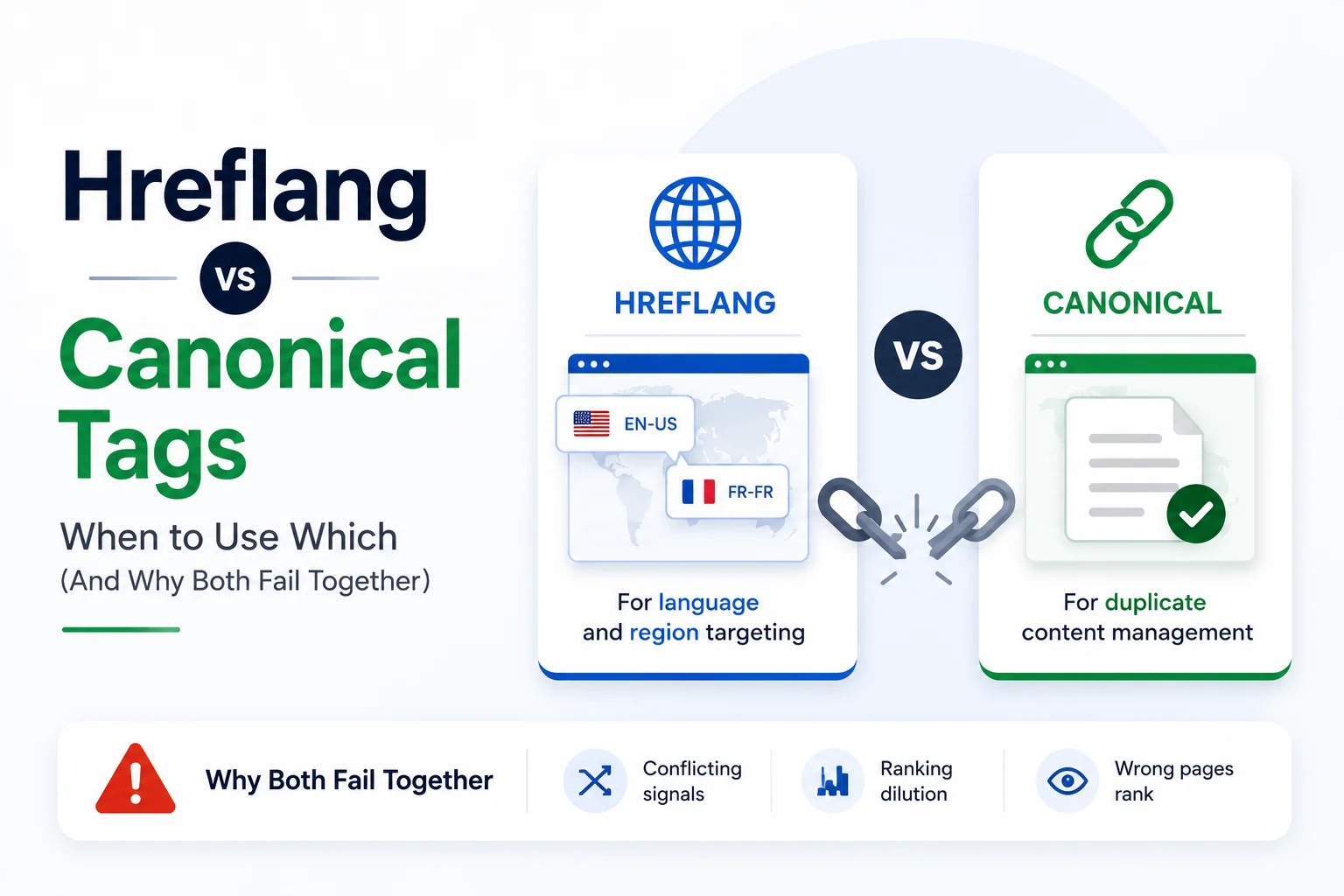
Both tags live in the same location, the head section of an HTML page, use similar rel-alternate or rel-canonical syntax, and both involve pointing from one URL toward another related one. That surface-level similarity is exactly why site owners confuse their purposes, and why the two tags configured incorrectly together can actively cancel each other out rather than simply being redundant.
This comparison defines what each tag actually does, where a multilingual site needs both simultaneously, and the specific configuration mistake that causes them to conflict.
What Canonical Tags Do
A canonical tag, using rel equals canonical, tells search engines which single URL among several near-duplicate or duplicate pages should be treated as the authoritative version for ranking purposes. It exists to consolidate ranking signals when the same or very similar content is accidentally or intentionally accessible at multiple URLs, such as with and without a trailing slash, or with tracking parameters appended.
What Hreflang Tags Do
An hreflang tag, using rel equals alternate combined with an hreflang attribute, tells search engines that multiple URLs are intentional language or regional variants of the same content, each of which should be allowed to rank independently for its respective audience. Unlike canonical tags, hreflang does not consolidate ranking signals toward one version. It explicitly wants multiple versions to each perform well for their own language or region.
The Core Difference in One Sentence
Canonical tags say only one of these pages should rank. Hreflang tags say each of these pages should rank, just for different people. Applying canonical logic to a set of pages that actually need hreflang logic, or vice versa, produces exactly the wrong outcome for a multilingual site.
Where Both Tags Are Needed Together
A multilingual site does need both tags, just serving different roles. Each language variant should have a self-referencing canonical tag pointing to itself, not to any other language version, confirming that page is the authoritative version of itself. Hreflang tags then separately declare the relationship between that page and its variants in other languages.
The Mistake That Makes Them Cancel Each Other Out
The most damaging configuration error is a language variant’s canonical tag pointing to a different language version rather than to itself, often the result of copying canonical tag logic meant for handling URL parameter duplicates and applying it incorrectly to language variants. When this happens, the canonical tag tells search engines to consolidate ranking toward the other-language page, directly undermining the hreflang declaration that was trying to keep both versions ranking independently.
This specific failure is common enough to warrant its own detailed breakdown, covered alongside seven other frequent implementation errors in 8 Hreflang Errors That Trigger Duplicate Content Penalties.
Comparison at a Glance
| Attribute | Canonical Tag | Hreflang Tag |
| Purpose | Consolidate ranking to one URL | Allow multiple URLs to each rank |
| Correct target for language variants | Self (points to itself) | Each other language variant |
| Solves | Duplicate or near-duplicate content | Intentional language and regional variants |
| Common error | Pointing to another language version | Missing reciprocity between variants |
Setting Both Up Correctly From the Start
The safest implementation pattern treats canonical and hreflang as entirely separate configuration steps: confirm every language variant has a self-referencing canonical tag first, independent of any hreflang planning, then layer the hreflang relationships on top afterward. WritoryBuzz’s meta tag generator handles the canonical tag output specifically, which is worth configuring correctly before adding hreflang on top of an already-correct canonical baseline.
Once canonical tags are confirmed correct, WritoryBuzz’s free hreflang generator builds the full reciprocal hreflang set without touching the canonical configuration at all, keeping the two systems cleanly separated.
Background and Implementation Detail
For a fuller introduction to what hreflang solves before getting into how it interacts with canonical tags specifically, see What Are Hreflang Tags and Why Multilingual Sites Break Without Them.
For the exact syntax across all three hreflang implementation methods referenced in this comparison, see How to Implement Hreflang: HTML, XML Sitemap and HTTP Header Methods.
Two Tags, Two Jobs, Zero Overlap When Configured Right
Canonical and hreflang tags are not competing standards and do not need to be reconciled against each other conceptually. The failures that make them look like they conflict all trace back to one specific misconfiguration: a canonical tag pointing somewhere other than the page itself. Get that one detail right, and the two systems work independently exactly as intended. Explore the rest of WritoryBuzz’s free technical SEO toolkit to verify both are configured correctly across a full multilingual site.
Frequently Asked Questions: Hreflang vs Canonical Tags
What is the main difference between hreflang and canonical tags?
Canonical tags tell search engines which single URL should rank among near-duplicates, consolidating ranking signals to one version. Hreflang tags tell search engines that multiple language or region variants should each rank independently for their own audience.
Do multilingual sites need both hreflang and canonical tags?
Yes. Each language variant should have a self-referencing canonical tag confirming it is its own authoritative version, alongside hreflang tags separately declaring its relationship to variants in other languages.
What happens if a canonical tag points to a different language version?
This consolidates ranking signals toward the other-language page, directly undermining the hreflang declaration that was trying to keep both language versions ranking independently, which is the most damaging common configuration error involving these two tags.
Can canonical tags replace hreflang tags for multilingual sites?
No. Canonical tags actively work against the goal of having multiple language versions rank simultaneously, since their entire purpose is consolidating ranking toward one URL, the opposite of what a multilingual site needs.
Should a translated page ever use a canonical tag pointing elsewhere?
Only when the translated page is a genuine near-duplicate of another URL in the same language, such as a URL parameter variant. A translated page should never use a canonical tag pointing to a different language version of itself.
How do you check if hreflang and canonical tags are configured correctly together?
Confirm every language variant has a self-referencing canonical tag first, independent of hreflang, then verify the hreflang relationships separately. Checking both in the same technical audit, rather than assuming one implies the other, catches most configuration conflicts.