
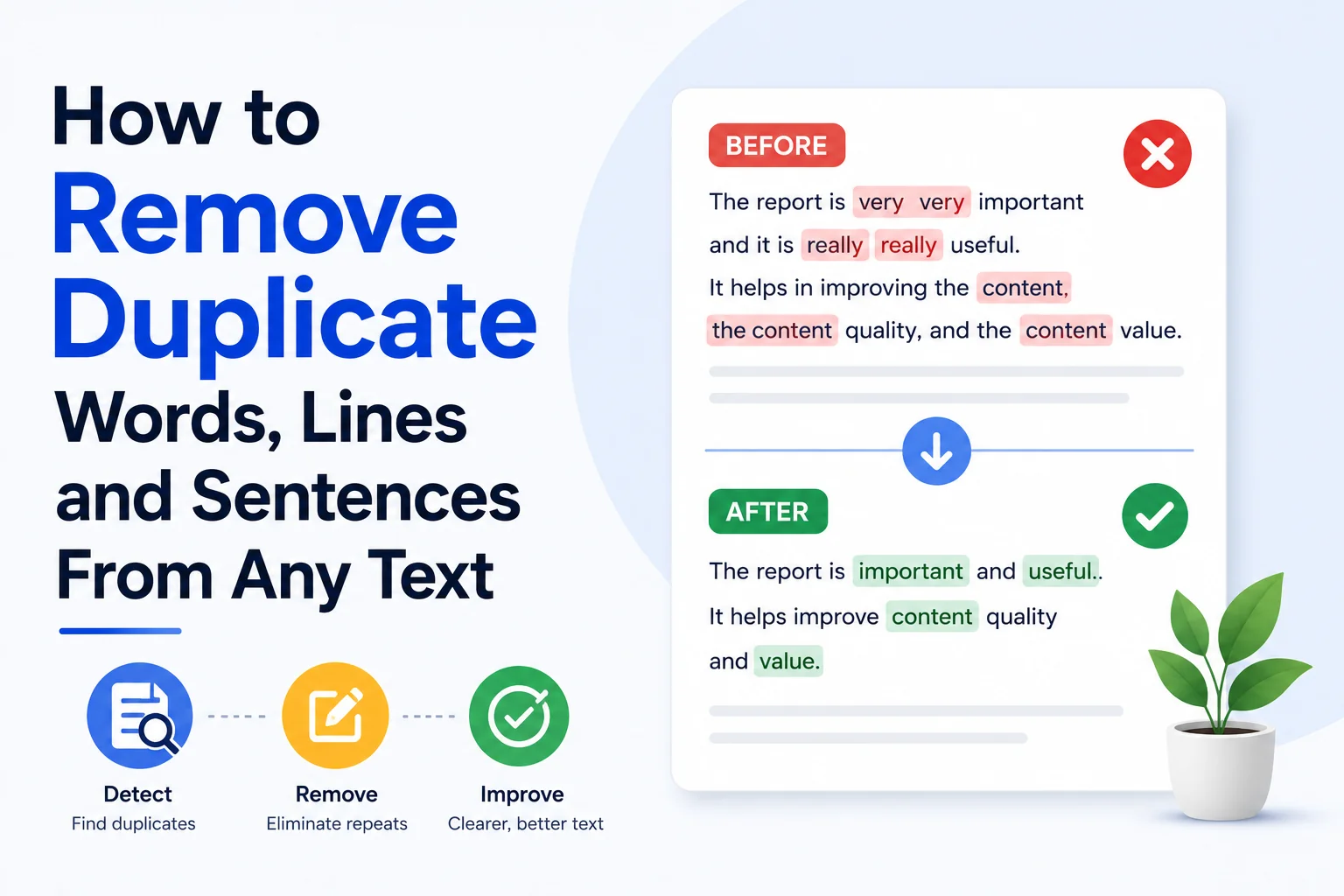
Repetition shows up at three distinct levels in a piece of writing, the word level, the line level, and the sentence level, and each requires a different detection approach to catch reliably. A tool built to catch one level often misses the others entirely, which is why understanding the distinction matters before choosing how to clean up a piece of text.
This guide covers how to catch and fix repetition at each of the three levels, plus the specific edge cases that make automated detection harder than it first appears.
Word-Level Repetition
This is the most granular level: the same word appearing twice in immediate succession, such as the the, or within very close proximity in a way that reads as an obvious error rather than a stylistic choice. This category is the easiest to catch automatically, since immediate adjacency is unambiguous, and the fastest to fix once flagged.
Line-Level Repetition
This applies most directly to structured content: a duplicated bullet point, a repeated row in a data export, or an accidentally pasted-twice paragraph in a document. Line-level duplication often comes from copy-paste errors during editing rather than from the original writing process, which means it tends to cluster around sections that were revised multiple times.
Sentence-Level Repetition
The hardest level to catch reliably, since sentence-level repetition is rarely an exact duplicate. It usually takes the form of the same idea restated in slightly different words at two separate points in a piece, sometimes several paragraphs apart, which exact-match detection tools miss entirely since the wording differs even though the underlying content does not.
Step 1: Run an Exact-Match Pass First
Before attempting to catch the harder, paraphrased repetition, clear the easy cases first. A free remove duplicate words tool that scans for exact word, line, or sentence duplication handles this pass automatically and immediately, removing the mechanical errors that a manual read-through often glosses over precisely because they are so mechanical.
Step 2: Read for Paraphrased Repetition
Exact-match tools cannot catch a point made twice in different words, which requires a human read-through specifically looking for it. The most reliable method is reading with a specific question in mind: has this exact point already been made somewhere earlier in the piece. This is a different reading mode than checking for grammar or flow, and it benefits from being a dedicated pass rather than something caught incidentally during a general edit.
Step 3: Check Transitional Phrase Variety
A specific subcategory worth checking separately: transitional phrases opening consecutive paragraphs. However, additionally, and furthermore repeated as the opening word of three or four paragraphs in a row is a common pattern in both human-drafted and AI-assisted writing, easy to miss when editing paragraph by paragraph rather than scanning the full structure at once.
Step 4: Verify Length Didn’t Change Unexpectedly
After removing duplication, checking the resulting word count against the original draft confirms the edit removed genuine redundancy rather than accidentally deleting unique content alongside it, an easy mistake when working through a long document manually. A word counter run before and after the cleanup pass catches an unexpectedly large word count drop that would signal over-aggressive deletion.
Handling Edge Cases Automated Tools Miss
Proper nouns, technical terms, and brand names that legitimately repeat throughout a piece should not be flagged the same way as accidental repetition. Most automated tools handle this reasonably well for obvious cases but can still flag legitimate repeated terminology in dense technical writing, which is worth a quick manual override rather than accepting every automated suggestion uncritically.
Quoted material presents a related edge case. A quote that repeats a phrase used elsewhere in the surrounding text is not an error, since the repetition originates from the source being quoted rather than from the writer’s own drafting. Automated tools generally cannot distinguish quoted from original text without explicit formatting cues, which is another reason a final human pass remains necessary even after running an automated check.
Building This Into a Regular Process
Running a dedicated dedupe pass as a required step before every publish, rather than an occasional cleanup exercise, catches issues while they are still fresh in a writer’s memory and easy to fix quickly. This step fits naturally into a broader pre-publish routine, covered fully in Text Cleanup Checklist: 8 Passes Before You Hit Publish.
For the underlying reasoning behind why this matters for both readability and, indirectly, SEO performance, see Why Duplicate Words and Repetition Hurt Readability.
Word-level repetition within a single page is a distinct issue from duplicate content across multiple pages, a distinction worth understanding separately and covered in Duplicate Words vs Duplicate Content: Two Very Different SEO Problems.
Explore the rest of WritoryBuzz’s free content and SEO toolkit for the other pre-publish checks worth running alongside this one.
Frequently Asked Questions: Removing Duplicate Text
What are the three levels of text repetition?
Word-level repetition involves the same word repeated in close proximity, line-level repetition involves a duplicated line or paragraph often from a copy-paste error, and sentence-level repetition involves the same point restated in different words elsewhere in the text.
Can automated tools catch paraphrased repetition?
Exact-match tools generally cannot, since the wording differs even when the underlying point is the same. Catching this level of repetition reliably still requires a dedicated human read-through looking specifically for restated ideas.
Why does duplication often cluster around revised sections?
Line-level duplication frequently comes from copy-paste errors made during editing rather than the original writing process, which is why heavily revised sections of a document tend to show more of this type of error than untouched sections.
Should proper nouns and technical terms be flagged as repetition?
No, legitimate repeated terminology such as brand names or technical terms should not be treated as an error. Most automated tools handle common cases well, though a manual override is sometimes needed for dense technical writing.
How do you check if a text cleanup removed too much content?
Comparing the word count before and after the cleanup pass flags an unexpectedly large drop, which signals content may have been deleted alongside the intended redundancy rather than only the repetition itself.
What is the fastest way to remove duplicate words from text?
A dedicated dedupe tool that scans for exact word, line, or sentence duplication handles the mechanical, easy-to-miss cases automatically and immediately, which should be run before attempting to catch harder, paraphrased repetition manually.