
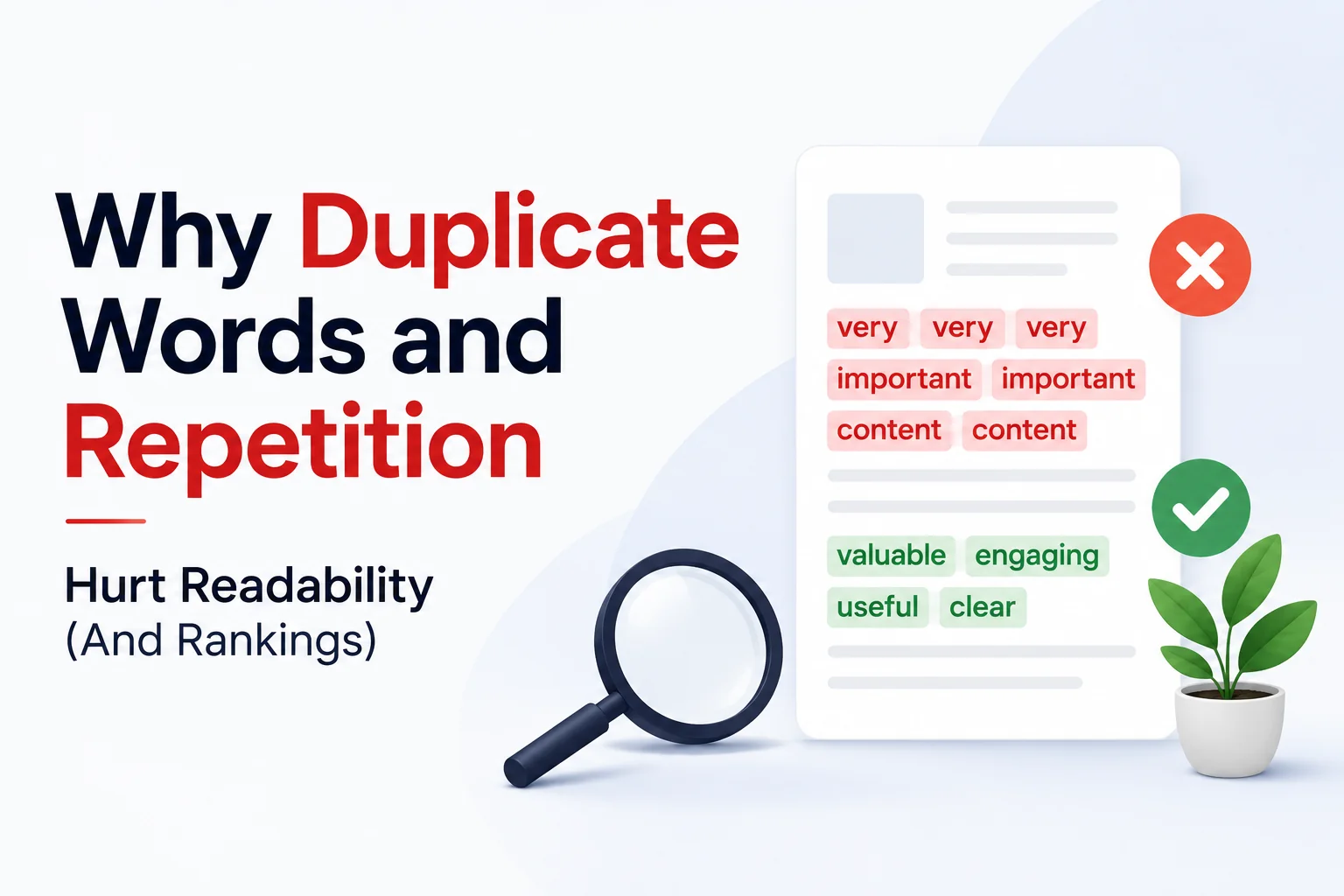
The Flesch Reading Ease formula, developed by Rudolf Flesch in 1948 and still the basis of most modern readability scoring, penalises longer sentences and complex word choice directly, but unnecessary repetition compounds both effects indirectly by inflating sentence length without adding meaning. A sentence carrying a repeated word or phrase reads measurably harder to parse than the same sentence with the repetition removed, even when the underlying idea is identical.
Repetition shows up in writing for a specific, common reason: drafting in pieces, editing in pieces, and never reading the finished piece straight through before publishing. This article covers why repeated words and phrases hurt both how content reads and, indirectly, how it performs in search, and what to actually watch for when editing.
What Counts as Harmful Repetition
Not all repetition is a problem. Deliberate repetition for rhetorical emphasis, a technical term that has no natural synonym, or a brand name used consistently are all intentional and appropriate. The repetition that hurts readability is unintentional: the same transitional phrase opening three consecutive paragraphs, a word repeated twice in one sentence by accident, or a filler phrase like in order to used a dozen times across a single article without variation.
The Readability Cost, Specifically
Repetition increases what readability researchers call cognitive load, the mental effort required to process text, even when it does not technically make a sentence grammatically incorrect. A reader’s attention snags briefly on an unexpectedly repeated word, breaking the reading flow in a way that is often felt rather than consciously noticed, which is part of why repetitive writing feels harder to read without an obvious single cause.
This matters more in web content than in print, since online readers scan rather than read linearly far more often, confirmed by eye-tracking research from the Nielsen Norman Group going back to the early 2000s and reconfirmed in subsequent studies. Repetition disrupts scanning specifically, since a scanning reader relies on word variation to distinguish one point from the next at a glance.
The Indirect SEO Connection
Repetition does not directly cause a ranking penalty the way, for example, hidden text or cloaking might. The indirect path runs through engagement signals: content that reads as repetitive tends to produce shorter time-on-page and higher bounce rates, both of which search engines have confirmed factor into ranking evaluation, even if the exact weighting is not publicly disclosed. A keyword density checker that flags unnatural repetition alongside standard density metrics catches the specific pattern that risks reading as keyword stuffing, a more direct SEO concern than general repetition.
How Much Repetition Is Too Much
There is no fixed percentage threshold the way there is for keyword density, since repetition is a pattern-recognition problem rather than a countable one. A rough working rule: if the same distinctive word or phrase, excluding common function words, appears more than three times within a few paragraphs of each other, it is worth a manual check to confirm the repetition is deliberate rather than accidental.
Distinguishing distinctive words from common ones matters here. A word like the or and repeating dozens of times per page is normal and expected. A specific phrase like in order to achieve or it is important to note repeating five times across a short article is the pattern actually worth catching.
Where Repetition Comes From Most Often
The most common source is drafting across multiple sessions without rereading previous sections, which leads to the same explanatory phrase or transition being reinvented independently each time a writer picks the piece back up. A second common source is content produced or heavily assisted by AI writing tools, which have a documented tendency toward specific repeated sentence structures and transitional phrases across a single piece, a pattern experienced editors learn to recognise quickly.
Catching It Before Publishing
Reading a finished piece aloud remains one of the most reliable manual methods for catching repetition, since the ear notices repeated phrasing that the eye skips past during silent reading. For actually removing what gets caught, a free remove duplicate words tool that scans for repeated words, lines, or sentences automatically catches instances a manual read-through misses, particularly in longer pieces where repetition across distant sections is harder to notice.
A Small Fix With a Real Effect on How Content Performs
Fixing repetition is rarely the single biggest lever available for improving a piece of content, but it is one of the fastest fixes relative to the readability improvement it produces. The specific mechanics of running that fix are covered in How to Remove Duplicate Words, Lines and Sentences From Any Text.
For a broader pre-publish process that catches repetition alongside other common issues in the same pass, see Text Cleanup Checklist: 8 Passes Before You Hit Publish.
Repetition at the word level is a distinct problem from duplicate content at the page level, a distinction covered fully in Duplicate Words vs Duplicate Content: Two Very Different SEO Problems.
Frequently Asked Questions: Repetition and Readability
Does word repetition actually hurt SEO rankings?
Not directly. Repetition affects readability first, which indirectly affects engagement metrics like time on page and bounce rate that do factor into ranking evaluation. Severe repetition can also read as keyword stuffing, which is a more direct SEO concern.
What is the difference between intentional and harmful repetition?
Intentional repetition, such as rhetorical emphasis or consistent use of a technical term, serves a purpose. Harmful repetition is unintentional, such as the same transitional phrase reused across multiple paragraphs without variation, which increases reading effort without adding meaning.
Why does AI-generated content often have more repetition?
AI writing tools have a documented tendency toward specific repeated sentence structures and transitional phrases within a single piece, a pattern that experienced editors and increasingly readers themselves have learned to recognise.
How does repetition affect reading comprehension?
Repetition increases cognitive load, the mental effort required to process text, causing a reader’s attention to snag briefly on unexpectedly repeated words even when the sentence remains grammatically correct.
What is the fastest way to catch repetition before publishing?
Reading the finished piece aloud catches phrasing repetition the eye tends to skip during silent reading. For repeated words, lines, or sentences specifically, a dedicated dedupe tool catches instances a manual read-through misses in longer pieces.
Is all repeated word usage bad for content quality?
No. Repeating a brand name, a technical term with no natural synonym, or a phrase for deliberate rhetorical effect are all appropriate uses of repetition. The concern is specifically unintentional, unvaried repetition that adds no value.