
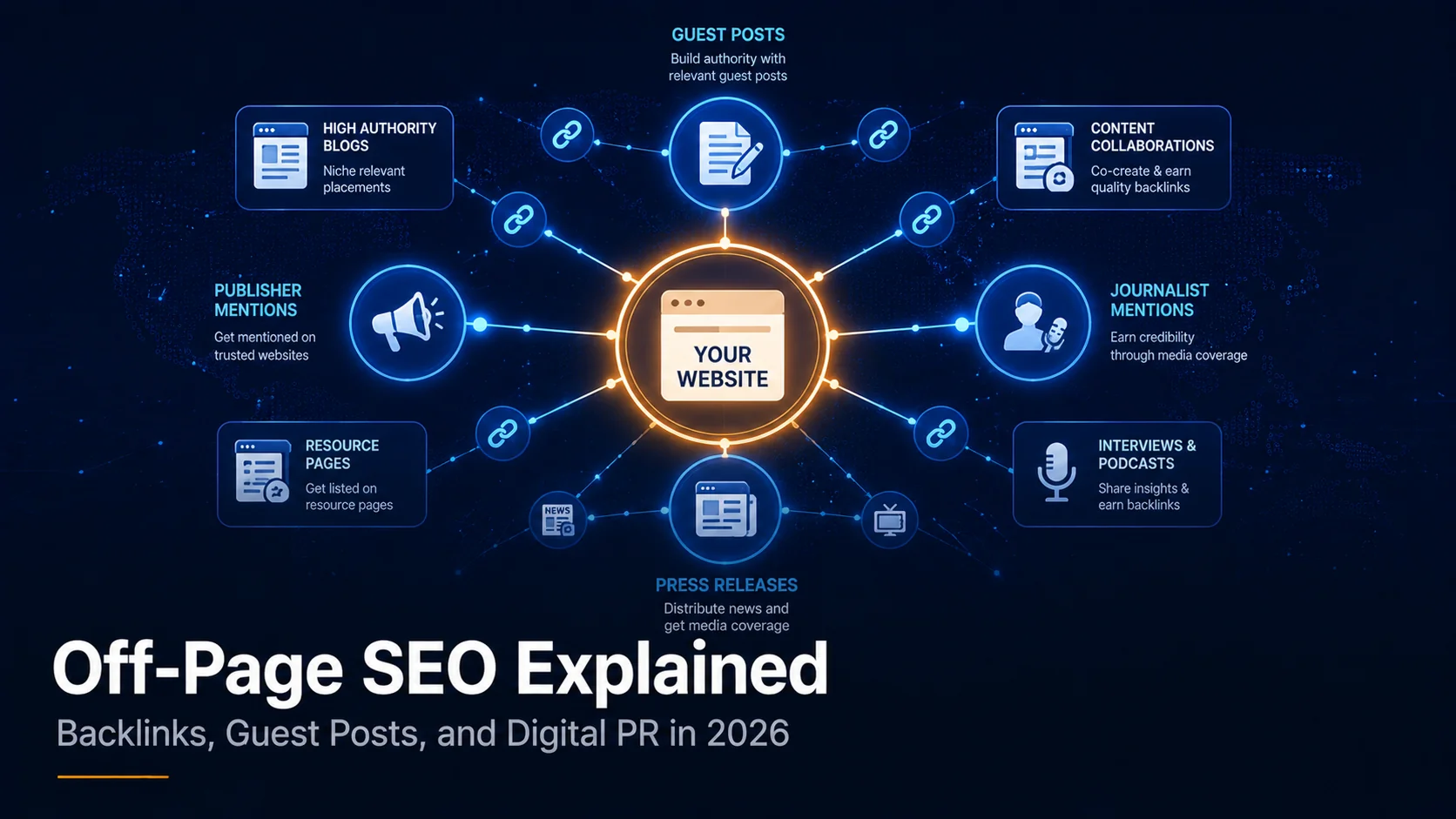
Agencies allocate roughly 32.1 percent of their total SEO budget to link building alone, and in-house teams invest even more at 36.03 percent on average, according to Editorial.Link’s 2026 link building statistics report. That level of investment reflects a simple reality: off-page SEO, everything that happens away from your own website to build its authority, remains one of the strongest levers available for competitive rankings in 2026, even as on-page content quality and technical SEO have matured across most industries.
Off-page SEO covers every ranking-relevant activity that happens outside your own site, primarily backlink acquisition but also brand mentions, social signals, and reputation management. It works alongside on-page SEO, which covers content and technical elements you control directly, and together the two form the full picture search engines use to evaluate a site’s trustworthiness and relevance.
The Core Off-Page SEO Techniques
Guest posting, publishing original content on a relevant third-party site with a backlink, remains the most widely used off-page technique, employed by an estimated 47 to 65 percent of SEO professionals according to RankZ’s 2026 research. Digital PR, earning editorial mentions and links by pitching newsworthy stories or original research to journalists, delivers the strongest authority signal but at the highest cost, typically 750 to 2,000 US dollars per placement. Niche edits, inserting a link into an already-published page, offer the fastest and cheapest route to link velocity, averaging 141 to 225 US dollars.
| Technique | What It Involves | Typical Cost |
| Guest posting | New article on a relevant third-party site with backlinks | 220 to 609 USD |
| Niche edits | Link inserted into an already-published, indexed page | 141 to 225 USD |
| Digital PR | Editorial mentions earned through journalist outreach | 750 to 2,000 USD |
| Broken link building | Replacing dead links on relevant sites with your own resource | Mostly time, low direct cost |
| Resource page outreach | Getting listed on curated industry resource pages | Mostly time, low direct cost |
Why Off-Page SEO Still Matters Alongside AI Search
RankZ’s 2026 research found 73.2 percent of SEO professionals believe backlinks from authoritative editorial sources are a primary factor in whether a brand appears in AI search overviews, including Google’s AI Mode and Perplexity. That finding matters because it shows off-page SEO has not lost relevance as search shifts toward AI-generated answers; if anything, editorial trust signals have become more important as a way to separate genuinely authoritative sources from AI-generated content flooding the web.
Off-Page SEO vs On-Page SEO: How They Work Together
On-page SEO ensures a page is technically crawlable, well-structured, and genuinely useful for the query it targets; off-page SEO builds the external trust signals that convince search engines to rank that page above competitors covering the same topic. Neither works well alone: exceptional content with no backlinks struggles to rank in competitive niches, while strong backlinks pointing to thin, unhelpful content produce diminishing returns as Google’s Helpful Content system increasingly weighs on-page quality alongside link signals.
A single well-placed guest article can anchor an off-page SEO strategy more effectively than a large batch of low-quality links. WritoryBuzz accepts contributor pitches across business, AI, fintech, and cybersecurity, offering exactly the kind of genuinely edited, topically relevant placement off-page SEO strategy depends on.
Build Off-Page Authority Deliberately
The businesses seeing real off-page SEO results in 2026 are not the ones with the largest number of backlinks. They are the ones building a deliberate mix of guest posts, digital PR, and earned mentions from sites that genuinely serve their target audience, treating every placement as a long-term credibility asset rather than a one-time ranking trick.
FAQs: Off-Page SEO Questions
What is off-page SEO?
Off-page SEO covers every ranking-relevant activity that happens outside your own website, primarily backlink acquisition through guest posting, digital PR, and niche edits, but also brand mentions and reputation signals. It works alongside on-page SEO, which covers content and technical factors you control directly on your own site.
What are the main off-page SEO techniques?
The main off-page SEO techniques are guest posting, publishing content on relevant third-party sites with backlinks, digital PR, earning editorial mentions through journalist outreach, niche edits, inserting links into existing published pages, and broken link building, replacing dead links with your own resource on relevant sites.
What is the difference between off-page SEO and on-page SEO?
On-page SEO covers content quality, keyword targeting, and technical elements you control directly on your own site, while off-page SEO covers external trust signals like backlinks and brand mentions earned from other websites. Both work together, since strong content with no external authority signals still struggles to rank in competitive niches.
Which off-page SEO technique gives the best ROI?
Guest posting generally offers the strongest balance of cost and durability among off-page techniques, since it costs less than digital PR while delivering more contextual relevance than a niche edit. RankZ’s 2026 data shows B2B SaaS companies see 702 percent average ROI from well-executed link building campaigns, with guest posting as the most widely used tactic.
Does off-page SEO still matter with AI search tools like ChatGPT?
Yes, off-page SEO still matters significantly with AI search tools. RankZ’s 2026 research found 73.2 percent of SEO professionals believe backlinks from authoritative editorial sources are a primary factor in whether a brand appears in AI search overviews, since editorial trust signals help distinguish genuine authority from AI-generated content.
How much should a business budget for off-page SEO in 2026?
Budgets vary widely, but Editorial.Link’s 2026 data shows agencies allocate roughly 32.1 percent of total SEO budget to link building, while in-house teams invest 36.03 percent on average. A realistic starting point for a mid-market business is 500 to 1,500 US dollars monthly across a mix of guest posts and niche edits.
Authority Is Built Off the Page, Then Proven On It
Off-page SEO earns the trust that gets a page seen. On-page quality is what keeps a reader, and increasingly an AI system, convinced that trust was deserved. The two have to move together in 2026, and neglecting either one caps how far the other can carry a site’s rankings.