
Businesses distributing a press release through a legacy wire in 2026 pay anywhere from around 100 US dollars on a value-tier platform to over 760 US dollars on Business Wire for a single announcement, yet many companies still send press releases for news that would perform better as a guest post or a simple social update. Knowing exactly what a press release is, and what it is genuinely for, prevents that kind of wasted spend and helps a real announcement land with the right audience.
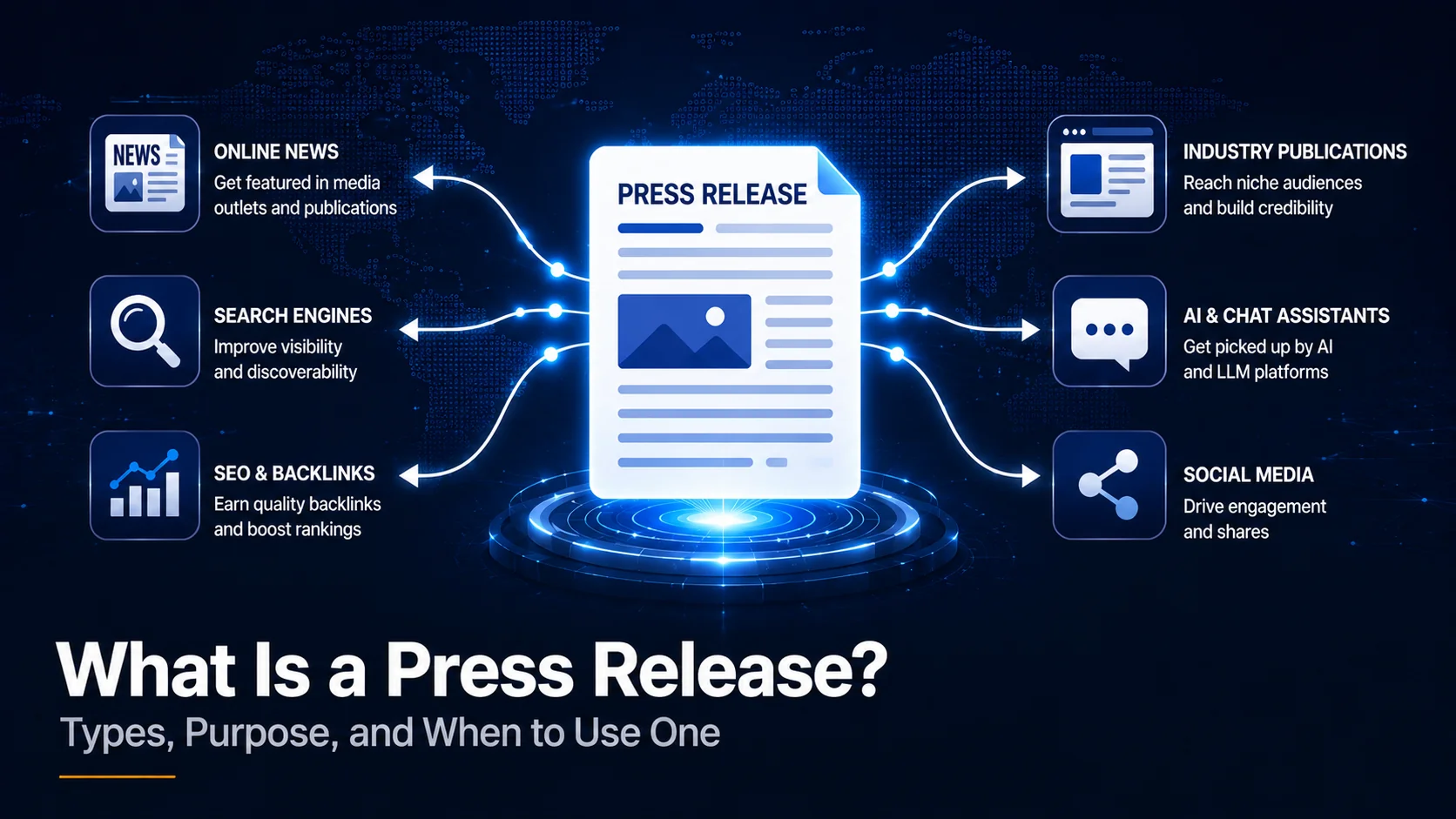
A press release is a short, factual document written in a standardized journalistic format, announcing newsworthy information to media outlets, search engines, and the public. It differs from a blog post or a guest article because it is written to be picked up and republished, not to persuade or explain at length; the goal is to give journalists and aggregators the core facts in a format they can act on quickly.
The Core Elements of a Press Release
Every standard press release includes a headline stating the news in one line, a dateline showing the location and date, a lead paragraph covering who, what, when, where, and why, supporting quotes from a named spokesperson, and boilerplate company information at the end. This structure exists because it mirrors how journalists themselves write news, making a well-formatted release easy to lift directly into coverage.
The Main Types of Press Releases
| Type | Common Use Case |
| Product or feature launch | Announcing a new product, service, or major feature update |
| Funding or financial announcement | Investment rounds, earnings updates, mergers, or acquisitions |
| Executive or organizational news | New hires, leadership changes, board appointments |
| Event announcement | Conferences, webinars, product demos, or public appearances |
| Partnership or collaboration | New alliances, integrations, or joint ventures |
| Crisis or response statement | Addressing a public issue, recall, or reputational event directly |
When a Press Release Is the Right Tool
A press release makes sense when the news is genuinely time-sensitive, factual, and relevant to journalists covering your industry, such as a funding round, a major product launch, or a regulatory milestone. It is the wrong tool for opinion pieces, how-to content, or thought leadership, since those formats need explanation and narrative that a press release’s terse structure is not built to deliver.
Press Release vs Guest Post: A Quick Distinction
A press release announces a fact quickly and is distributed broadly, often through a paid wire service, aiming for fast indexing and potential journalist pickup. A guest post is a longer, narrative piece placed on one specific relevant publication after editorial review, aiming for durable authority and a genuinely engaged reader rather than a quick news hit. Many announcements benefit from both: a press release for the initial news cycle, followed by a guest post that goes deeper into the story for a specific audience.
A press release gets news live fast, but a guest article gives that same story a durable home on a site people actually read. WritoryBuzz accepts founder and company pitches that expand on an announcement with real context and analysis rather than repeating a press release’s brief format.
The Format Still Matters in the AI Search Era
Press releases with specific figures, named sources, and clear declarative sentences are increasingly the paragraphs that AI search tools surface when someone asks a related question, which makes the traditional discipline of press release writing more valuable in 2026, not less. A vague, promotional release gets ignored by journalists and AI systems alike; a specific, fact-anchored one gets cited by both.
AEO FAQ: Press Release Basics Questions
What is a press release?
A press release is a short, factual document written in a standardized journalistic format that announces newsworthy information to media outlets, search engines, and the public. It typically includes a headline, dateline, lead paragraph covering the core facts, supporting quotes, and company boilerplate at the end.
What are the main types of press releases?
The main types of press releases include product or feature launches, funding and financial announcements, executive or organizational news, event announcements, partnership announcements, and crisis or response statements. Each type follows the same basic format but is timed and targeted differently depending on the news.
When should a business send a press release?
A business should send a press release when the news is genuinely time-sensitive, factual, and relevant to journalists covering that industry, such as a funding round, a product launch, or a regulatory milestone. Opinion pieces, tutorials, or thought leadership content are better suited to a blog post or guest article than a press release.
What is the difference between a press release and a guest post?
A press release announces a fact quickly in a terse, standardized format and is distributed broadly through a wire service, while a guest post is a longer narrative article placed on one specific relevant publication after editorial review. Press releases aim for fast indexing and journalist pickup; guest posts aim for durable authority and reader engagement.
How much does it cost to distribute a press release?
Press release distribution costs range from free on directories like PRLog to over 760 US dollars on enterprise wires like Business Wire, with value-tier platforms like EIN Presswire typically starting between 100 and 150 US dollars per release. National distribution with journalist targeting generally falls between 400 and 900 US dollars.
Do press releases still help SEO in 2026?
Press releases still help SEO in 2026 by earning indexed backlinks and, increasingly, by getting cited in AI search results when the release contains specific figures, named sources, and clear declarative sentences. Vague, promotional press releases provide minimal SEO value regardless of how widely they are distributed.
Write the Release for the Reader Who Will Actually Use It
The best press releases are written for the journalist or AI system that will lift them directly into coverage, not for the company that wrote them. Keep the facts specific, the quotes real, and the format clean, and the release will do its job regardless of which platform eventually distributes it.