
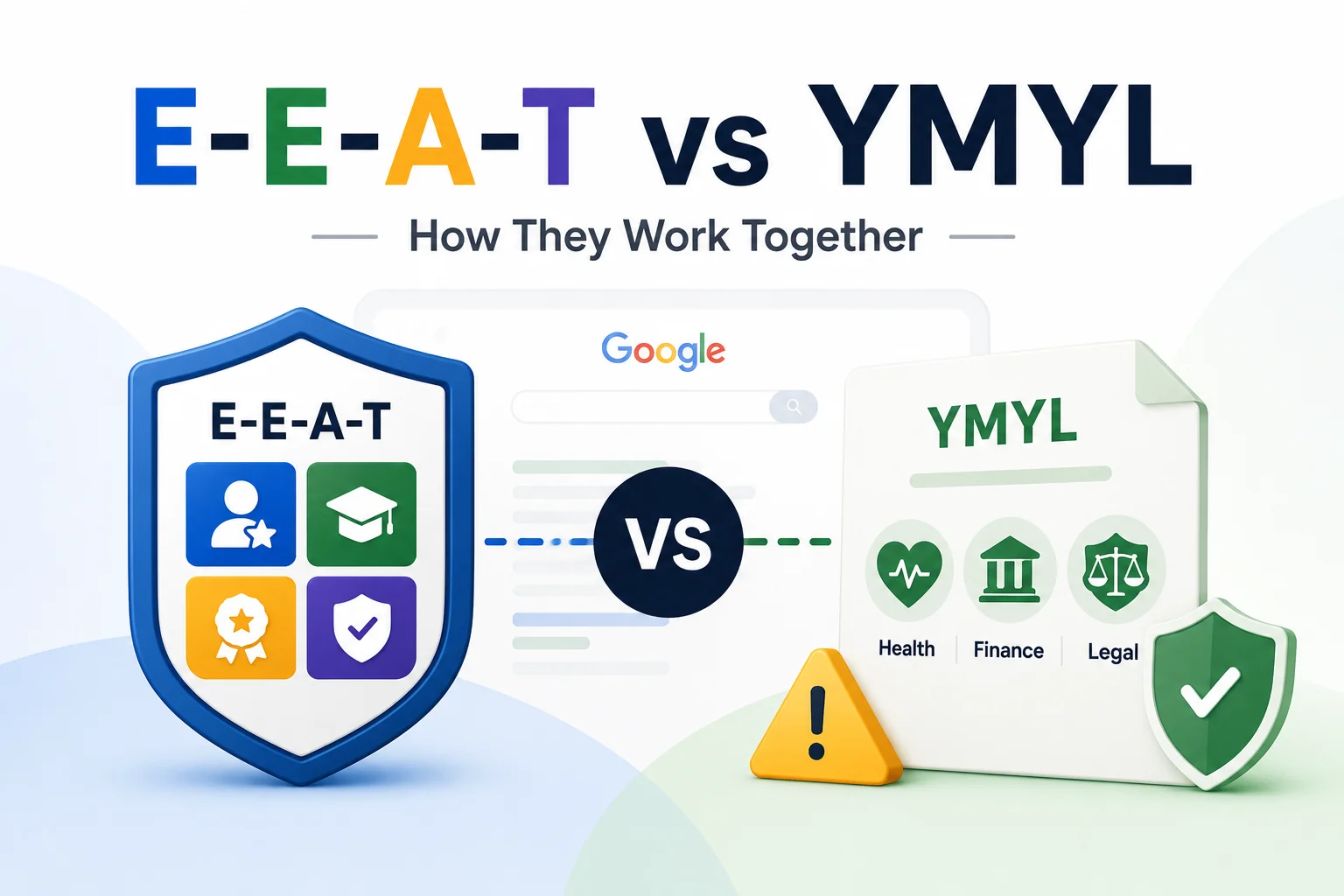
E-E-A-T and YMYL get mentioned together so often that many content creators assume they are the same thing. They are not. This comparison explains exactly what each concept means on its own, how they interact in practice, and why that interaction specifically hits certain content categories considerably harder than others.
E-E-A-T Is a Quality Framework, Applied Everywhere
E-E-A-T, Experience, Expertise, Authoritativeness, and Trustworthiness, is a general content quality framework Google’s quality raters apply across essentially all content categories, meaning even a casual recipe blog or a hobby website benefits from stronger E-E-A-T signals, just with generally lower stakes attached to any specific quality gap. Checking a page’s current standing with a free eeat checker applies regardless of the specific topic category involved.
YMYL Is a Risk Category, Applied Selectively
YMYL, your money or your life, is not a quality framework at all, it is a specific content category designation, health, financial, legal, and safety-related topics specifically, where inaccurate information carries genuine, significant potential real-world harm to a reader, a designation that applies to certain topics and not others, entirely separate from how well any specific piece of content within that category happens to be written. A quick pass through a free eeat checker on a YMYL page will typically reveal the gap more clearly than on a lower-stakes page.
| Concept | What It Is | Where It Applies |
| E-E-A-T | A general content quality evaluation framework | All content categories, universally |
| YMYL | A content risk category designation | Health, financial, legal, and safety topics specifically |
| The interaction | Heightened E-E-A-T scrutiny within YMYL content | YMYL topics specifically, not universally |
How the Two Concepts Interact in Practice
Google’s quality rater guidelines specifically apply heightened, more rigorous E-E-A-T scrutiny to content falling within YMYL categories, meaning the same E-E-A-T gap, a thin author bio or an unsupported claim, carries considerably more consequence on a medical or financial page than on a casual hobby blog covering an identical gap in quality, even though the underlying E-E-A-T framework being applied is technically the same framework in both cases.
This is precisely why medical, financial, and legal content creators face a genuinely higher bar for author credentials, sourcing transparency, and demonstrated expertise than creators publishing in lower-stakes categories, not because a different quality framework applies to them, but because the same framework gets applied with considerably less tolerance for gaps once a topic is classified as YMYL.
Where This Bites Content Creators Who Do Not Realize It
Content creators publishing in a topic area bordering YMYL territory without recognizing it, general wellness content edging into medical claims, or personal finance content edging into specific investment advice, frequently underestimate how much heightened scrutiny that content actually receives, since they may not consciously recognize their topic has crossed into YMYL classification at all.
Confirming a page’s technical authorship and organizational signals through a schema markup generator, and confirming its broader AI citation readiness through an aeo checker, both help address this heightened scrutiny once a creator recognizes their content genuinely falls within this higher-stakes category.
The Practical Takeaway
Treat E-E-A-T as the universal quality bar every piece of content should clear, and treat YMYL as a flag that specifically raises how high that bar sits for a given topic, rather than treating these as two separate, unrelated concerns requiring entirely different strategies. Understanding which of your own topics genuinely fall into YMYL territory, then applying correspondingly heightened E-E-A-T rigor specifically there, addresses this interaction directly, a process the same free tools page supports from start to finish.
Explore WritoryBuzz’s free quality and SEO tools to evaluate both dimensions across your own content.